

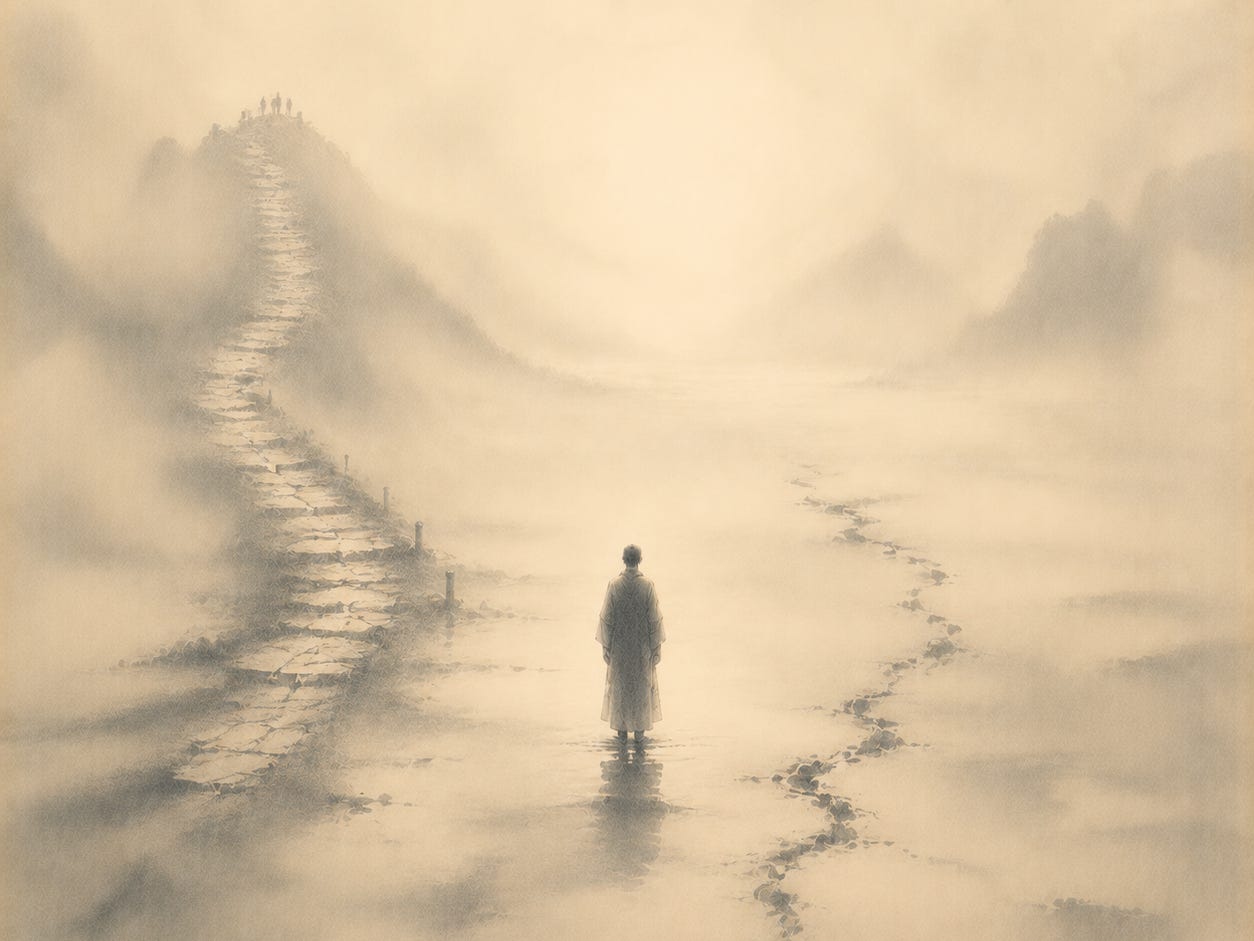
I used to think the problem with time was simply that it moved too fast. Too many things, too many messages packed too tight, too urgent a pace. You put your phone down and a second later you want to pick it up again; you’ve barely sat down and your mind is already lining up the next task; nothing has actually happened, and yet you feel like you’ve already been pushed forward, running, for a long time. So, like a lot of people, I assumed the solution was simple: just slow down.
But later I found out it wasn’t that simple. Sometimes you really do slow down — even deliberately so, slowly enough that it feels like you’re carving yourself an exit. But strangely, that doesn’t make anything feel lighter inside. If anything, it makes it easier to feel empty. You suddenly realize: even though time has slowed down, the material is still the same material — cluttered, broken, without a thread running through it, like a floor scattered with fragments. Only then do you start to suspect: maybe the problem was never speed. The problem is that time itself is broken.
Broken doesn’t mean it stopped, and it doesn’t mean there’s less of it. It means it lost its structure. Time used to at least have some shape to it: today had some relation to yesterday, earlier things left traces on what came later, certain experiences would slowly settle, turning into memory, into judgment, into part of what you’d later use to explain yourself.
But that’s less and less how it works now. So many moments now are like isolated atoms, with no bond between them, no echo, no direction. A moment is just a moment — once it’s past, it’s past; once it slides away, it’s gone — no longer entering into a relationship with any other moment. Time like this looks very clean. Very light, too. Light enough that nothing can stay.
I’ve slowly come to understand that so-called “acceleration” is only a surface symptom. The real problem isn’t that you’re running too fast — it’s that the road is already cracked while you’re running on it. You think you’re moving forward along a path, but that path was never actually connecting what came before to what comes after. You pass through a great many places, without ever truly experiencing any single one of them. This is also why simply “slowing down” so often doesn’t help. Slow down broken time, and it’s still broken. You’ve just gotten a clearer look at the fragments.
So that popular “slow living” slogan, however right it sounds, is really just a comfort. It tells you not to rush, not to panic, that slowing down will make things better. But if the structure of time itself has already come apart, slowing down won’t automatically grow any meaning back. Slow doesn’t mean ordered.
I think what best explains this is “narrative.” Why does time carry weight? Why do some days, long past, still stay with you; why do some things that are clearly over still keep influencing you; why does touching some memories bring up a whole cluster of other things with them? Because they don’t exist in isolation. They’ve been woven into a narrative.
Narrative isn’t as simple as “telling a story.” Narrative is the way past, present, and future get connected. It turns a given moment from a mere point into a position. You know which stretch of the road you’re on, you know where this thing sits within the whole path, you know what still lies ahead, and where things lead from here. With that structure in place, time has gravity. Without gravity, every moment just floats — never touching another moment, never settling down.
The difference between a pilgrim and a tourist illustrates this quite well. The pilgrim walks a road that has a direction. That road isn’t just wandering — every step is moving toward a destination. Along the way there’s waiting, there are thresholds, there’s hardship, there’s endurance, and there’s a small joy of getting closer. Most importantly, the road itself carries meaning, and the process itself can’t be skipped.
The tourist is different. The tourist is moving too, of course, looking around, going everywhere. But at any moment, he can swap in a different place, a different attraction, a different experience. Locations are interchangeable, the process can be interrupted at any point, and no moment needs to have any deep connection to the next. The tourist lives in the present, but not inside a stretch of time that’s heading somewhere. He simply keeps passing through the present, over and over.
These two senses of time are very different. One has narrative, the other only has flow.
We’re becoming more and more like tourists these days. Not that we’re actually traveling, but that the way we face life is more and more like browsing attractions. One task finishes, switch to the next; one page closes, open the next; a thing has barely happened, hasn’t even had time to grow any meaning, before it’s already been paved over by the next thing. We think we’ve experienced a lot, when really we’ve just skimmed past a lot. Skimming past, by its nature, leaves nothing behind.
This is why so much of memory has changed too. In the past, you remembered something because it was linked to something else. A certain smell, a certain sentence, a certain face, a certain season would pull an entire stretch of memory back with it. Memory isn’t an archive, isn’t just something stored away — it’s more like a place that keeps getting lit up again and again.
But a lot of memory today is more like a landfill. Not because there’s too little of it, but because there’s too much of it, too scattered — it can neither truly settle nor truly clear out. You have a little of everything, and none of it has actually been digested. It all just piles up there, giving off no light, growing into nothing, just taking up space. This is what’s actually exhausting. It’s not that you forget too fast — it’s that you can’t forget, and can’t hold on to it either. It’s not that there’s no memory — it’s that memory has lost its vitality.
So I’ve come to increasingly believe that the symptoms of broken time aren’t just being busy, just being tired, just having poor attention. The deeper issue is this: it’s becoming harder and harder for us to let a thing truly begin, truly unfold, truly end.
If a thing has no beginning and no end, no threshold, no waiting, no middle stretch, no echo, it’s very hard for it to form a narrative. Time without narrative is like space without gravity. You can move around inside it, but you never actually land. This is also why people feel more and more empty. Not because nothing happened, but because what happened never settled into anything.
So what’s to be done? Maybe the answer isn’t to rush toward some grand solution. Not to overhaul your whole life immediately. And definitely not to force yourself into some new kind of “slow.” Maybe it’s simply giving time back a little structure, first. Let a thing not always get processed and disposed of instantly. Let a meal run a little longer. Let a conversation not rush toward a conclusion. Let a stretch of road be about more than just arriving. Let a moment linger a little longer, instead of swallowing it so quickly into the next thing.
Not for the sake of romance. For the sake of giving it a chance to stay. Because once time starts leaving traces again, it slowly gains weight. And only once it has weight can narrative reappear. Only once narrative reappears will time stop being just fragments. Only then will it become a road that can actually be walked to the end.
I’ve increasingly come to feel that what’s truly frightening isn’t speed. What’s truly frightening is that time is clearly still moving, and yet we can barely sense where it’s moving toward anymore. It no longer carries us toward some place. It just keeps shoving us forward into the next instant. And if a person keeps living inside nothing but the next instant, they’ll eventually forget even how they got here at all.