

There’s a fact worth pausing on here. AlphaFold, an AI system, predicted protein structures without any “understanding” of the mechanism of protein folding. It produced valid knowledge. It solved a problem that had stumped biologists for decades. But it doesn’t understand what it did. It has no curiosity, no moment of insight, none of that feeling of “I get it now.” It simply computed, and produced a correct result.
So — does “understanding” still require a human subject? And if it doesn’t, is “knowing” still something that belongs to humans? This isn’t science fiction. This is already happening.
But let’s not rush to answer that question. Because this feeling — the shock of humanity being displaced from some central position — isn’t new.
Copernicus said the Earth wasn’t the center of the universe. At the time, this was hard to accept — not just in a religious sense, but as an existential shock: it turned out we weren’t in the most important position after all.
Darwin said humans weren’t the pinnacle of creation, but a product of evolution. It turned out there was no sacred line separating us from other creatures.
Freud said consciousness wasn’t the center of the mind — the unconscious was. It turned out we thought we knew what we were doing, but we didn’t.
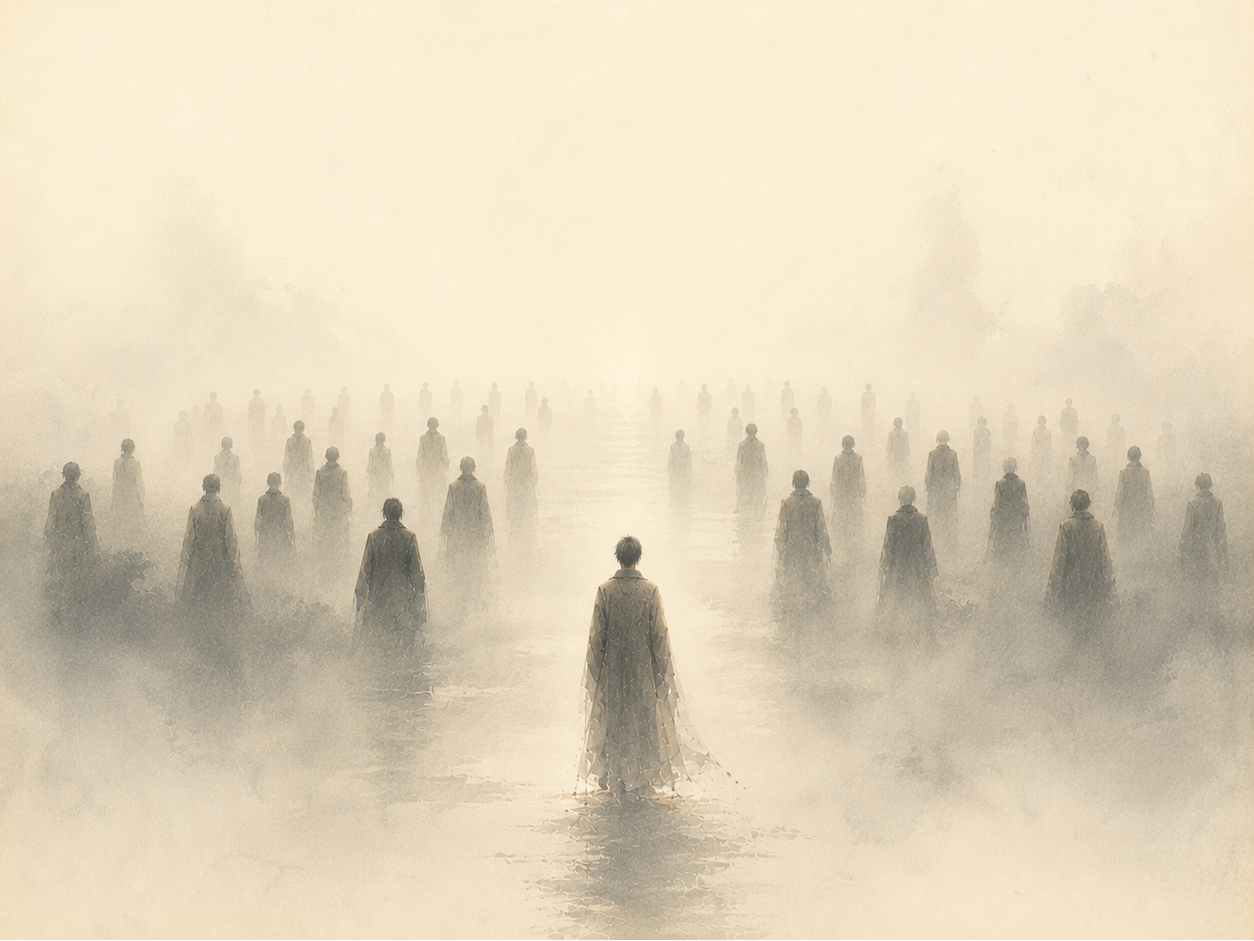
Each time, some privileged position of “man” was taken away. Each time, that same shock followed. But each time, humanity’s understanding of the world actually deepened afterward. Not because “man” became less important, but because once that falsely occupied central position was vacated, something truer moved in.
So when Foucault spoke of “the death of man,” he didn’t mean humans would physically disappear. He meant that the position of “man” as the ultimate source and center of the legitimacy of knowledge might be replaced. Historically, this decentering itself has always been a form of progress, not a catastrophe.
But this time, there’s something that’s never existed before. In the earlier rounds of decentering, the production of knowledge itself still required humans. Copernicus needed observation, Darwin needed fieldwork, Freud needed clinical experience. No matter how much those discoveries overturned “man’s” central position, the knowledge still grew out of human acts of knowing.
This time is different.AI can produce knowledge that works in practice without any human understanding at all. Knowledge production is beginning to be able to detach from the human subject.This is a qualitative leap.
And there’s a question here that’s deeper, and more urgent, than “will AI replace humans” — Who gets to define “valid knowledge”?
AlphaFold’s results count as valid because they can be published in *Nature*, incorporated into medical practice, turned into commercial value. But those standards for judging “validity” are upheld by specific institutions, capital, and power relations. Before AI-produced knowledge is accepted, it has to pass through that filter.
A deep paradox is forming here: AI has decentralized the production of knowledge, but at the point where knowledge gets legitimized, power may be hyper-concentrating.
There’s a historical case that can help you feel the weight of this. Gutenberg’s printing press broke the church’s monopoly on the spread of knowledge. Before that, the Bible existed only in Latin, and only clergy could read it. The printing press let knowledge circulate on a mass scale — a real act of decentering.
What was the result?
On one hand: the Reformation, the Enlightenment, the Scientific Revolution. Enormous leaps forward for human civilization.
On the other: religious wars, nationalist mobilization, mass political propaganda. Some of the bloodiest centuries in human history.
The same technology produced both Voltaire and pamphlets inciting genocide. Compared to the printing press, AI is an amplification by orders of magnitude. It doesn’t just make knowledge spread faster — it lets the production of knowledge itself detach from the human subject. Both the positive and negative potential here are unprecedented.
And right now, AI infrastructure is highly concentrated in the hands of a very small number of private entities and a very small number of countries. Once capital gets its hands on a paradigm-level shift like this, power expands. And expanding power, as history has told us again and again, tends to be closely tied to human suffering.
But there’s an even more fundamental question here, worth addressing on its own. What kind of progress should this actually be? Not the kind of progress that conquers the world, not the kind that lets a small few use knowledge as a tool to rule over the many — but the kind of progress where understanding and exploration are satisfied for their own sake. Knowing, as an end in itself, not merely a tool of productivity.
But the modern episteme has bound knowledge to production, survival, competition — every piece of research has to justify its practical value, every university has to prove its economic contribution. Knowledge becomes a tool, in service of competition, in service of growth. Capital has amplified this logic to its limit.
The concentration of AI infrastructure means this logic could be reinforced even further — not knowledge liberating people, but the authority to judge knowledge’s legitimacy concentrating even further into the hands of a few, while most people are left to consume only the filtered results.
This is a new kind of monopoly, harder to see than the church’s ever was, because it isn’t wrapped in theological language — it builds its authority out of words that sound neutral: “science,” “validity,” “intelligence.”
So the real question isn’t “will AI wipe out humanity.”
It’s: in this paradigm shift, who is defining valid knowledge, who is controlling the infrastructure of knowledge, who benefits from this discourse, and who is being rendered more powerless by it.
None of these questions has a ready-made answer. But knowing to ask them is already, in itself, a form of resistance. Because it’s only power that goes unquestioned that can truly expand without limit.