

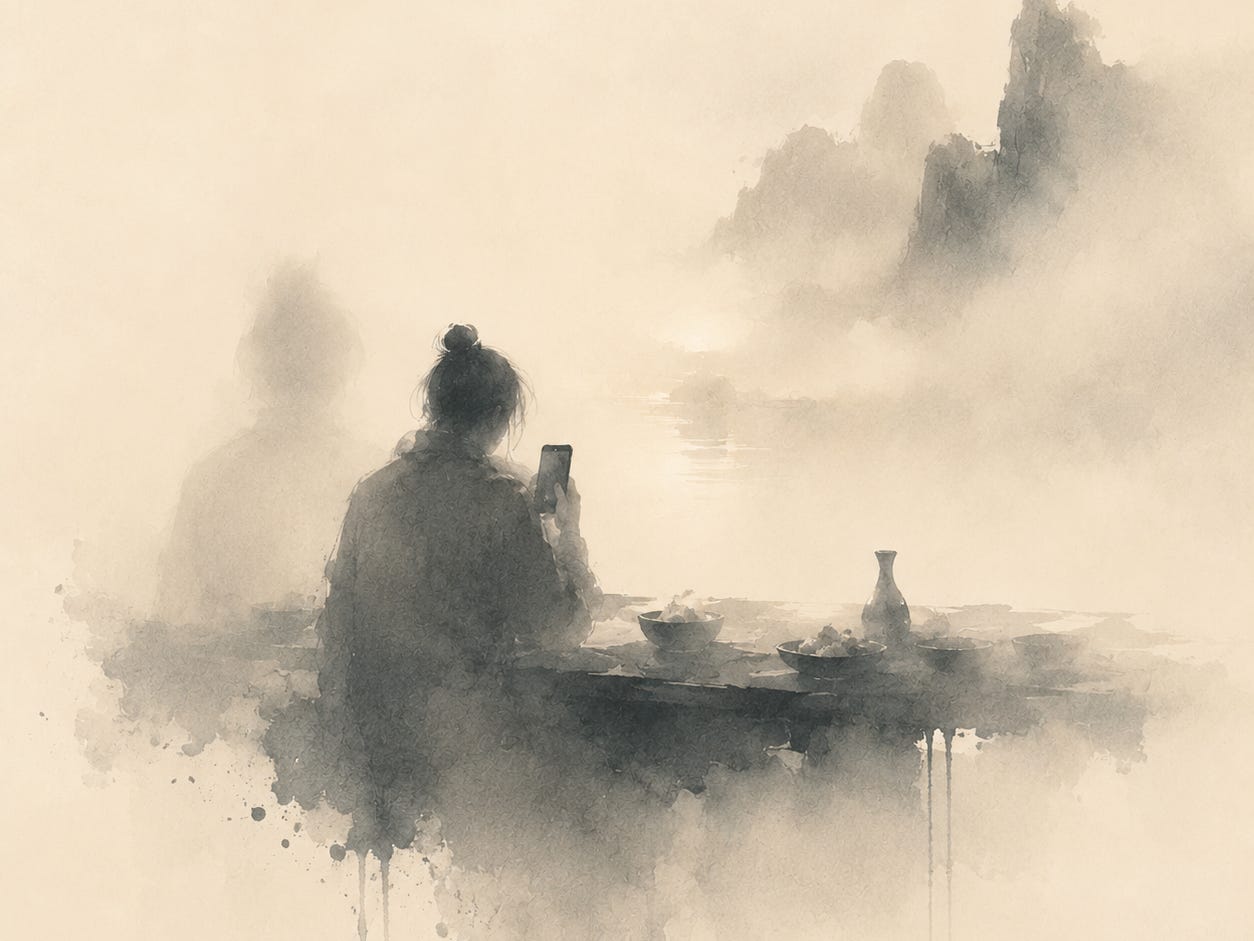
Debord said, “We no longer live directly — we watch images of life instead.” Reading this line, you don’t think much of it at first. Those two words, “direct life,” sound perfectly ordinary, as if that’s just how things should naturally be. But try to actually pin down what it looks like, and it turns out to be surprisingly hard.
But flip the question around, and it gets a little easier — what does “indirect life” look like, exactly? Scrolling your phone, eyes on the screen, mind drifting elsewhere, not a single piece of content actually taken in. Eating a meal, attention entirely on the next message, chopsticks still moving, but the taste of the food barely registering.
Talking with someone, mouth responding on autopilot, mind already working out what to say next — the other person’s words haven’t even fully landed in your ears before your own prepared response has already elbowed its way into the spot.
In these moments, a person is clearly present, body sitting right there, but the feeling is separated by a layer, never actually landing on whatever is actually happening — as if someone had stepped in between you and the thing in front of you, and slid in a pane of glass.
Set against this, “direct life” probably means a state where feeling isn’t blocked by anything in between. Eating a meal, genuinely tasting the saltiness and the layers of flavor in the dish, the tongue actually noticing one bite suddenly turn more fragrant than the last.
Talking with someone, genuinely taking in what they’re saying, even catching the unfinished half of a sentence they didn’t say out loud, instead of half-listening while calculating your next reply. Nothing stands between feeling and whatever is actually happening. That pane of glass never appears at all.
But think about it closely, and this unblocked directness seems to be getting harder and harder to reach naturally. Even deliberately trying to focus on eating a meal, other thoughts keep intruding — wondering whether to take a photo and post it later, whether the meal is refined enough, worth documenting, whether the plating is photogenic.
Even the thought “should I document this” is already, itself, that pane of glass, slid in between life and feeling before anything else even happens. At some point, without anyone noticing when, this pane of glass seems to have become the default. The moments without it have become the rare ones instead.
This raises a thorny issue: direct life probably isn’t a state that sheer willpower can guarantee. It’s a state you can only barely approach by actively blocking out a lot of habitual intermediate steps. To genuinely taste that dish, you first have to hold back the urge to photograph it.
To genuinely take in what someone is saying, you first have to set down the anxiety of half-listening while planning your response. To genuinely see the view in front of you, you first have to hold back the reflex to raise your phone. Each of these impulses is smaller than the last, small enough that you barely register having made a choice at all — but it’s precisely these tiny choices that, again and again, push feeling to the back.
The longer this habitual motion is practiced, the faster the reaction gets, fast enough to happen almost without passing through thought at all — the phone rings, the hand reaches for it first; the dish arrives, the phone comes out to photograph it first; in the gap while someone else is talking, the mind wanders off to something else first. These motions have already been trained into instinct.
The word “instinct” sounds like it carries a whiff of something innate, but this particular instinct is actually something trained — worn, through endless repetition, into something close to a conditioned reflex. Pulling this reflex apart isn’t something a line like “I need to focus” can solve. It takes, every single time, consciously and deliberately holding back the hand that wants to reach for the phone first, for a few seconds.
So directness is no longer the default state. It’s something you can only touch again by continuously, repeatedly, pushing aside the layer of image that keeps sliding in. It’s more like something that has to be won back over and over, not something you’re naturally entitled to and can keep hold of forever just by not actively destroying it.
This runs exactly opposite to what a lot of people unconsciously assume — the belief that as long as you don’t deliberately use your phone, feeling will naturally return on its own. But the reality is, that habit is already there, and unless you actively push it aside, it won’t ever step out of the way by itself.
Every time you genuinely put the phone down, genuinely let your attention land on this one bite, this one sentence, right in front of you, you’re taking back a small piece of your own unblocked feeling from the territory the image had occupied. This act of taking back looks small — small enough that it isn’t even worth mentioning to anyone. But it’s precisely these unremarkable moments that, bit by bit, take life back out of the image’s hands, and place it back into your own.