

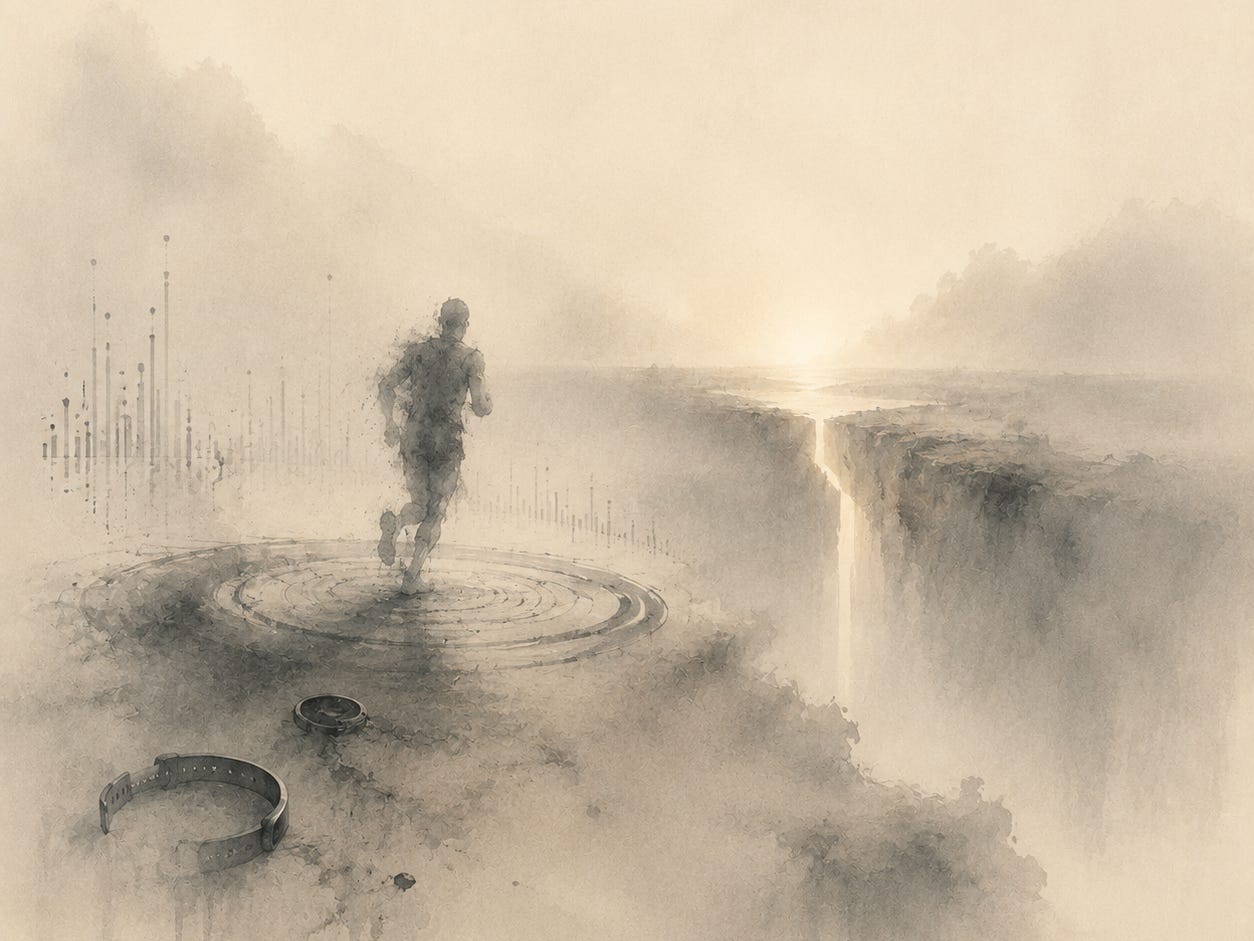
You know the type — maybe from your feed, maybe from your own life. Someone who has taken the management of their health to its absolute limit.
They log every step, every calorie, every sleep score. They can’t relax unless they’ve hit seven hours. Any number on a checkup that isn’t perfect gets researched immediately, corrected, escalated to a doctor with the question: is this the beginning of something serious? Calling in sick stirs up a vague guilt — as if they’ve inconvenienced someone, as if this glitch in the body were a personal failure of management.
This is usually read as a good thing. As discipline. As responsibility. As what a mature adult is supposed to look like. The people around them praise the discipline, and it’s true — this person’s life looks orderly, like it’s moving in a better direction.
But if you sit with this for one more second, an uncomfortable question surfaces: is this actually reverence for life? Or is something else running quietly underneath it, wearing reverence as a costume — something you’ve never quite named?
One thing needs to be said first, because it’s where this whole line of thought begins.
Death used to be a heavy thing. Not heavy with sadness — heavy because it forced a person to face something no one else could face for them. Someone else can go to work for you, wait in line for you, say all the polite things for you. No one can die for you. That total, untransferable solitude is exactly what once made death a thing capable of showing a person who they really were. It wasn’t just an endpoint — it was an abyss hanging behind the back of everyday life, and it’s what gave living any weight at all.
Today, death has been demoted. It no longer speaks. It’s been stripped of language and reduced to one purely functional label: the termination of output. Nothing more. That sounds clinical, but the logic behind it is cold: once the ability to keep producing becomes the only ruler for measuring whether anything matters, then anything that ends production completely and irreversibly no longer even qualifies to be taken seriously. Death used to be an abyss. Now it’s just a system crash — an inconvenience to be delayed for as long as possible.
This demotion looks like it only concerns death, like it has nothing to do with your actual life. But push the logic one step further, and you find it has already soaked into daily habits you’d never think to connect to death at all.
The hysteria around health is, underneath, a hysteria about output.
Worth unpacking slowly. Working out, eating clean, getting checkups, tracking sleep — all of it looks like reverence for life, like an effort to live longer and more fully. But if what’s actually driving these behaviors is anxiety — guilt for skipping a workout, panic over a checkup number slightly out of range, the feeling of falling behind after one sick day — then the real target of all this isn’t a fuller, freer life. It’s making sure the machine that is you keeps running without a malfunction, without downtime, without interruption. Health, here, isn’t the goal. It’s maintenance. It exists to keep production going.
Here’s a sharper comparison worth sitting with: the epidemic of health-optimization might be just as obscene as the epidemic of obesity.
That sentence will likely feel offensive, because we instinctively place working out on the “good” side of the ledger and obesity on the “bad” side — two ends of a scale, one virtuous, one alarming. But look closely at the psychological mechanism underneath both, and you find the same structure: a compulsive, runaway demand on the self, a systemic clog caused by an excess of the same driving force. Bingeing stuffs down the anxiety with excess consumption; discipline stuffs it down with excess control. What gets suppressed is identical. One looks like indulgence, the other looks like restraint, but neither actually faces the anxiety itself. They’re just two opposite ways of pushing it back under the surface.
Follow the question down far enough and you hit the deepest layer: life itself seems to need an opponent before it can grow any real strength.
Muscle only grows by working against resistance. Remove all resistance, let the muscle move without any effort at all, and it won’t get stronger — it will waste away until it loses the strength it once had. The mind probably works the same way. It needs pain, needs rupture, needs the negative experiences it can’t control or easily erase, to temper it — not endless protection from everything that might make it uncomfortable. A mind only earns the right to call itself strong when it can look directly at what’s negative and unsettling, and stay there, without running.
A life that has been completely shielded — no pauses allowed, no pain allowed, no moment permitted to simply not move forward — looks like it’s accelerating, but it’s being hollowed out one piece at a time. It has no real opponent to push against. It’s just spinning in a vacuum — fast, loud, looking vital — but a vacuum spin doesn’t come to a peaceful stop. Eventually it collapses on itself.
One thing has to be said clearly here, or this gets misread easily.
The point was never that pain is good and pleasure is bad — that would be far too simple. The real problem is that when any single state gets pushed to its extreme, forced into being the only acceptable way to exist, with no room for another voice, another rhythm, another possibility — it turns into its own kind of hell. A life made entirely of pain, with no room to breathe, is a hell everyone recognizes. But a life made entirely of positivity, with no shadow, no fragility, no pause allowed, is just as much a hell. It just wears better clothes — clothes good enough to post — so it takes longer to recognize what it actually is.
So, back to that person tracking every step, every hour of sleep, unable to tolerate a single flaw on a checkup — what is the health they’re actually chasing?
Is it bringing them closer to life itself, closer to feeling the weight and texture of being alive? Or is it just keeping a machine that’s already been running a long time from breaking down — a few more years of uninterrupted operation, nothing more?