

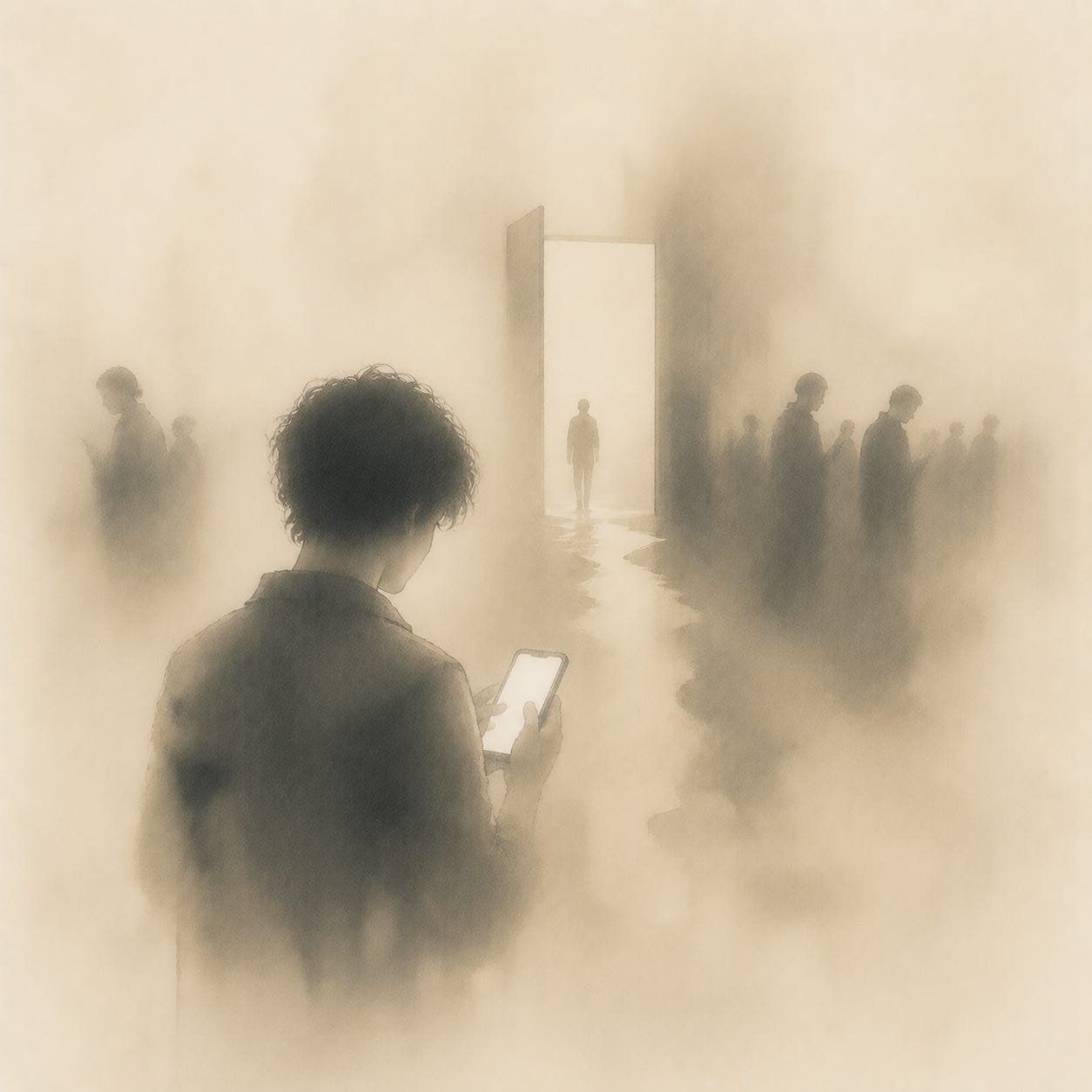
Over a hundred years ago, British gunboats arrived off the coast of China, rows of black cannon mouths lined up on deck, firing round after round at the tightly shut ports. What they were battering was a door — and standing behind that door wasn’t some abstract “nation,” but the day-to-day lives of countless households: farming the fields, weaving cloth, going to market, marking the holidays according to rules handed down from their ancestors — an entire self-sustaining order that never needed anyone from outside to keep it turning.
What the gunboats were really trying to destroy was exactly this self-sufficiency. By the time the door was smashed open, before the gun smoke had even cleared, opium and foreign goods came flooding through the blasted opening, and that sense of steadiness — the kind you could get just by shutting your own door — was never coming back. Even the doorframe raised again on the ruins came out crooked.
Not many people talk much anymore about what became of that door afterward. But it actually already changed its face long ago, and reappeared in the palm of everyone’s hand — smaller than a palm itself.
The phone screen is the latest shape this door has taken — no soldiers, no gunsmoke, not a single cannon blast. Notifications pop up one after another, videos autoplay one after another, and the gap in the door gets pried a little wider, bit by bit.
In the moment you first pick up your phone, no one feels like they’re opening anything at all — you just want to check the time, or reply to a message. But the instant your fingertip swipes across the screen, the gap is already open, the screen’s light glowing on your face, far gentler than the muzzle flash of those cannons back then.
The most cunning thing about this new invasion is that it never forces anyone. It even seems polite — the pop-up says “watch later,” says “not interested,” even considerately asks “want to see fewer posts like this?” The power to choose looks like it’s always in your own hands, one tap away from turning it off.
But by the time you actually come back to yourself, the sky outside is already pitch dark, and that rhythm of life that used to belong to you — when to focus, when to zone out, when to get up and pour a glass of water — has already been sliced into pieces by these images constantly barging in, like a perfectly good piece of cloth cut into a pile of unusable scraps. It never broke down a single physical door. It just gets you, again and again, to reach out yourself and push the door open a little wider.
When the gunboats approached, people at least knew what to guard against — they could see the masts, could hear the cannon fire, someone would run to the village entrance banging a gong to sound the alarm. But this time, there isn’t even the slightest warning — because the door was pushed open by your own hand, and even with a certain contentment.
Compared to the gunboats of that era, this invasion goes even further. The gunboats forced open the nation’s gates; what today’s images force open is **consciousness itself, in every single person.** It isn’t satisfied with getting someone to accept a single product — it wants people to accept an entire set of rules: life has to be put on display, emotions have to be consumed, and even solitude first has to prove that “I’m not wasting my time.”
Curl up alone on the couch for an entire evening of doing nothing, and a flicker of guilt surfaces first, before any sense of quiet ever does. Where that guilt comes from is hard to say. It’s just there, hanging overhead like the air itself, so pervasive that even taking a deep breath carries a trace of unease.
Back then, opium at least still had a concrete body — a dark brown paste packed in small boxes, something that could be weighed, something that could be set on fire and burned. The fire at Humen that destroyed the opium burned for more than twenty days, and what it burned was something you could see, something you could touch.
But this invasion now, you can’t even find a single thing to set alight. It has no shape, no smell. Once it gets in, it moves straight into the most ordinary gaps in your mind — the ten minutes before sleep, the dead time in a line, the few seconds waiting for an elevator.
The real Opium War, back then, at least left behind a clear boundary once it was over. Victor and vanquished, treaties and reparations, written down in black and white — who struck whom, who owed whom.
That boundary was humiliating, but it at least left something for later generations to point to, to resent, to write into textbooks as a warning to themselves. **But this invasion without any gunsmoke doesn’t leave you even a boundary at all.** There’s no treaty to point to, no specific enemy to resent.
The door stays open, the wind keeps coming in, and by now it’s impossible to tell whether what came in was forced on you, or whether you simply let it in yourself, without even thinking.
Even wanting to hate some specific person, you can’t find where that person is standing. All you can do is stare, blankly, at your own finger, sliding downward on its own, again.