

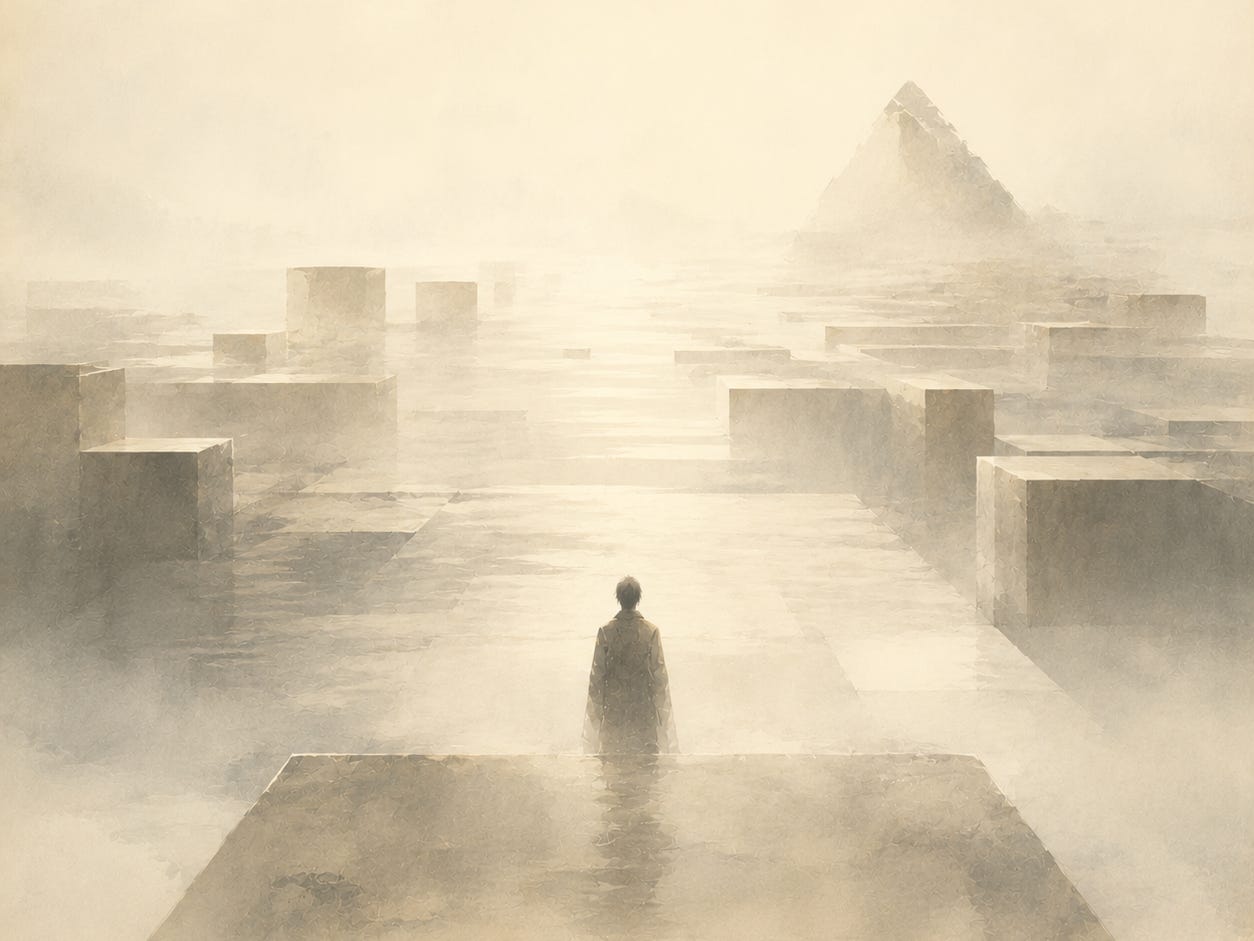
Sometimes, being somewhere alone, you get a feeling that’s hard to explain.
Not the awe of some natural wonder — something quieter. You’re sitting under a tree, or standing by the sea, or walking through some mountains, and suddenly, for no clear reason, you feel that the thing in front of you is responding to you, somehow. Not really speaking, but not entirely silent either. You can’t explain it. You just know that in that moment, you don’t feel like you’re “looking at” something — you feel like something is flowing between you and it.
Then the feeling passes. You return to normal, keep walking, or pull out your phone, or start thinking about what to eat later.
But what actually happened, in that moment?
I’ve since thought that what happened in that moment can be described quite simply —You temporarily changed a grammar. Our default grammar toward nature is third person. Nature is “It.” A resource, a landscape, an object of study, a unit for calculating carbon emissions, an object to be either protected or developed. This isn’t just an attitude — it’s a grammar, a structure of relation already decided at the level of language.
How you treat an “It” and how you treat a “You” are two completely different things. Facing an “It,” you can calculate, use, alter, assess its value, and discard it once that value is gone. All of this is normal, reasonable, even “scientific.” But facing a “You,” all of this changes in kind. You cannot “conquer” a “You” you love. You cannot use a “You” as a resource. Facing a “You,” you have to listen, to respond, to acknowledge that the other has an inner life you can never fully grasp.
A nineteenth-century German poet, Novalis, did something that sounds simple but was really a shift at the level of worldview — he turned nature from an “It” into a “You.” Not as a metaphor. He actually swapped out the relation at the grammatical level.
Then he said something that stopped me in my tracks.
He said nature has more imagination than humans do, a stronger artistic instinct. The forms it creates — the crystal structure of a snowflake, the spiral of a seashell, the growth pattern of a tree — are far more intricate, far richer, far more astonishing than anything humans have designed.
Have you ever really looked at a snowflake?
Not a photograph — actually seen its full shape before it melted? That sixfold symmetric structure, that complexity only visible under a microscope, the fact that no two snowflakes in the world are ever exactly alike — can we build that? Can we design a nautilus’s spiral? We haven’t even fully figured out how a tree decides to grow into the shape it grows into.
There are two possible responses to this. One is: so we should study it harder, analyze it, eventually master its laws, then replicate it, and surpass it. The other is: so I need to stay humble in front of it, stop pretending to be its master, and start learning to listen. The first response is still the grammar of “It” — nature as a more complicated object, waiting to be cracked by a smarter subject. Only the second begins to approach “You.”
But I’ve since thought this isn’t only happening between us and nature.
Turning nature into an “It” didn’t happen in isolation. We seem to be doing the same thing everywhere — We’ve turned time into an “It”: a resource to be managed, scheduled, maximized. We’ve turned language into an “It”: a tool to be optimized, packaged, used to extract a response. We’ve turned other people into an “It”: a relationship asset to be maintained, a node performing some function within our personal system.
We’ve even turned ourselves into an “It” — a system to be improved, optimized, continuously iterated on. It’s the same grammar, spreading into everything. We’ve lost the capacity to say “You” to the world. Every “You” has become an “It.”
This loss didn’t happen in a day. It happened bit by bit, as that grammar took over our perception more and more completely. It happened so naturally that when you occasionally feel, under some tree, that something is flowing between you and it, your first reaction isn’t “oh, it can still be like this” — it’s confusion, even a flicker of embarrassment. You wonder if you’re overthinking it, if you’re being too sentimental, if you should be looking at the thing in front of you with a more “objective” eye instead. That flicker of embarrassment is the grammar absorbing the last of your resistance.
So that moment — under the tree, by the sea, when you suddenly feel something flowing — That isn’t an illusion. That isn’t you being overly sentimental. That’s you, for a moment, briefly finding that grammar again. You didn’t say it out loud, but somewhere inside you, you called out “You” to that thing. And for that moment, the relationship came alive. That simple. And that hard.