

Let me ask you a question first.
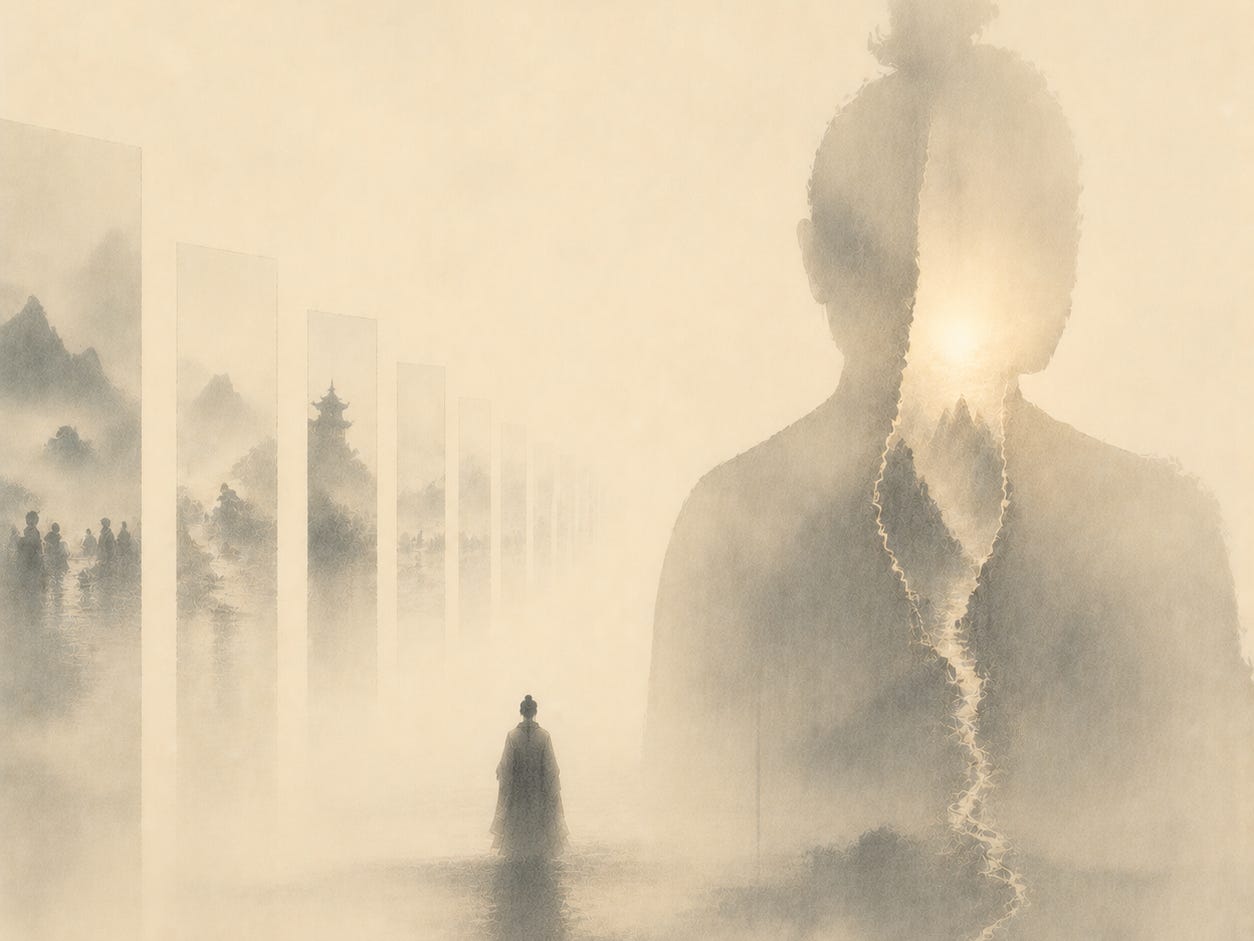
Have you ever had an experience like this — encountering something, a culture, a person, a work of art, whatever it might be — and afterward finding that the way you see the world had a real crack running through it. Not that you learned something, not that you came to like something, but that you, as a person, after that encounter, were irreversibly different from who you’d been before.
Sit with that for a moment.
When was the last time you had an experience like that?
I spent a little over two years in Russia. Before I went, I’d grown up in China, and I carried a piece of logic in my bones I’d never once questioned: this moment is always in service of the next one. Today’s happiness is something to be saved. Today exists for tomorrow, tomorrow exists for the day after. This had seeped into the way I perceived time itself, into my relationship with everything I did — without some “useful” reason, I found it hard to genuinely throw myself into anything. I’d never chosen it. It was simply already there, and I mistook it for who I was.
In Russia, I found that a lot of people were the complete opposite of me. They didn’t spend much time thinking about tomorrow — they lived in the present, and lived in it completely. That completeness wasn’t performed; it was genuinely written into the way they related to time.
The first few weeks, the discomfort was real. Drinking on a whim, meeting strangers anywhere at any time, no thought at all for the future — all of it registered as a genuine foreign body to me, an operating logic my own system simply couldn’t parse. I knew that to really enter a culture you have to avoid the enclave of your own countrymen, so during that stretch in Russia I deliberately kept my distance from other Chinese people, spending my days with the European classmates from language school, forcing myself, despite my shaky language skills, to meet people, to drink, to talk, to play games whose rules I had no idea of.
That stretch of time was uncomfortable, but I didn’t pull back, and I didn’t stop. Some months later, one day, I suddenly realized that the sense of constraint I’d carried for over twenty years had genuinely loosened. Not because I’d reasoned my way to some insight, but because I had actually spent real time inside another way of existing, and it had left something inside me that hadn’t been there before. It wasn’t that I understood why Russians lived the way they did — it was that I myself had started to be able to live that way.
Looking back later, I tried to work out what had actually happened during those two-plus years. That discomfort, that sense of a system unable to parse what it was encountering, that pushing forward despite not understanding the language — those things were the very mode of entry itself. Not obstacles that needed to be overcome. It was precisely because that logic wasn’t ready-made for me, wasn’t something I could pick up whenever I wanted, that I was forced to actually spend real time inside it. That “having spent time inside it” — that is where the change happened.
But some encounters change nothing at all. You can eat authentic Mexican food in Tokyo, browse music and film from every corner of the globe without leaving your house, furnish your home with Scandinavian minimalism and decorate your life with Japanese aesthetics. All of it is within reach, available whenever you want, swappable for the next thing whenever you’re done. None of it costs anything. None of it requires actually spending real time inside anything. None of it requires living through any discomfort your system can’t parse.
The symbols are real. The flavors are real. But there’s always a layer of glass between you and those things. Whoever you were before you went in, that’s who you are when you come out.
The market discovered that cultural difference has value — that it can be sold. So it commodified difference — not by erasing it, but by turning it into flavor. The outward differences are carefully preserved, even amplified, but the thing that once made entry costly has been extracted out of it — that inner logic which could only be entered through time, through immersion, through real, unparseable discomfort.
That sense of foreign-bodiedness I felt during those months in Russia, that unparseable discomfort, that process of walking in without knowing the rules — none of that can be packaged into an option you can pick up whenever you like. The only thing that can be packaged is the flavor.
The flavor survives. The thing that could actually change a person disappears.
Today you have access to more culture than any era before you. An ordinary person sitting at home encounters more cultural elements than a traveler circling the globe a hundred years ago ever did. The symbols of difference are proliferating wildly, the options keep expanding, the world looks more and more diverse. But the possibility of actually being changed by another culture keeps getting smaller.
It isn’t that those cultures aren’t good enough. It’s that the way they now reach you has systematically removed the very thing that made change possible. No cost, no discomfort, no real time spent inside any logic. Contact keeps getting easier. Encounter keeps getting rarer.
Every difference, in the end, obeys the same logic — selectable, switchable, droppable at will, and once consumed, on to the next. That logic itself is the real sameness. Byung-Chul Han called this the “hell of the same” — not that there’s nothing there, but that everything is trapped inside the same structure with no way out. On the surface it spins on and on like a kaleidoscope; underneath, nothing has ever actually moved.
Those two years in Russia were the period in my life when I had the least contact with the world — and yet was touched most deeply by it.
There was no endless feed to scroll, no options within arm’s reach. Just an unfamiliar place, a group of unfamiliar people, a way of existing entirely different from my own, and those real months of discomfort, the slow loosening, and then one day, suddenly, discovering I had changed. There was no announcement, no ceremony. Just, one day, looking back, and finding that the person who once believed “the present always exists for the sake of tomorrow” was no longer entirely me.
Since coming home, I’ve had access to more than I could possibly count, many times over what I had back then.
But that feeling of having been genuinely changed by something — it has never come back.