

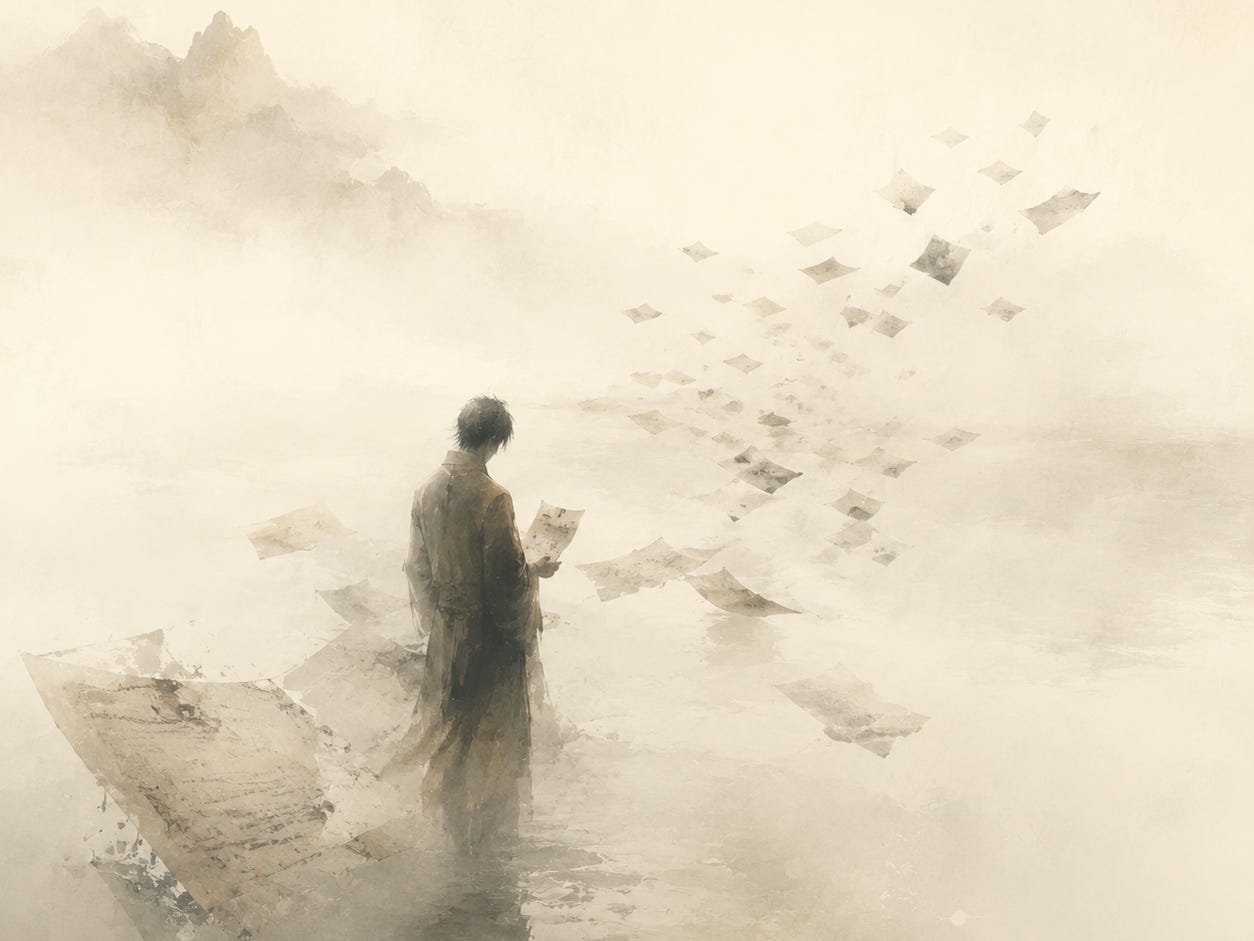
There’s a moment I’ve lived through many times, and I’ve never quite found the words for it. You’re explaining something to someone. You talk for a long time, carefully, and you feel you’ve made it clear. They listen, then hesitate for a moment, and say, “Yeah, got it.”
It’s that hesitation. You can sense, in that hesitation, that they haven’t really understood. Not because they aren’t smart, not because you didn’t explain it well. It’s that the “got it” happened on their lips, not somewhere inside them. You don’t call it out, and they don’t press further. The conversation just moves on.
The reverse has happened too. As a kid, a teacher would stand at the blackboard and talk for a long time, clearly, thoroughly, filling the board with notes. Then, when it was done: Understand? We didn’t understand, but we were too embarrassed to say so. We mumbled: yeah. Then that strange silence — the teacher actually knew we hadn’t understood, and we knew the teacher knew, but everyone moved on anyway, pretending the “yeah” was real. Even then, something felt off about it, though I couldn’t say exactly what.
Growing up, this didn’t go away — it just changed shape. Sometimes the “other person” isn’t even a person anymore. You send a question to an AI, and within seconds a clear, well-organized answer appears. You read it, nod, and think: yeah, got it. But often, that “got it” is the exact same thing as the “got it” back in that childhood classroom.
“Got it” is, more often than not, a social move, not a cognitive state. What it actually means is often not “this has entered me,” but “we can move on now.” Class can proceed, the conversation can continue, the page can be closed, the question can seemingly be set aside. Between these two kinds of “understanding,” there’s a gap — and it’s far wider than we usually assume.
We carry a deep misconception about understanding: that it’s the result of transmission. Explain something clearly enough, and the other person will get it. Direct enough, unambiguous enough, and the information will have done its job. But that “done” only confirms the information was received. It entered the mind, got filed somewhere retrievable, can be repeated, paraphrased, even handed straight off to explain to someone else. Nothing actually happened inside you.
Real understanding isn’t information entering you. It’s you entering the information. There’s a gap between these two things, and there’s no shortcut across it — you can only jump it yourself. No explanation, however clear, can jump it for you.
Augustine thought about this, and thought about it deeply. He said God could have written the true meaning in plain sight, laid out clearly, so that every reader of Scripture would grasp it at a glance. But He didn’t. He wrapped the true meaning in metaphor, in language that demands you go in and out of it again and again, turning it over.
This isn’t an obstacle. It’s a design. Tell you the answer directly, and you’re just a receiver. You catch it, nod, write it down, move on. Make you grope your own way through the metaphor, and you actually get pulled in. It’s in the process of searching, in thinking you’ve understood only to discover you haven’t, again and again, in that feeling of almost-but-not-quite — that some real transformation might begin.
Some of the pleasure of understanding comes precisely from this. Not the answer suddenly laid out in front of you, but the answer being unveiled bit by bit. You’re not looking at an already-processed result — you’re walking a stretch of road alongside it. And that road has hesitation in it, detours, doubling back, the slow surfacing of “oh, so that’s what it was.” Understanding isn’t just reception — it carries something that pulls you forward. The unveiling itself is the path. Not preparation before the path, not decoration alongside it. It is the path.
Zen does the same thing, only more ruthlessly. Someone once asked Zhaozhou: “What is the essential meaning of the Buddhadharma?” Zhaozhou said: “The cypress tree in the garden.” The first time you read that answer, it seems absurd. What does a cypress tree have to do with the Buddhadharma? Is this some kind of riddle? But it isn’t a riddle. A riddle has an answer — guess right, and the game is over. “The cypress tree in the garden” doesn’t work that way. It’s a wall.
Zhaozhou is deliberately leading your thinking into a dead end. You start reasoning, start associating, trying to find the connection between this answer and the question. But the reasoning goes nowhere, the associations find no footing, and logic simply fails here. You’ve hit a wall with nowhere left to go. What the Linji school values is exactly this place with nowhere left to go. Not because you finally figured out the answer, but because you’ve been forced to give up on the very idea of “thinking your way to clarity.” That surrender, that moment reasoning fails, is the entry point where a different kind of understanding opens up.
The stick, the shout, the koan — they all follow the same logic: right when you think you’re about to grasp the answer, the path is deliberately cut off, and you’re pushed back into the place with no answer. Because that place with no answer is the real starting point.
Augustine in North Africa, Zhaozhou in China — the two never crossed paths, but they were doing the same thing: refusing to hand you the answer directly. Not out of mystification. Not out of stinginess. But because both of them understood: an answer handed straight over can’t reach the place it actually needs to reach inside you.
Information can be transmitted. Wisdom cannot. Wisdom can only grow slowly inside you, and only under a specific condition. That condition isn’t clarity, isn’t directness, isn’t being obvious at a glance. That condition is a certain amount of resistance, a certain amount of being lost — a stretch of time when you can’t get out, and can’t even say exactly where you’re stuck.
That stretch of time is uncomfortable. But it isn’t empty. In the past, once you walked into a dead end, you usually just had to stay there. No one could answer you right away, or maybe no one could answer at all, or even if you asked, you had to wait a long time. That process of “staying there” looked, at the time, like helplessness, like stagnation, like waste.
Now it’s different. AI and all kinds of instant answer tools have turned a place that used to require lingering into a place you can almost always jump out of at any moment. The feeling of uncertainty has barely risen before it’s had time to properly settle in your body, and a seemingly complete answer is already sitting in front of you — well-organized, decently worded, even helpfully summarized into three neat points. Very often, that door opens too fast. So fast that you never get the chance to find out what place you were actually about to walk into.
So maybe what’s really worth being wary of isn’t only the ready-made answers other people hand you. What’s harder to guard against is your own craving for ready-made answers — the moment uncertainty rises, you’re already unconsciously trying to erase it, trying to hurry up and figure it out, get some kind of explanation, and move on. That impulse is completely natural. Because that suspended feeling really is uncomfortable. You don’t know whether you’ve truly understood, don’t know when you’ll count as having understood, don’t know how much longer you’ll be stuck here.
But sometimes, that’s exactly where the problem lies. We eliminate that discomfort too quickly. Patch up that crack too quickly. Rush ourselves back too quickly to the position of “I already get it.” And so the thing that might have slowly grown inside us ends before it ever gets the chance to grow.
That feeling of having nowhere left to go — you probably know exactly what I mean. The reasoning goes nowhere, the associations find no footing, and you want someone to just tell you the answer. And then, immediately, one appears in front of you.
But sometimes, the real difficulty isn’t that no one will answer you.
It’s that you have to decide, yourself, whether to walk out of it that fast.