

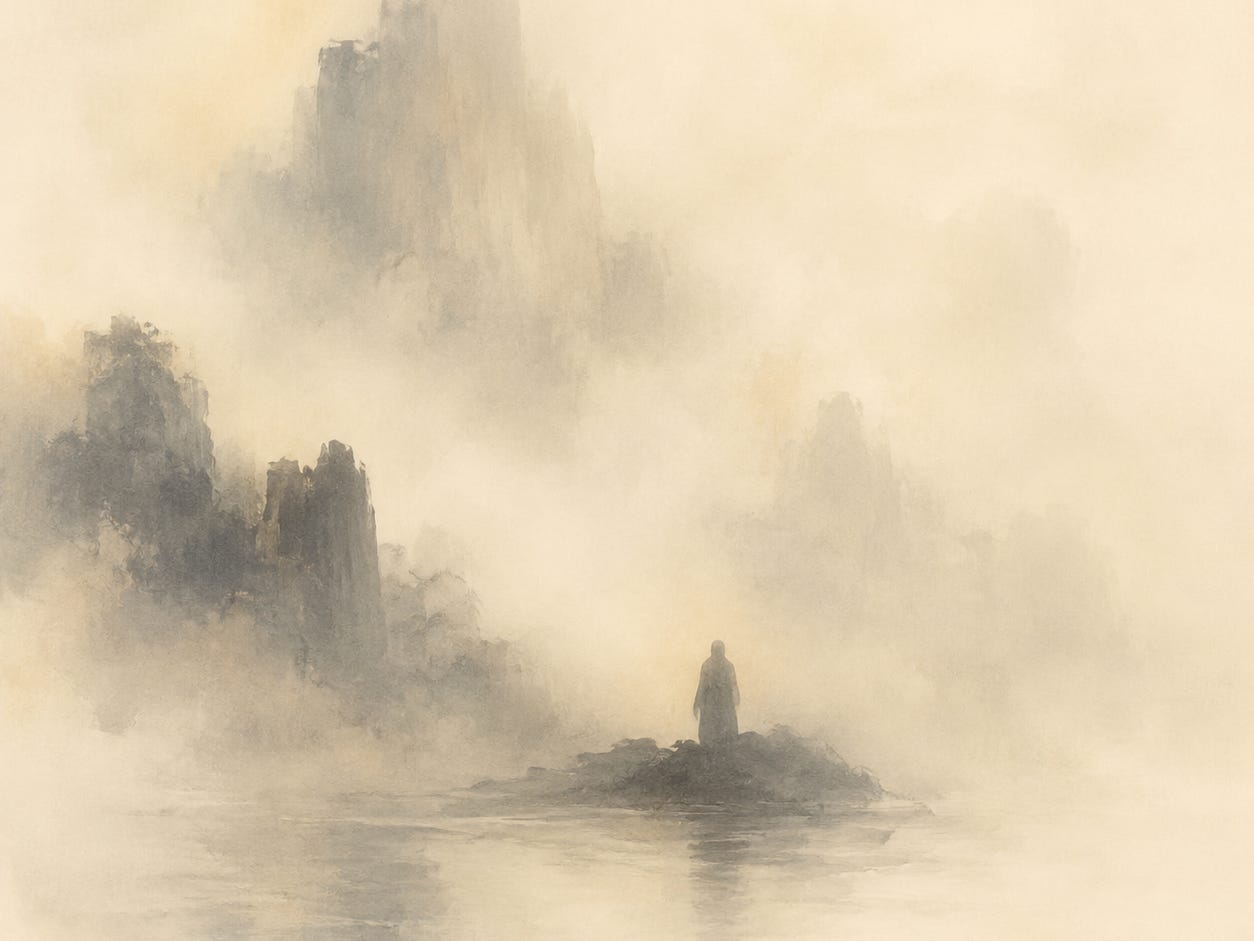
Have you ever seen that kind of person — standing in front of a painting, and staying there a long time.
Around him, people come and go — taking photos, moving along, glancing up at the label, glancing back down at their phones. Five seconds, ten seconds, and that’s about it, they’re gone. Only he is still there. Not pretending to have understood something, not trying hard to memorize anything. He’s simply stopped. As if there’s something in that painting that everyone else glances past, but that has held him back.
It’s actually a strange scene.
Because on the surface, the painting is still just the painting. It hasn’t moved, hasn’t spoken, hasn’t actively pushed anything toward you. And yet some people walk right past it while others stop. That tells you the question was never only “what’s in the painting” — it’s also “whether the person still has the capacity to stop.”
This makes me increasingly think that what’s genuinely scarce today isn’t images, isn’t content, isn’t beauty — it’s the capacity to be willing to stay a little longer in front of something.
We’ve grown far too used to treating “seeing clearly” as a virtue in itself.
High definition, complete, no blind spots, every detail maxed out — ideally every strand of hair, every crease of expression magnified and rendered crystal clear. As if beauty automatically follows once you can see clearly enough; as if understanding happens automatically once there’s enough exposure. We’re even increasingly prone to mistake “visibility” itself for a kind of power: the brighter, closer, and more complete an image is, the more worth seeing it seems to be.
But strangely, plenty of things are already clear enough, and still can’t hold anyone’s attention.
You scroll past a face, a scene, a set of photos on your screen. Your first glance says it’s beautiful, maybe even “refined,” “high quality.” But as you keep looking, nothing catches hold of you. Not because it’s bad, and not because you’ve hit aesthetic fatigue. It’s more that it has everything — except for the one force that would make you pause.
This is where the real problem begins.
Some things get seen without ever being lingered on. They existed, of course — they were even looked at thoroughly — but they never held you. You finish looking, and that’s the end of it. The next photo, the next post, the next clip immediately pushes it out of the way. It left no resistance in you at all.
And so “seeing” slowly starts to come apart from “encountering.”
This is probably where the aura still lives.
Aura isn’t some mystical atmosphere, and it isn’t a nostalgic filter that makes old things seem classier. It’s more like a relationship: you know the thing is there, you’ve even already seen it, but you can’t take it in all at once, in one go. It keeps a small distance from you — not a cold distance, but a strange kind of closeness — you can draw near to it, but you can never fully possess it.
Truly beautiful things, more often than not, carry this distance.
It isn’t in a hurry to hand itself over completely. It won’t, just because you’re looking at it, immediately spread out all its meaning, all its charm, all its layers flat before you. It always keeps a little back, leaving you with the sense that you haven’t fully arrived yet. That feeling of “not there yet” isn’t a flaw — it’s exactly what makes it able to hold you.
So the truly remarkable things aren’t necessarily the ones that hit you all at once, at first glance.
They’re more like a quiet invitation: you can keep staying here. You can look a little longer. What you just saw might not be all of it. You think you’ve already understood, but there’s still something in it that hasn’t fully unfolded.
That feeling of “there’s still more to see” — that is the aura.
The problem with a lot of today’s images isn’t that they aren’t beautiful enough — it’s that they’re too easy to finish looking at.
Digital images, short videos, overexposed faces, feeds full of scrolling footage — they’re all moving in the same direction: brighter, closer, clearer, more complete, easier to instantly recognize and instantly consume. They’ve certainly increased visibility, but in doing so, they’ve also gradually shaved away everything else — time, distance, sedimentation, and that small margin that can’t be taken in all at once.
So images start to become nothing but surface.
And it’s exactly here that appearance and semblance start to part ways.
Appearance isn’t merely a surface. Appearance is something grown, something lived into, something bearing the traces of time. It might not be standard, might not be perfect, might even carry a bit of hesitation, a bit of unevenness — but precisely because of that, it has thickness. When you look at it, you’re not just looking at an outline; you’re watching how time has slowly settled into a thing.
Semblance isn’t like that.
Semblance is something served up to you, presented for instant viewing, endlessly reproducible. It has no real history, doesn’t need to age, doesn’t need to change, doesn’t need you to stay with it for long. Its only job is to appear. It appears complete enough, pleasant enough, shareable enough — and so you see it, and then it’s over.
This is why semblance is so often “correct,” and yet leaves so little to miss.
Not because it’s fake, but because it never has the depth — it never had time to grow one.
Real depth was never something more exposure can light up.
Depth needs time. It needs sedimentation. It needs the thing itself to still hold on to some part that hasn’t been immediately processed and finished off. When you see someone standing in front of a work in a museum for a long time, most people’s first reaction is: does he understand it better, is he engaged in some kind of refined appreciation I don’t have.
But often, it’s not just that.
Often, it’s simply that the work still has something in it worth stopping for.
It hasn’t laid itself flat all at once. It didn’t hand over its entire content in the first second. It holds the viewer, and lets the viewer slow down in front of it. A less utilitarian relationship forms between person and work: not “have I understood it,” not “what have I learned,” not even “is it worth photographing and posting” — but simply, am I willing to keep staying here.
That’s become rare. Because most of today’s looking has been trained into a motion of quick swallowing. One glance, a snap judgment, swipe away. One glance, looks nice, swipe away. One glance, feels boring, also swipe away. Over time, what we’ve built up isn’t sharper judgment — it’s a faster ability to leave. And once a person is left with nothing but a faster ability to leave, it becomes harder and harder for them to enter real looking at all.
So the problem isn’t really just that there are more images now.
The deeper problem is: the mechanics of images are quietly reshaping looking itself.
When everything can be refreshed instantly, zoomed instantly, copied instantly, consumed instantly, the kind of relationship that used to form slowly between us and an object becomes harder and harder to arrive at. You no longer need to linger, no longer need to hesitate, no longer need to let a thing unfold slowly in front of you. The system rewards “seeing,” not “staying”; it rewards “processing,” not “encountering.”
Over time, the things that truly still have an aura start to look clumsy by comparison.
They’re not fast enough, not direct enough, don’t satisfy you immediately enough. They can even make you a little impatient: why haven’t I understood this yet, why isn’t there an answer yet, why can’t this go faster.
But it’s exactly this “not fast enough” that is where they’re still alive.
Because you can’t take them in all at once.
This is also why some things aren’t the most eye-catching at first, and yet the longer you look, the deeper they seem to go — while other things look great in the first second, only to start hollowing out fast by the tenth or fifteenth second.
Not because the former is more refined, or the latter more lowbrow. It’s simply that the former still keeps a bit of distance, a bit of history, a bit of a place you haven’t reached — while the latter has already spread itself out entirely, given itself away entirely, turned itself entirely into one-time visibility.
Once a thing has nothing left but “visibility,” it easily loses its “stayability.”
And once it loses that, it becomes very hard for it to carry any real weight again.
The things that can make a person stand in front of them for a long time — that tells you they’re still alive.
But this isn’t only the work’s power, acting alone.
It also tells you that the person standing in front of it is willing to stop. Willing to slow down, willing to pull themselves out of the rhythm of quick swallowing, willing to let a thing unfold itself slowly.
Aura isn’t something a work simply emits and is done with — it has to be caught.
On one side, the work still holds on to a part of itself not yet taken. On the other, the person still holds on to a capacity not to rush toward finishing. It’s only when these two things meet that aura happens.
Once one side gives too much, and the other moves too fast, all that’s left is surface.
And surface can never truly hold on to anyone.