

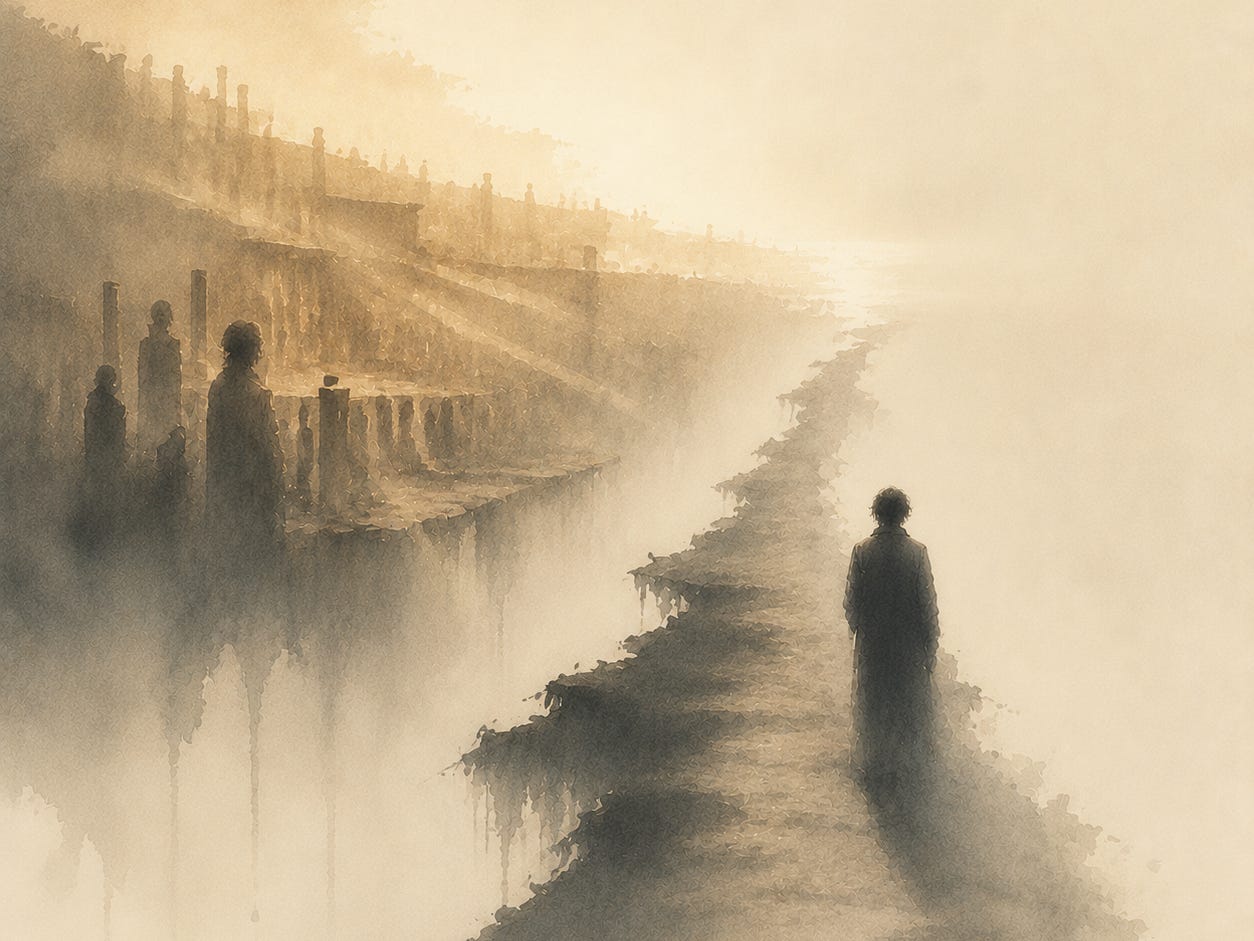
Byung-Chul Han said: modern people are growing old, but never growing up.
The first time I read that line, it felt like an accusation — that people today aren’t grounded enough, aren’t steady enough; their years pile up, but their minds never catch up. But if you sit with it a little longer, you realize it isn’t really a judgment on anyone’s character. It points to something more structural — that “maturity” was never something a person could simply cook up on their own, over the years they’d lived. It always needed something larger to hold it up before it could actually take shape.
In traditional societies, when a person reached a certain age, there were coming-of-age rites; they learned how to treat their elders; the family held ceremonies to honor the ancestors. These rituals look, on the surface, like nothing more than customs and etiquette — but what they quietly did ran far deeper than that. They stitched a person’s aging and death into the same web as the generations before and after them. The role he would play in old age had already been played by the elders before him; how he would be remembered after death, the village elders already remembered from watching his father and grandfather being sent off. His life wasn’t something starting from scratch, alone — it picked up a road that had already been laid down.
Clearly this wasn’t something one generation happened to figure out on its own — how to grow old, how to face death. It was something fixed in place gradually, generation after generation, tested and reused within an almost identical rhythm of life.
In agrarian society, the arc of a person’s life closely resembled his father’s arc, which closely resembled his grandfather’s. What crops to plant, when one came of age, when one should have children, how the elderly in the family were cared for, how the dead were buried — these things passed from generation to generation with almost no need for change. It was precisely this slowness that made it possible for an “answer” to actually be inherited — not because the older generation had invented some ultimate wisdom, but because their way of life repeated itself long enough, long enough for that account of how to age and how to face death to be tested, and long enough to be picked up, unaltered, by those who came after.
Which pushes the question a step further — why can’t people today pick up that ready-made answer anymore?
Probably because the slowness that once carried the answer down through the generations is simply gone. A person’s way of living today may already differ enormously from their parents’ — where they live, the nature of their work, the age at which they marry and have children, even the answer to who will care for them in old age. As the pace of life accelerates from one generation to the next — faster than the previous generation’s experience can even be tested into a stable account — the next generation’s circumstances have already changed.
The answers about aging and death handed down by the older generation weren’t deliberately rejected or discarded by anyone. They simply, slowly, stopped matching up — like a map drawn ten years ago: still a map, held in your hand, but no longer able to point you in the right direction against the streets in front of you.
This is the truly uncomfortable core of “never growing up” — it isn’t that this generation is more restless or less patient than the ones before it. It’s that they are the first to face a situation in which the very network once responsible for passing answers down has, because life itself now moves too fast, failed to deliver any ready-made account securely into their hands. They haven’t refused to inherit anything — there’s simply nothing left for them to inherit.
And so almost everyone has to start from zero, working out for themselves what this age is supposed to mean; who will care for them when they’re old; how they’ll be remembered. In the past, no one ever had to think through such questions alone — the family, the village, customs passed down through generations, had already worked it out; the answer was ready-made. Now these questions land on each individual person, and for the first time, truly become “what am I going to do,” rather than “this is how it’s always been done.”
This shift is worth dwelling on a little further.
The old answers weren’t just “ready-made” — they were “shared.” The way the elderly in a village grew old, the way they were sent off, was understood by everyone in more or less the same way; that understanding was carried together, by everyone at once. When a person faced death, a whole set of familiar rituals and familiar words stood beside him, facing it with him. Now, whatever understanding each person manages to work out on their own — even after considerable effort — is hard to pass on to anyone else, because the next person’s circumstances will very likely already be different again.
This is the loneliest part of being of this generation — not that we are more fragile than those before us, but that we are the first who must work out, alone, something that was always meant to be carried across many generations together. Rilke, in his letters to a young poet, wrote that no one can advise you, no one can help you — there is only one way: to go inward, into your own depths. That line was written about how a person comes to live out their own path, and set down here, it suddenly feels precisely fitting — because so many of today’s questions really do have no ready-made counsel left to borrow. All that’s left is to walk, alone, slowly inward.
Looking back at Han’s line, you realize it isn’t really blaming anyone for a lack of maturity. It’s describing something rather helpless — that every generation now may have to reinvent, in isolation, something other people already invented long ago, except each time the reinventing happens, there’s less and less company along the way.
That answer, invented over and over, may not yet have a single, shared shape everyone agrees on. But maybe this is exactly where it needs to be pieced back together — not through a whole system of ritual, but person by person, each one slowly willing to speak about how they’ve come to understand growing old, speaking it to the people around them — even if, for now, that telling hasn’t yet become a ready-made answer the next generation can simply pick up.