

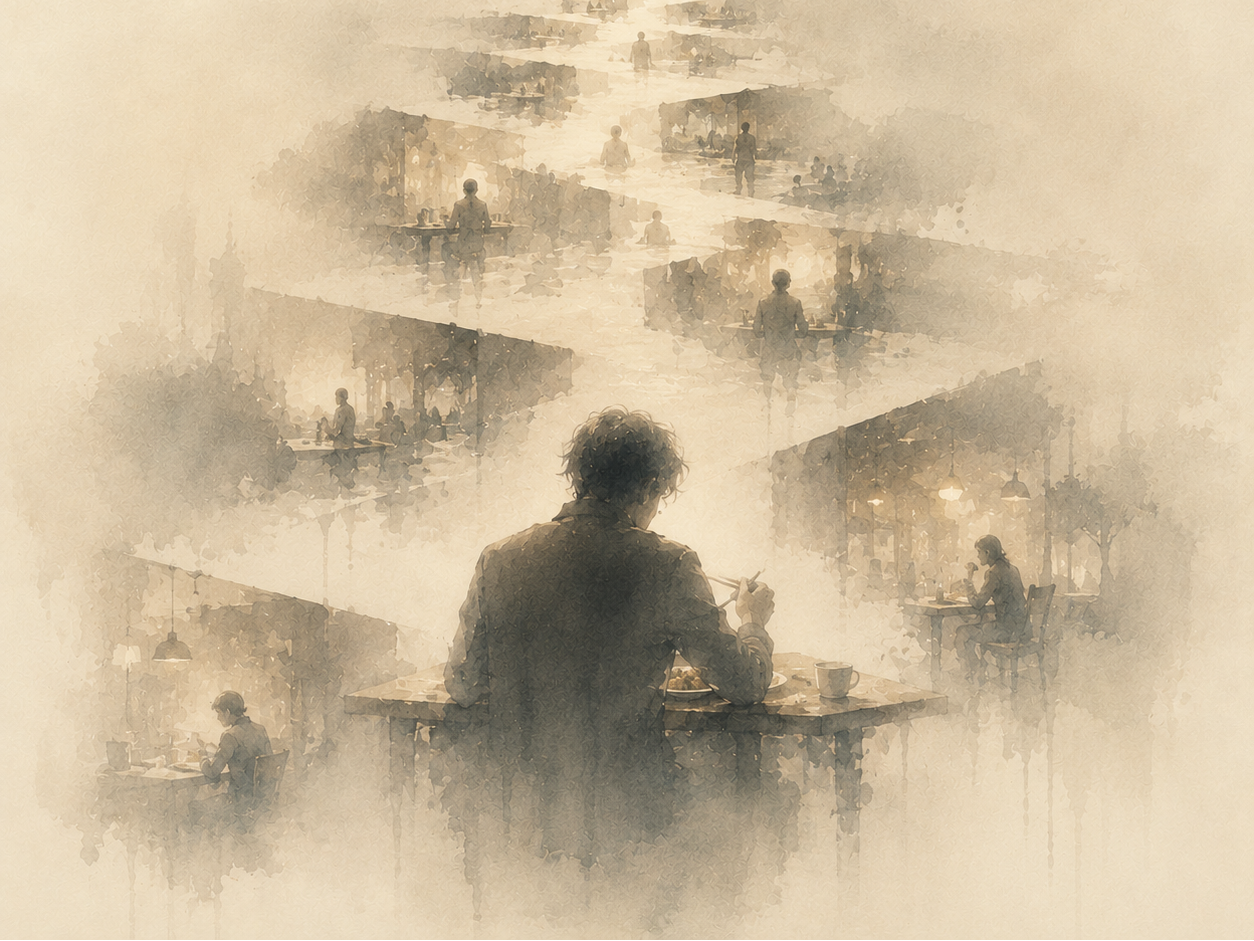
A person is sitting in a pretty decent restaurant, eating. Their phone suddenly pushes a notification — a new restaurant nearby, rated even higher, has just opened.
That notification doesn’t actually make the food taste any worse — the plate is still the same one that was just set down, still steaming. But when they pick up their chopsticks for the next bite, it’s no longer entirely this dish they’re eating. Part of their attention has already drifted over to the doorway of that new place, sizing up its sign, even starting to imagine what the decor might look like, what the menu might have on it. The dish in front of them is clearly still hot, and yet half of their tongue is already tasting something else — not this dish’s flavor, but the imagined flavor of a dish that doesn’t even exist yet.
The food hasn’t changed. The chopsticks haven’t changed. But part of them is no longer at this table. This bit of distraction is light, barely noticeable, and won’t even stop them from finishing the meal just fine — but it quietly shifts something basic: eating this dish used to be the one thing they were doing, right now. Now, eating this dish becomes the thing they’re doing for the time being, with a thin crack left open beside it, leading somewhere else.
Cracks like this probably open more than once in a single day. Halfway through a movie, you suddenly recall that another film supposedly has better reviews. Lying down to rest, a thought drifts through your mind — should you be using this time on something more productive instead. Each of these thoughts is short, short enough to barely take up any space at all, but they all show up in almost exactly the same way — each one reminding you that whatever you’re doing isn’t the only option, that something else might be better.
You still finish the movie, still get your rest, but looking back at the day, it feels like you were never truly settled anywhere. The meal got eaten, the movie got watched, the things got done — everything got finished, and yet everything is left with some small unfilled space. It’s as if the day got sliced by countless thin cracks into pieces of uneven length, none of them heavy enough on their own, and put back together they still add up to a full day, but a day that can’t hold the thickness a full day should have.
In the end, all these cracks are the same motion, repeated over and over: the moment you know another option exists — a higher-rated restaurant, a better-reviewed film, a more efficient use of your time — whatever you’re currently doing quietly gets demoted one rank, from “the thing I am doing” to “the thing I’m doing for now.” “Demoted” sounds heavy, but when it actually happens, it’s nothing heavy at all — just a flicker, almost as if nothing happened. But it’s exactly that flicker that turns something that should have been whole into an interlude that could be pulled out and swapped at any moment — like a play where the actor might get replaced at any time, while the audience keeps right on applauding as usual.
So an enormous physical freedom of choice can, at times, make it even harder for the mind to genuinely settle. But this isn’t about having too many options and getting overwhelmed. Follow those thin cracks back, and you’ll find the problem isn’t that you can’t pick one — it’s that there was never really any intention to pick one and then stay put. Every option is kept open, ready to be reopened at any moment — like every door in the house left deliberately ajar, the wind constantly moving through, not a single room ever truly closed.
Here’s the interesting part: these notifications, these ratings, these “there’s something better” prompts — every time you open one, what you get in exchange is a more fragmented day. And yet people still can’t help opening them, again and again. Probably because comparing gives you the feeling that you’re getting closer to the answer — as if every comparison brings you one step nearer to the best option.
But that higher-rated new restaurant won’t have been open a month before yet another one, rated even higher, pops up ahead of it. This game of comparison genuinely has no endpoint, because the endpoint was never something comparison could arrive at in the first place — the endpoint is a moment when a person decides, on their own, to stop comparing, and closes the door.
If a person keeps waiting for that moment when “comparison is finished” before they’re willing to hand their full attention over to whatever’s in front of them, they’ll probably wait their whole life — because that moment was never actually going to arrive. It only ever gets pushed further back, pushed to tomorrow, pushed to the next time a notification pops up.
Looking back, the moments that actually felt truly settled were rarely the “optimal choices” arrived at through endless comparison. They were the times when the thing itself left no crack open at all — whether a meal tasted good, it turns out, doesn’t depend so much on whether some better restaurant exists somewhere else. It depends on whether, while eating that meal, a person was actually, fully, at that table — instead of half-drifted off somewhere else.