

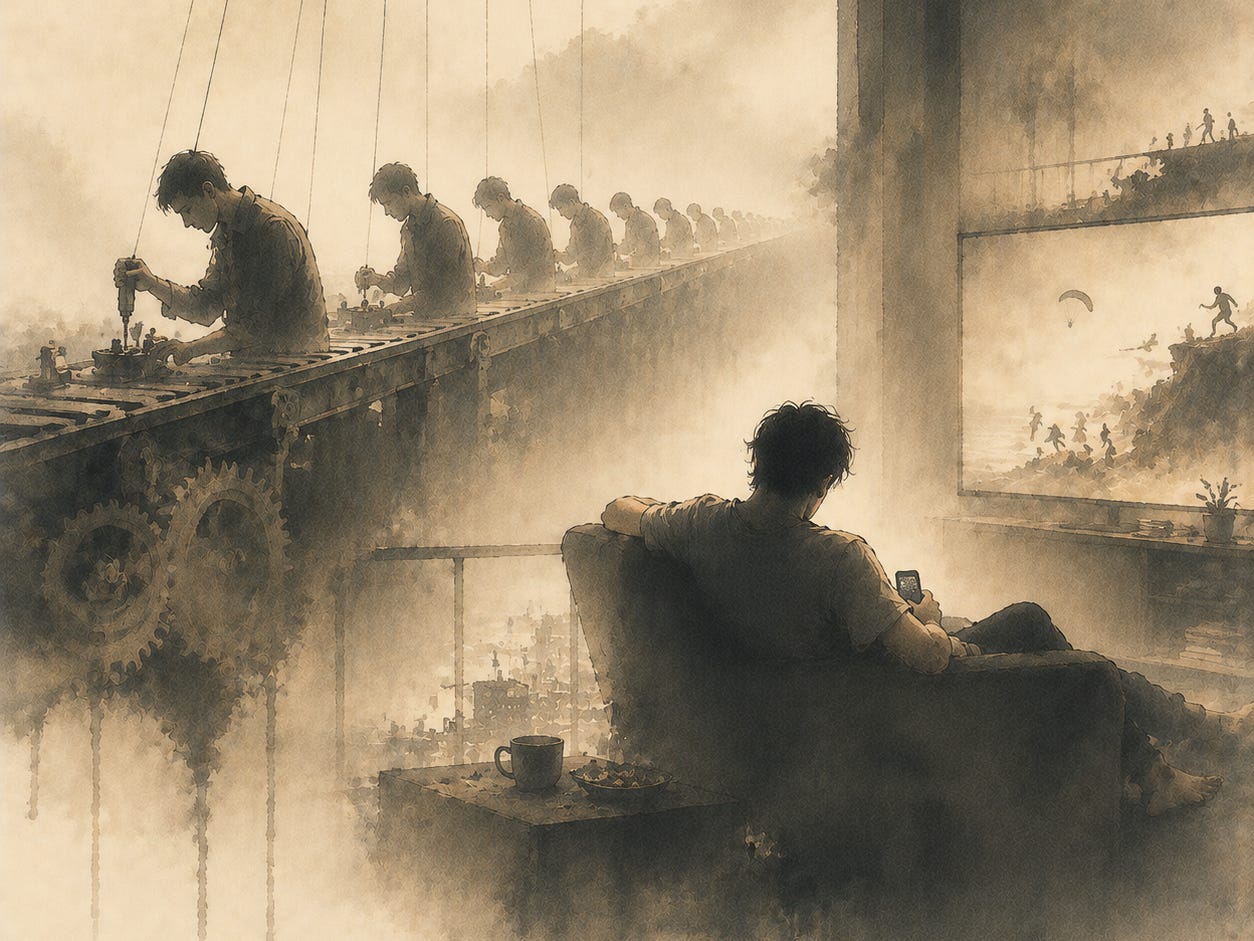
The word “division of labor” was first used to describe the assembly line. One person does nothing but tighten bolts, one person does nothing but manage the books, one person does nothing but watch over a single stage of the process, and efficiency shoots up as a result.
This logic helped factories produce more, and quite naturally walked straight out of the workshop and into the office, into every position getting sliced ever thinner — a person spends eight hours a day, getting to a certain line in a spreadsheet, a certain function in the code, the motions repeating like one gear meshing with another. No one can quite say when this became the taken-for-granted way things are now.
Push division of labor to its extreme, and efficiency really does go up. But the ledger behind that efficiency has never actually been settled honestly. A person spends eight hours a day repeating what might be one single, tiny motion, and the price paid for that efficiency is this: their lived experience gets compressed into that one tiny motion, while everything else that was supposed to be lived — adventure, romance, ups and downs, living a life to the fullest — can’t find even a foothold anywhere in this system.
Collapsing into a chair after work, that indescribable emptiness isn’t exhaustion of the body. It’s all the parts of you that got squeezed out, knocking at the door, with no one there to answer.
This squeezed-out lived experience doesn’t actually disappear — it just grows back somewhere else. The place it grows back is in celebrities, influencers, idols. Their profession, in a sense, is to experience — on behalf of everyone whose lived experience has been hollowed out by division of labor — that rich, free, romantic, successful, glamorous life, and then film it, edit it, post it.
Watching that post scroll by for a few seconds, it feels almost like you went somewhere you’ve never been, fell in love the way you never have, and this compensation arrives fast and light — light enough that no one stops to ask whether this experience of “living vividly” was ever supposed to be something you earned yourself.
Follow this line of thought further, and you’ll find that “living vividly” itself has already been absorbed into the division-of-labor system — not everyone is supposed to experience excitement; instead, one segment of people is specifically assigned to experience it, while the rest are assigned to watch and envy.
Excitement gets processed into content, distributed to those fixed in place on assembly lines and in cubicles. Living excitingly has become a job title — the same kind of thing, in nature, as tightening bolts or filling out spreadsheets — both are products of division of labor. It’s just that tightening bolts produces components, while experiencing excitement produces footage other people are willing to pause and watch for a few extra seconds.
Once this division of labor takes hold, even the word “excitement” itself starts to carry a professional quality, as if it were naturally something certain specialized people should be responsible for carrying, separated from ordinary people’s daily lives by an invisible job description.
This division of labor hollows out ordinary people even more thoroughly than the factory kind did. Because the person tightening bolts at least still knows what kind of life they should be fighting for — they just don’t currently have the time or the conditions, but that longing is still there, intact.
But a person who’s grown used to watching someone else live excitingly on their behalf gradually has even the thought of “should I be experiencing this myself” worn away. And since excitement has already been outsourced to professionals responsible for it, going out and fighting for it yourself starts to look almost redundant, even a little clumsy.
“Not having time to experience it” and “giving up on experiencing it firsthand” are two entirely different degrees of loss. The first kind of person still has an unredeemed hope in hand. The second kind doesn’t even know when they quietly set that hope down.
Division of labor was originally meant to raise efficiency, to manufacture more things. But once division of labor extends to the act of living itself, what it manufactures isn’t more life at all — it’s an entire class of people hired to live on other people’s behalf, and an entire class of people who have given up living for themselves. The more completely this division of labor is carried out, the further humanity drifts from experiencing its own life with its own hands.
A hand that’s been tightening bolts can still be lifted to do other things — it’s just never been given the chance. But once you’ve grown used to letting someone else claim your right to live on your behalf, taking it back for yourself becomes, ironically, one of the rustiest, most unpracticed skills of this entire era.