

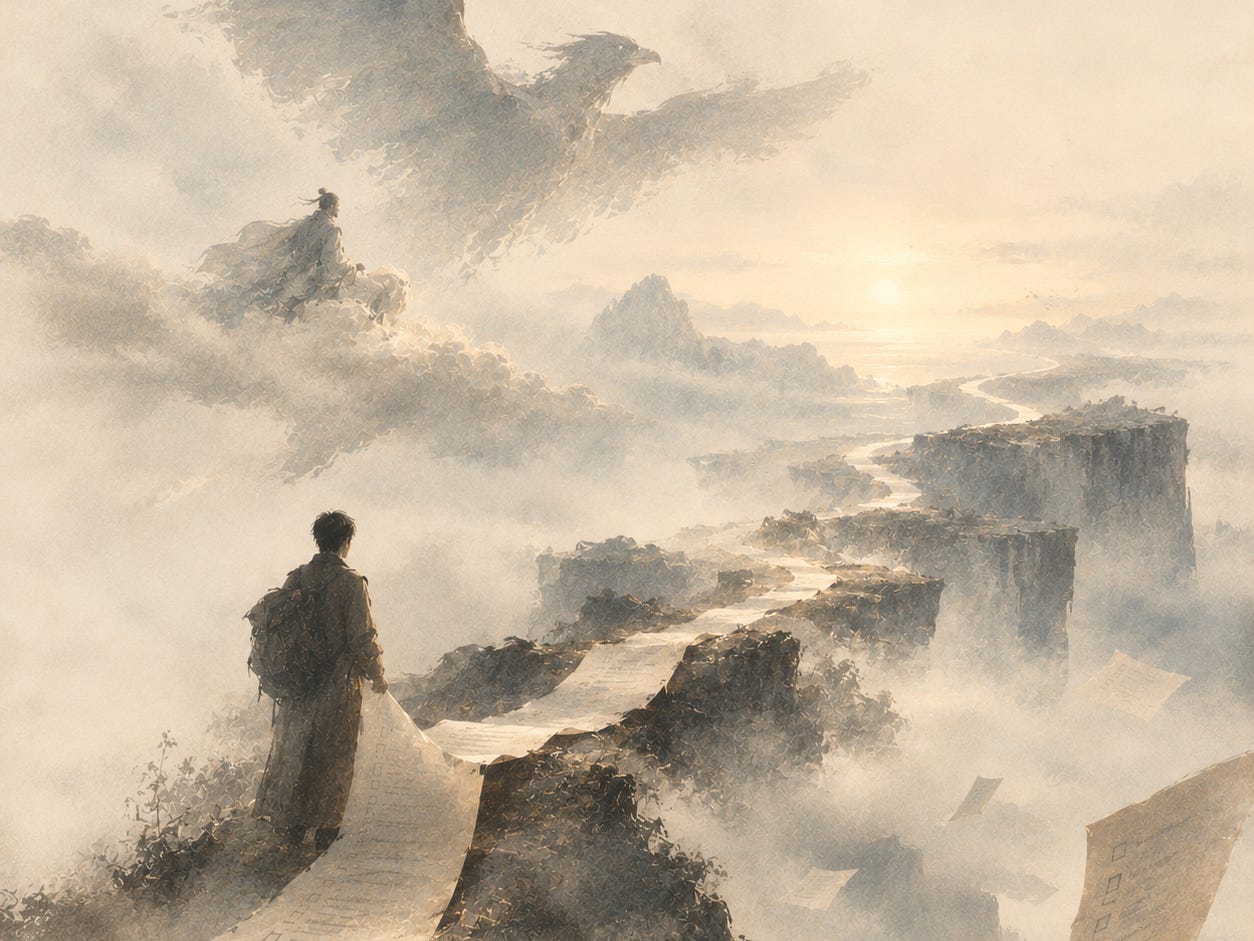
Try to work out what “true freedom” actually means, and a lot of people unconsciously do the same thing — make a list, writing down what they’re still missing. A little short on money, a little short on time, a little short on skill, a little short of a position where they don’t have to answer to anyone. Once the list is drawn up, it feels like the moment all these items are checked off, freedom should finally be in hand.
But this list has a strange flaw — check off one item, and another quickly appears. Save up enough money, and suddenly you’re short on time. Free up the time, and suddenly you’re short on the confidence to actually sustain that leisure. The list never has a day when it’s truly finished — cross off one line, and another grows at the end, as if you’re forever chasing a finish line that keeps retreating.
This feeling of “there’s always one more thing missing” is put more directly by Zhuangzi in “Free and Easy Wandering.” The great Peng bird can fly ninety thousand li into the sky, which sounds like the ultimate freedom already — but Zhuangzi immediately points out that wings that large need a wind piled up thick enough beneath them before they can even be lifted. If the wind isn’t thick enough, no matter how vast the wings, they still can’t fly.
Next comes Liezi, who could ride the wind and drift off for as long as fifteen days at a stretch — far more graceful than an ordinary person walking on two legs. But even that grace still can’t do without the wind. The moment the wind stops, the person comes back down to earth.
So whether it’s a small insect that can only muster enough strength to hop up onto a branch, or the great Peng bird that needs ninety thousand li of wind just to take off — what they depend on differs wildly in scale, but the structure of “you first need something to lean on before you can move at all” never changes. The list of conditions can be short, or it can be long, but as long as you’re still making a list, you’re fundamentally waiting for something to be fully assembled before you dare take a single step forward.
So if even a freedom on the scale of the Peng bird’s still depends on nothing more than a bigger, harder-to-assemble condition, is there a kind of freedom with nothing left to put on the list at all? Later in “Free and Easy Wandering,” there’s a remarkable response to exactly this: it speaks of a kind of person — one who rides upon the rightness of heaven and earth, and drives the transformations of the six vital forces, to wander in the boundless — and then asks: what, then, would such a person have to depend on?
Reading this line, it’s easy to fall into old habits and wait for a concrete answer — something like “such a person doesn’t need money, doesn’t need mountains, doesn’t need luck.” But what it gives isn’t a checklist-style denial. It simply leaves the very question of “what does this depend on” suspended in midair. It’s as if, at this level, even the question “what are you still missing” can’t be asked anymore.
This forms a solid contrast with that ever-lengthening list from before — the end point of checklist-thinking never arrives at a day when “the list is finally complete,” because you can always think of one more item. What this rhetorical question points to isn’t a completed list. It’s being entirely outside the logic of “what should go on the list” to begin with.
Think closely about this difference, and the key might lie here: the freedom of the Peng bird and of Liezi both depend on “borrowing” — borrowing the lift of the wind, borrowing the flow of the air. Whatever is borrowed is, in the end, something belonging elsewhere — usable, but also liable to be withdrawn at any moment.
The state this rhetorical question is pointing to, though, doesn’t take the path of borrowing at all. This person’s own movement already lines up with the workings of heaven and earth and all things in it. There’s no need to reach out and borrow anything else, because the whole procedure of “something’s missing, go find it to fill the gap” was never there to begin with.
Thinking about it this way, the biggest problem with that freedom checklist was probably never that it wasn’t complete enough. It’s that the very need to make a list at all already places a person into a situation of forever waiting, forever assembling, forever feeling like something’s just a little short. So true freedom probably isn’t the moment the checklist finally gets completed — it’s the sudden realization that you no longer need that checklist at all to measure your own freedom.