

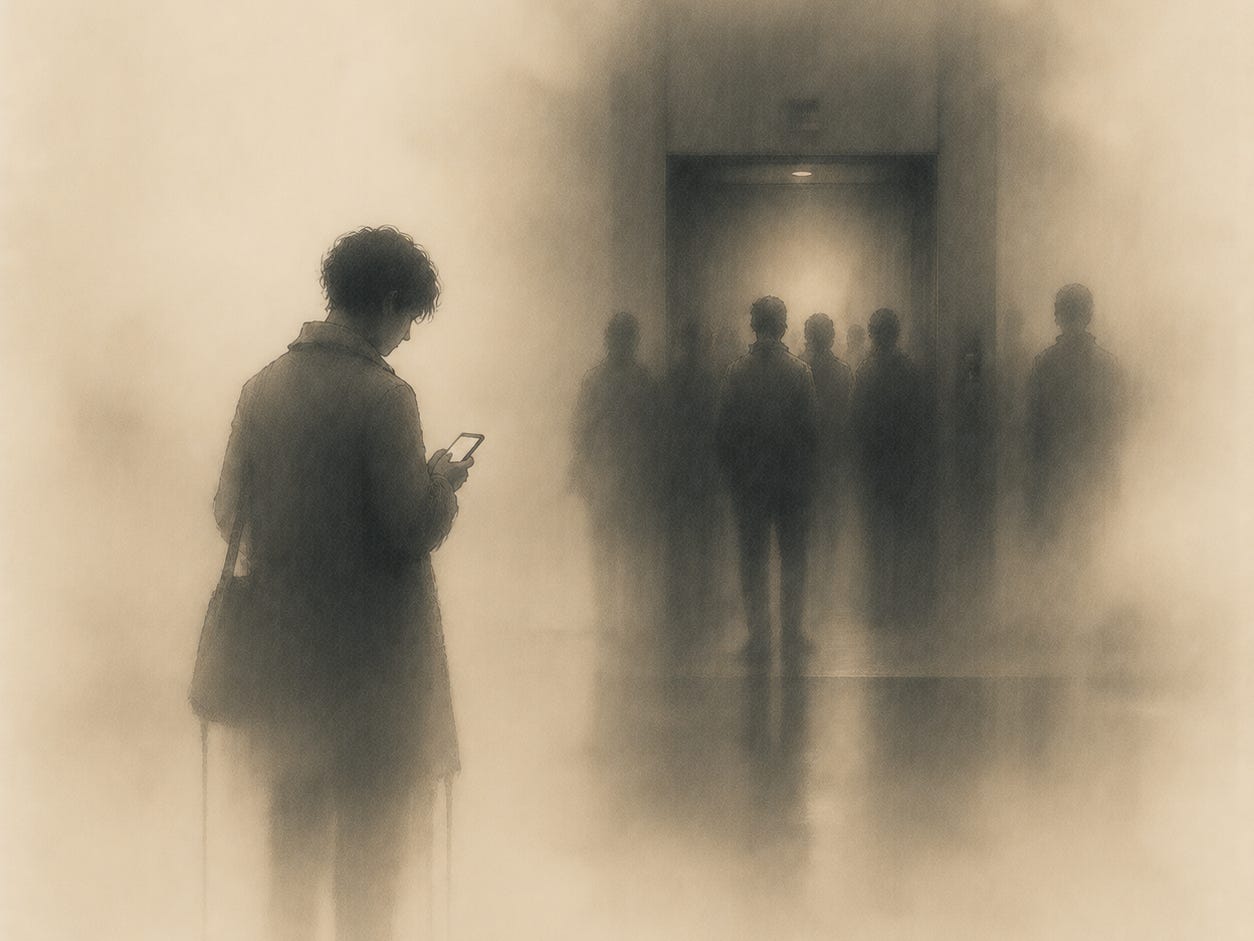
Waiting for the elevator, the screen shows it’s still twenty seconds away. The hand has already reached for the phone. The screen lights up, the lock screen swipes open — the twenty seconds haven’t even passed, and the phone has already lit up first. The person standing next to them is doing the exact same thing. Neither of them glances at the other, each head bowed, each face lit by the glow of their own screen.
The motion is so fast it barely passes through thought at all. In that moment standing at the elevator door, no thought ever surfaces in the head — it skips right past the step of “should I check my phone” and lands directly in the state of “checking my phone,” as if the body made the decision on its own, and by the time consciousness catches up, the screen is already lit, the finger already swiping.
There’s not even a single moment in this whole sequence that could be called a “choice.” A choice requires a pause, requires at least a flicker of hesitation, but there’s not half a second of hesitation in this motion at all. It’s more like a conditioned reflex — the same speed as flinching instinctively when something flies toward your face.
Thinking back on it afterward, you can’t even say for sure whether you saw the elevator’s waiting indicator first, or felt your hand already reaching for your pocket first — the two motions nearly overlap, impossible to tell which came before the other.
But thinking back, anything at all could have happened in those twenty seconds. You could have thought about what to have for dinner, what’s left in the fridge, whether to stop and buy something on the way down. You could have gone back over some line from that meeting a moment ago, wondering if there was something meant between the words, whether it was worth thinking through further.
You could have simply stood there, staring at your own reflection in the elevator doors, checking whether today’s outfit actually worked. Or you could have thought about nothing at all, just stood there, feeling the faint chill of the building’s air conditioning.
Not one of these possibilities was ever given a chance to happen. The phone beat all of them, so fast that none of them even got the chance to poke their heads up before being replaced by that lit-up screen. This isn’t the phone winning some race. It’s that the thoughts that were supposed to surface on their own never even made it to the starting line — the gun hadn’t fired yet, and the track was already empty.
This “faster” isn’t because the phone itself is so tempting — it’s that leaving something blank hasn’t been allowed to happen in a long time. The instant even the slightest gap appears, the body’s first response is to find something to fill it with, and this response is fast enough to make you think it’s instinct.
In reality, it’s just a conditioned reflex, trained into you through endless repetition. Like Pavlov’s dog salivating at the sound of a bell — here, the bell has simply been swapped for any stretch of blank time, and what flows isn’t saliva, it’s the hand already reaching for the pocket.
The process of building this reflex is almost impossible to feel happening. No one consciously trains themselves to “pull out the phone the moment a gap appears” — it gets quietly welded into daily motion through thousands upon thousands of tiny repetitions, welded so firmly that now, trying to get around it actually requires a deliberate reminder to yourself.
This training happens across countless twenty-second stretches just like this one — twenty seconds waiting for coffee, twenty seconds waiting for the elevator, twenty seconds waiting at a red light — and every repetition reinforces this reflex arc a little more, until, eventually, consciousness can’t even find a way in anymore.
It’s not hard to imagine: if you forgot your phone one day, those twenty seconds standing at the elevator would feel unusually long, even leave you a little restless, unable to sit still. And that restlessness isn’t because twenty seconds is genuinely that long — it’s that the capacity to generate something of your own to fill that stretch of time hasn’t been used in so long that, all of a sudden, you can’t find anything to fill it with at all.
Your mind is like someone asked a sudden question, stammering, unable to answer — you stand there, not knowing where to put your eyes, not knowing where to put your hands, left to just watch the floor numbers tick upward one by one. That awkwardness feels a little like the embarrassment of forgetting your lines the first time you speak in front of an audience.
This awkwardness is actually the most honest moment of all. Nothing covers it up — it lays the gap bare, directly, forcing you to face a question: once every habitual filler is taken away, what’s actually left in you to pass the time? The answer is often a little embarrassing — almost nothing is left. That once-natural capacity to effortlessly conjure up a thought seems to have quietly exited, at some moment that went entirely unnoticed.
The elevator hasn’t arrived yet, and the phone has already lit up first. What this sequence exposes isn’t who’s more impatient — it’s that the capacity to generate your own thoughts, to pass your own time, has been trained, by this very “lighting up first,” into something you use less and less.