

The shelf, as a structure, carries a hidden requirement for whatever gets placed on it — it has to be uniform enough, predictable enough, consistent in size, with a clearly defined shelf life, so that it’s easy to arrange, easy to price, easy to restock.
A row of apples lined up neatly on the shelf, similar in size, similar in color, even their stems all pointing the same direction. A scanner beeps, the price pops up instantly, the whole process clean and efficient, without a moment’s hesitation. Look at this uniformity long enough, and you might start to believe fruit was simply always meant to grow this way.
But this uniformity has actually had its blood replaced. A piece of fruit ripening on its own natural schedule turns sweeter in a year with more rain, more sour in a year that’s drier. On the same tree, the fruit facing the sun and the fruit facing the shade differ in color, and this one and that one might not taste quite the same either.
It can’t promise that the next bite will taste exactly like the last — even within a single piece of fruit, the sweetness quietly shifts from the stem end to the tip. This inability to promise anything is exactly the most authentic part of it, as a living thing.
And this authenticity is exactly what the shelf can least tolerate. The shelf needs every piece to look about the same, taste about the same, in order to be efficiently displayed, scanned, checked out. So the fruit gets sorted, artificially ripened, graded — the undersized ones pulled out, the unevenly ripened ones put into a ripening chamber and uniformly gassed with ethylene, the ones with substandard color slapped with a different label and marked down.
The unevenness that belongs to natural growth gets ground flat, process after process, into a single uniform specification. The piece sitting on the shelf and the piece that originally grew on the tree look like the same fruit, but between them sits an entire processing chain built to make it “predictable.”
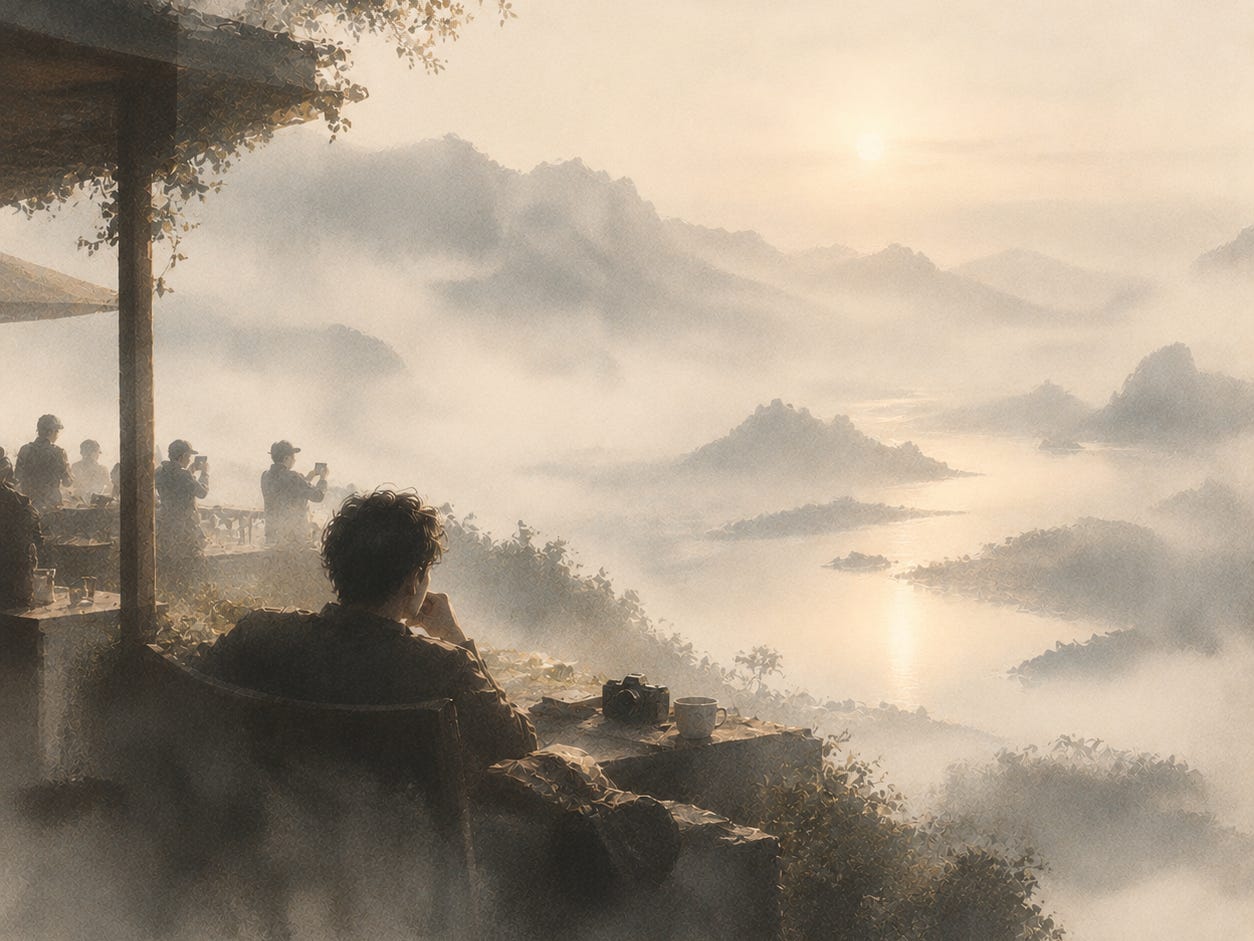
Going through old photos once, I found one from a few years back — a random evening, sitting on a rooftop with a friend watching the sunset. The clouds on the horizon happened to hang unusually low, the colors shifting fast, sinking from orange-red all the way into deep purple. Partway through talking, the two of us suddenly went quiet, just watching, saying nothing.
The wind had a slight chill to it, and neither of us suggested going back down. Later, going by that old photo, I specifically booked a “best sunset viewing spot” travel package — the same dusk hour, the same kind of company invited along, a location even more open than that old rooftop. But no matter what, that settling-into-quiet feeling never came. The view was beautiful, the camera turned out some very good photos — but that indescribable something didn’t come along with it.
It was only later I understood — this is the exact same thing as that ground-flat apple. A genuine stretch of time should be like a naturally ripened piece of fruit, carrying an unrepeatable contingency — the clouds happened to hang low that day, that silence happened to go unbroken, that breeze happened to carry a chill.
But once time has to be packaged into a product and placed on a shelf, it too first has to go through that same flattening process, turned into so many days and nights, so many experiences, a standard procedure, a clearly marked price.
The itinerary reads “one hour of dusk viewing,” and that hour really does arrive on schedule, the sun really does set on time, the tour guide can even announce right on cue, “the best photo moment is now.” But the one thing that belonged only to that particular evening, the silence that could never be reproduced — there’s no way to write that into the itinerary.
What’s even more unsettling is that once this flattening process is complete, what sits on the shelf is no longer that original stretch of time carrying contingency at all — it’s a processed substitute, capable of being mass-reproduced. The person who buys it does genuinely get “a stretch of time” — they really did sit there and watch the sunset, really did spend an hour, might even genuinely feel quite relaxed — but it isn’t that naturally grown kind of time, the kind that’s a little different every single time.
It’s more like that artificially ripened apple — the shape, the sweetness, the size, all meet the standard, indistinguishable from the other apples on the shelf, missing only the one thing that only natural growth could leave behind: the difference between this one and that one.
Time that can be placed on a shelf is, necessarily, no longer the kind of time that becomes unique through contingency. The shelf needs uniformity; life needs unevenness. The two grew, from the very start, out of two different logics.
Once time becomes a commodity, uniformly processed, uniformly placed on a shelf, what it loses is that uncertain sourness or sweetness that belonged to it, and only to it — and it’s exactly that uncertainty of sour and sweet that gives someone a reason to want to walk back into life, again and again, and taste it for themselves.