

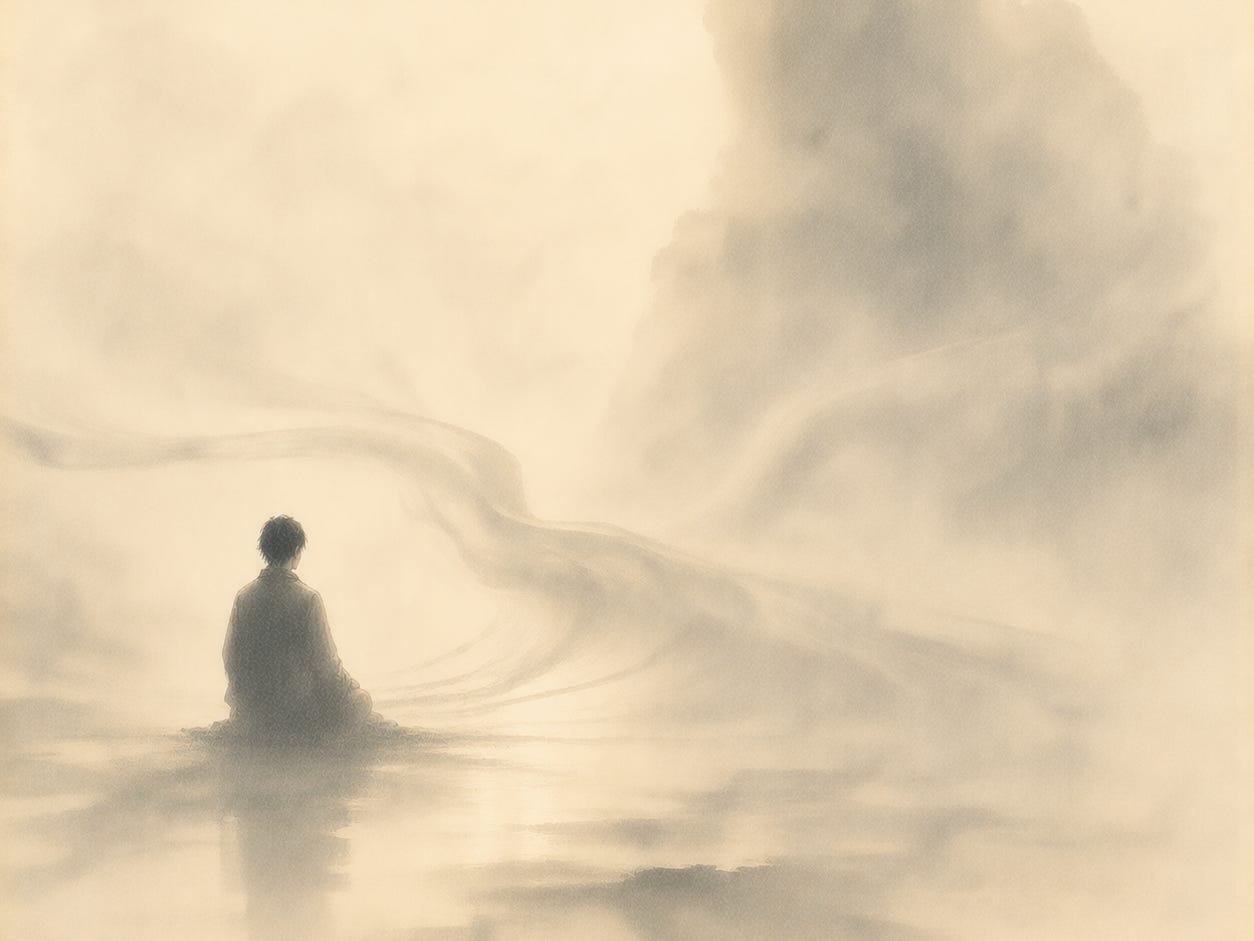
The first time I went to Paris, the Louvre was obviously on the list. I went right after lunch. Not long after going in, I came across a very large painting. I snapped a quick photo, glanced at the placard next to it. Good composition — it would look nice on my social feed. Kept walking.
Next to that painting there was a bench, and a woman was sitting on it, quietly looking at the painting. Probably a local. I didn’t think much of it, and kept moving — the Mona Lisa, the Venus, the Winged Victory. Photographed them, posted them, made the Louvre trip worthwhile.
On my way out, I passed that large painting again. The woman was still on the bench. I only had one reaction at the time: confusion. Hours, spent on a single painting — was it really worth it?
Later, working as a photographer at a media company, I went to art museums in Shanghai often, saw plenty of exhibitions. My approach never changed — see it, read the placard, understand what it’s trying to say, move to the next one. The feeling was very specific: I had finished this piece. Like something that stops being interesting the moment it’s in hand, and you have to go find the next one. I thought this was efficiency. I thought this was comprehension.
But there was one thing I could never figure out. That day at the Louvre, I understood a great many things — and now I can’t remember any of them. Yet that large painting I still can’t tell you the subject of, and that woman on the bench, have stayed lodged in my mind for well over a decade.
Everything I understood, I forgot. The painting I never finished has stayed with me the whole time.
This isn’t just a quirk of my memory. I slowly realized that this way of “see it, understand it, possess it, next” wasn’t a habit I’d developed on my own — I never actively chose it, it was simply already there. I used it to look at art, to read books, to approach almost anything that made me feel I “ought to be getting something out of it.” Trace it back to its source, and you find that this logic crept in with almost no sound at all — quietly enough to leave almost no trace.
It didn’t change overnight. It’s something the entire modern world has been doing for centuries — making everything transparent, explicable, fully graspable by human beings. The meaning of the world lies in being understood; understanding means mastering it; mastering it means you can move on and master something else. This logic lives in science, in education, in the cult of efficiency, in every “do you get it?” question ever asked. It’s the background color of all modern life, which is exactly why it’s invisible — the way a fish can’t see the water it swims in.
And then even art — the very domain that was supposed to resist this logic — got infiltrated too. The moment a work starts to believe its own value lies in conveying an idea that can be spoken aloud, in making people “get it,” in coming with an explanatory text attached — that’s the moment this logic has already gotten inside art. A work that can be fully explained is a success; one that can’t be pinned down is either a failure or accused of being pretentious. The critical apparatus, the exhibition system, art education — all of it reinforces this standard.
But what actually stays with you is precisely the part the placard could never fully capture. Calligraphy is an example close to home. Its charm comes from several things happening at once — the pictographic origins of the characters themselves, the flow of the calligrapher’s qi in that particular moment, the depth of time the work carries. None of this can ever be fully put into words. It can only be felt in the body, when you’re truly standing in front of the characters.
But today’s calligraphy exhibitions increasingly lean toward formal experiments and conceptual statements — deconstructing characters, exploring the randomness of ink, manufacturing visual tension. These things can be displayed, interpreted, written up in criticism. And qiyun — spirit-resonance, the living vitality a work carries — because it can never be fully put into words, gradually loses its place. It’s not that no one cares about qiyun. It’s that the logic demanding everything be explained is making it harder and harder to see.
So what was that woman in the Louvre actually doing? She wasn’t “finishing” anything. She wasn’t taking away anything portable, wasn’t understanding some point she could paraphrase to someone else, wasn’t taking a photo to post. She was simply sitting there, letting the painting keep working on her.
The tea ceremony works on the same logic. Its content is extremely simple — prepare the tea, whisk the tea, drink the tea. But the precision and care of the entire ritual go far beyond anything that “drinking tea” alone could explain. It isn’t conveying some idea. It’s changing the rhythm of the participant’s perception, creating a particular sensitivity to space, to vessels, to movement. That state can’t be carried away, can’t be paraphrased. It only exists inside the process itself.
This doesn’t require any special ability. It only requires one thing — stopping, for long enough, not rushing to finish it, not rushing to turn it into something portable, letting it actually work on you.
To this day, I still don’t know what that painting depicted, or who painted it. I only remember that it was large, that the woman sat in front of it, and that both times I passed by, she was still there. I possessed everything I understood that day, and then forgot all of it. The painting I never finished, and the woman on the bench — I’ve remembered them all along.
Maybe that’s the real way the painting worked on me. Not in the moment I understood it, but after it quietly left behind a mark I can’t explain. That mark isn’t information, isn’t knowledge, isn’t content you can post and send out. It’s just there.