

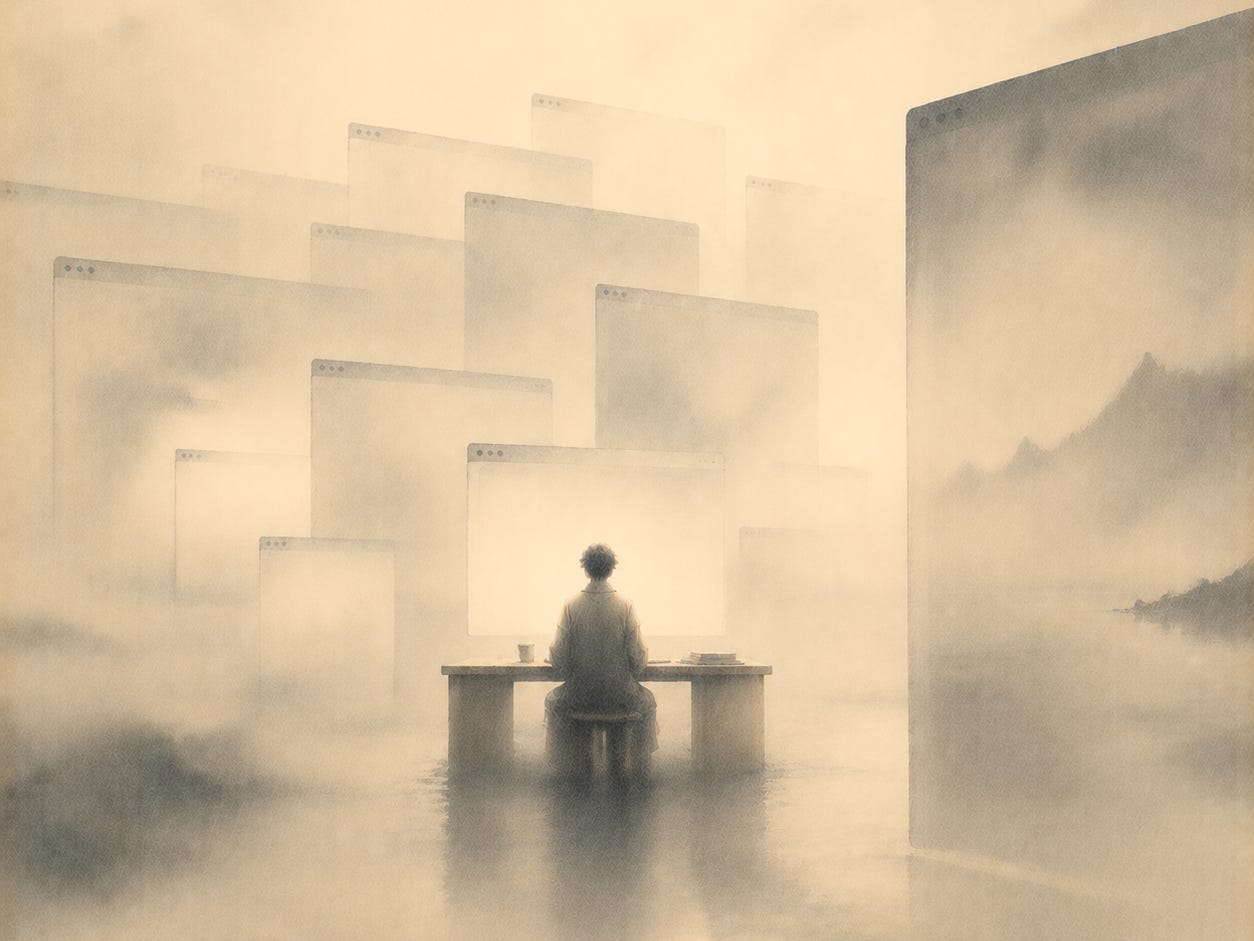
There’s a particular kind of quiet in an ICU hallway. Not really quiet — machines beep, footsteps pass, an intercom calls out numbers — but the deliberate, held-in quiet that people produce under extreme tension.
Family members sit in chairs in the hallway, waiting for news, not talking much, watching that door. Behind it, someone is intubated, hooked up to various machines, with professionals handling the matter. We’ve handed death off. Handed it to machines, to procedures, to people in white coats.
But when did this start? When did we start to feel that death was something that needed to be “handled”? Death used to happen at home. Family present, ritual, a farewell, a set way of bringing the whole thing to completion. Now it happens in a hospital, in an ICU, somewhere between the intubation tubes and the life-support machines, in that stretch of time family members spend waiting in the hallway for news. It’s not that one is “better.” It’s that their understanding of death is different at the root. One is completion. The other is failure.
Behind these two kinds of death are two completely different shapes of time. People who farm the land have an understanding of time that we can barely feel anymore — the end of winter isn’t a loss, it’s the precondition for spring. A field left fallow for a season is preparation for a better harvest next year. The end of one stage of life is the gestation of the next. Time is cyclical; every ending carries within it the seed of some beginning. Death has a place within this kind of time — not an end point, but a threshold, an entrance into the next cycle. This isn’t superstition. It’s a structure of time. Within this structure, death can be received, because a larger cycle holds it.
Modernity took this structure apart. Modern time is linear, one-directional — only forward, no looking back, no cycle. Progress, growth, acceleration, renewal — the entire logic of modern life is built on the premise that “moving forward is meaningful.” Time becomes a ray: it has a starting point but no endpoint, only an ever-extending stretch ahead. On this ray, there’s no cycle, and no place that can hold death.
A modern life is organized around a logic of production. You study in order to work. You work in order to accumulate. You accumulate in order to accumulate more. Within this logic, your time has a direction — you’re heading somewhere, you’re creating some kind of value, you’re moving forward. This logic has its own internal persuasiveness — you really are accumulating something, you really are heading somewhere, moving forward is meaningful because you’re building something.
And then death comes. In linear time, death isn’t completion — it’s a reset to zero. Not a threshold, but a wall. You spend your whole life building something, and then there’s nothing left. Not entering the next cycle, not providing the conditions for next year’s spring — just, nothing. At the end of this logic sits something the logic itself has no way to explain.
So we avoid it. It’s not that humans are innately afraid of death — people who lived inside cyclical time also died, but they had rituals, had funerals, had a set of symbolic practices to bring the matter to completion. Death, within that system, had dignity, could be faced directly, because it had its own place and meaning within the whole structure of time.
There’s no place in our structure of time that can hold death. Here, death is a leak, something that can never be integrated into the logic of “moving forward.” So we manage it with technology, postpone it with machines, move it out of the home and into the hospital, turn ritual into procedure, let professionals handle it, and try to keep it from disrupting the production that’s still underway. Death has become the most indecent thing there is, because it’s the most thorough negation of the entire logic.
So what is a funeral actually doing? What is Qingming — the festival for sweeping ancestors’ tombs — actually doing? The rituals surrounding death were never originally meant to just “handle the aftermath.” They give death an ending. They let it not just stop, but end — end completely, end with a shape, end in a way the living can integrate into their own understanding of time. They let the cycle close again, give grief a place to land, let the living know that this is over, and that it ended with dignity.
Without this completion, death is just a rupture, an inexplicable interruption, something you have to hurry up and stop thinking about. The rituals surrounding death — the ones many of us have grown unfamiliar with — may be doing exactly this. Not superstition, not mere custom, but an ancient way of telling everyone: this is over, and it ended completely, the way a complete thing should end. And these days, we rarely finish anything quite like that anymore.