

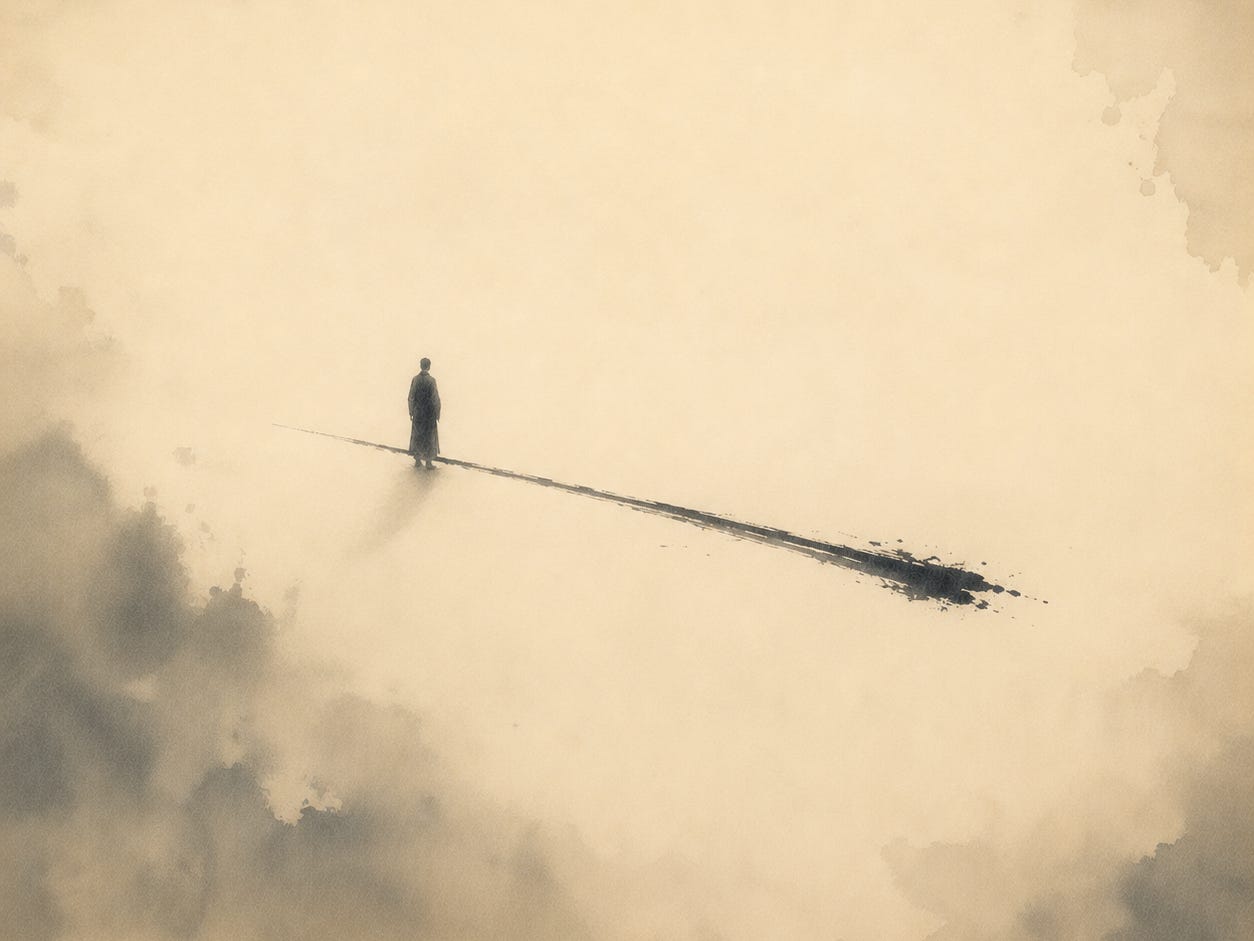
A blank sheet of paper sits in front of a painter. Right now, it could become anything at all — a sea, a face, a sentence. Every possibility is still intact, none of them ruled out.
This blankness looks like it’s nothing at all, but think about it carefully, and it’s actually the richest this piece of paper will ever be — it contains every possibility this paper could ever become, without a single one missing.
But the moment the painter actually puts down the first stroke, everything changes. That single stroke draws a line, and at the same time, quietly closes off thousands upon thousands of shapes this paper could otherwise have become — it can no longer be a sea, can no longer be a face, it can only become more and more like the thing currently being drawn. To put brush to paper is to create, and at the same time, to exclude — these two things have always happened together. No one gets to keep the first half without the second.
Thinking about it this way, “blankness” and “the specific” seem to stand, by nature, in two different positions — blankness contains every possibility; the specific can only ever be the one possibility chosen out of all of them, and choosing one means giving up every other. The further the painter goes, the more determined the paper becomes — but with every degree of determination gained, an equal degree of everything else it could have become is simultaneously shut off.
When a person starts believing solely in some specific god, some specific doctrine, they’re actually going through the exact same act of putting brush to paper. They really do get a clear answer, a shape they can rely on — but the price of that gain is that they must constantly exclude every possibility outside that answer, in order to keep that answer intact. “This is right, that is wrong” — this is nearly the unavoidable refrain of every specific belief system, not because believers are naturally fond of rejecting others, but because “the specific,” by its very nature, carries this quality of exclusion built into it from the start — just as, the moment that first stroke lands on the paper, the sea and the face and that sentence are all, together, struck out of that paper’s future at once.
This cost is rarely something people actually realize while they’re busy believing — they think what they’ve gained is simply an answer, without realizing that, at the very same time they gain that answer, the possibility that was once wide open is, bit by bit, being quietly closed by that very answer.
So why is it that so many specific belief systems, further down the line, end up needing constant reaffirmation, constant defense — almost never able to truly relax? Because that boundary was already drawn the moment the brush first touched the paper, and a boundary, by its very nature, is easy to challenge and always needs someone standing guard over it.
The more specific the object of a person’s belief is, the more clearly that boundary is drawn, and naturally, the more effort is needed to hold that line. A specific belief has to keep saying “this is right, that is wrong” just to maintain its own shape — this tension isn’t a sign that the believer isn’t devout enough. It’s a cost that “being specific” is fated to pay, no matter what.
So what would it look like if a person believed not in some specific object, but in the blank page itself, before any stroke has been made — not the sea that gets painted onto it, not the face, but the room, the latitude, that exists before any stroke ever falls, the capacity to become anything at all. This kind of belief sounds abstract, even a little hollow, because it has no specific object of belief that can be pointed at.
But precisely because it has no specific shape, it also has no boundary that needs to be constantly defended — no boundary, and there’s nothing that’s “wrong,” nothing that needs to be excluded. This kind of belief doesn’t need to belittle other possibilities to prove itself right, because it never shut any possibility out in the first place.
To believe in “nothing” may really mean believing in the blank page itself, before the first stroke — it doesn’t need to exclude anything, because it hasn’t yet become any specific shape at all. A person who truly believes in this blankness isn’t necessarily incapable of making specific choices in life, of putting down specific strokes — they’ll still have positions, still have preferences, still decide some things are more worth doing than others.
It’s just that, somewhere at the bottom of their heart, they keep hold of what that paper originally looked like, knowing that every stroke put down is only one temporarily chosen out of countless possibilities, not the one and only correct one. That remembering makes every stroke they draw a little lighter — not because they’re painting carelessly, but because they’ve never forgotten that the paper could once have become anything at all.