

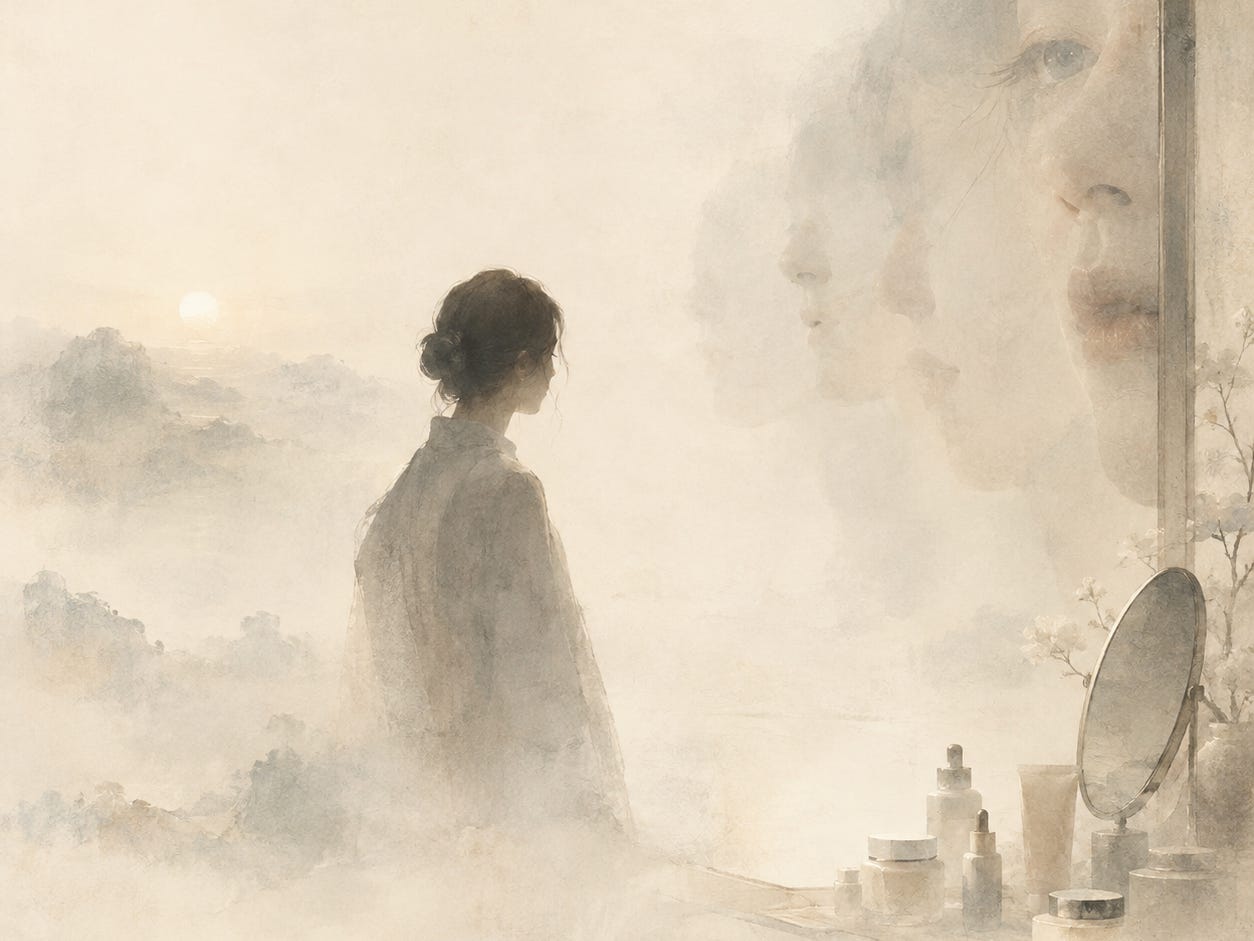
Advertisements keep hammering the same point — at forty, you should look thirty; at fifty, you should keep the stamina of someone thirty. Age, as a number, gets packaged into a war that has to be won, continuously, forever.
On the ad boards in elevators, the model is always in that “impossible to guess her age” state — skin taut, eyes bright, paired with a line like “reverse your age starting today.” The line is delivered with total certainty, as if aging were some accident that could be intercepted, rather than a place every single person is eventually going to arrive at.
What winning this war actually gets you is genuinely worth thinking through carefully. Health itself can be achieved through fairly simple means — eating well, sleeping well, enough daily movement, and the body naturally gives you the corresponding response, no need to maintain it with a pile of specific branded products. But what these ads are selling was never just health itself. It’s a sustained feeling of “not looking old yet,” a kind of eligibility to keep yourself inside the consumption cycle.
Behind this sustained feeling hides a fairly blunt piece of arithmetic. The more a person fears looking old, looking depleted of vitality, the more they need to keep buying, keep investing, to keep renewing that proof of “I’m still young.” Buy a bottle of serum today, apply it, and you feel settled for a few days. A few days later, look in the mirror, and there’s a new problem — a deeper line, a more visible spot — so you buy the next thing, renewing the proof once more.
This proof has a hidden property: it’s never a one-time purchase, because the body keeps quietly changing every single day. The product you bought yesterday has just started working, and today’s mirror already finds a new flaw. If this panic genuinely disappeared, the urgency to buy would disappear right along with it — no one keeps paying, over and over, for something that no longer frightens them.
This war was never really fought against wrinkles. It’s fought to maintain a state of ongoing anxiety, ongoing payment. Wrinkles are only the nominal enemy of this war. What’s actually being fed is that lingering unease, ready to be reignited by any single new line, at any moment.
Think about it the other way around — what would a person actually look like if they genuinely accepted that they were aging, no longer fixated on maintaining some illusion of youth? Not anxious, so no need to fight anxiety through consumption. No need to prove they “can still keep up,” so no need to relentlessly burn themselves out maintaining high-intensity output, no need to force themselves, when their stamina has clearly declined, to sign up for a marathon they genuinely can’t handle, just to post “still got it” to their feed.
This person looks in the mirror, sees the wrinkles and the gray hair, and feels none of that familiar sting inside. They simply know, calmly, that this is what they look like right now — the same way they’d know it’s three in the afternoon. Nothing to panic about.
Strangely, a person who seems to be living this at-ease often draws some vague, hard-to-pin-down judgment. Someone will say he’s not ambitious enough. Someone will worry on his behalf, thinking, “how could he just give up on himself like that.” Someone else will gently suggest, in a roundabout way, that he try some cosmetic treatment, get a gym membership — as if simply, honestly accepting one’s own age were the same thing as giving up the right to manage one’s own life.
This faint moral pressure is worth turning over carefully — a person who’s clearly in good spirits, living a fairly stable life, just no longer bothering to mask his age — how did that become something that needs to be counseled against, worried over?
Think about it closely, and you find this pressure was never actually about genuine concern for how this person is doing. If it were genuine concern, it would focus on whether he’s sleeping well, whether his mood feels open and easy — not on whether he has fine lines on his face.
This pressure looks more like an instinctive reaction from the system itself, a defense mechanism kicking in automatically. A person no longer driven by the idea “I must stay young” has, precisely, quietly slipped out of the entire operating logic. He doesn’t buy, doesn’t burn himself out, no longer needs to keep proving himself to feel secure. To the market, a person like this is almost impossible to convert into any kind of business at all. No matter how the billboard reads “reverse your age starting today,” it can’t stir a single ripple in him.
This also reveals something: this war against aging was never really fought against wrinkles and gray hair. It’s fought over whether a person stays inside the anxiety-driven cycle. Wrinkles have never actively hurt anyone — they grow quietly on a face, minding their own business. What actually keeps people tossing and turning is that vague feeling that the moment you stop, the moment you let up, you’ll be left behind, phased out.
An old person who’s no longer panicking is, to this system, the hardest kind of existence to monetize. He just stands there, buying nothing, anxious about nothing, and yet lives more soundly than most people still desperately chasing after youth. And this is exactly what exposes the truth: what this system genuinely fears was never aging itself. It’s a person who has truly figured out that you can live a good life without needing panic to drive it.