

Ordering delivery, you want it there instantly. Following a show, you can’t stand waiting for one new episode a week — you have to binge it all in one sitting. Falling for someone, you can hardly wait to lock down the relationship the same day. Reading an article halfway through, you want someone to just hand you the conclusion.
These habits are so common that almost no one thinks there’s anything wrong with them. If anything, there’s a quiet sense that this is a kind of ability — not dawdling, going straight after what you want, high efficiency, a decisive personality. Many people even offer it up as a virtue when describing themselves: “I’m just the kind of person who acts the moment I think of something.” In this kind of self-description, waiting is almost never treated as something worth practicing — only as a blank stretch of time to be shortened as much as possible, ideally skipped altogether.
The term for premature ejaculation isn’t a pleasant one, but the structure it describes is far more precise than its literal meaning suggests.
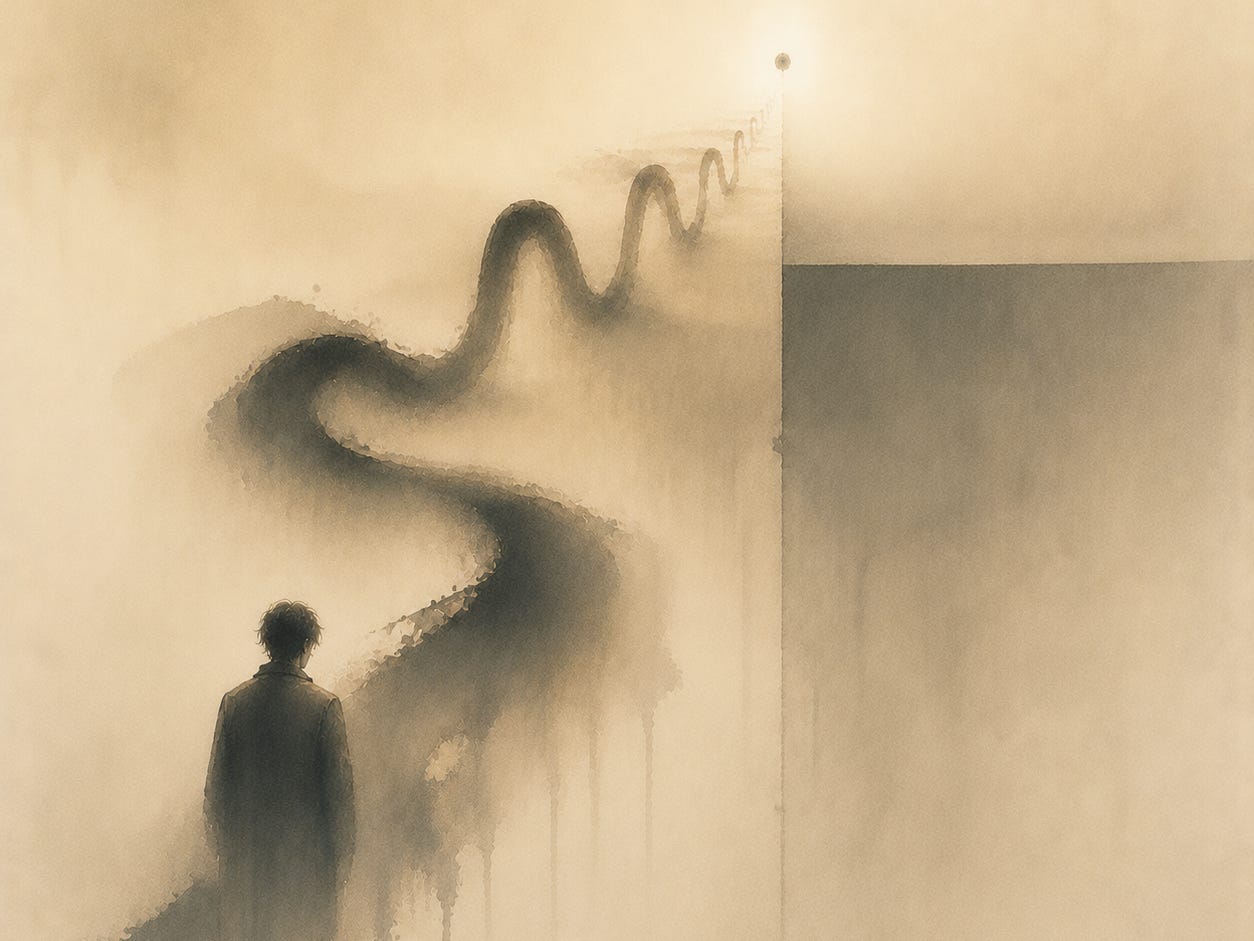
Its core problem was never “that sex happened” — it’s that the process that should exist — teasing, testing, alternating fast and slow, building, delaying — gets compressed until it nearly disappears. Under normal circumstances, this middle stretch is itself the core of the experience; pleasure is a stretched-out, undulating curve, rising and falling, building tension, then releasing it. What this term describes is that curve flattened into something almost vertical — jumping directly from stimulation to conclusion, leaving nothing in between, so the pleasure itself becomes extremely thin, barely leaving anything behind worth savoring.
Set this same structure back against the everyday habits from the opening, and you find exactly the same thing.
Delivery arriving instantly, a show binged in one sitting, a relationship locked down the moment you like someone — the problem here isn’t “desire being satisfied” either. It’s that “satisfaction comes so fast that the entire middle process of temptation, anticipation, and ritual waiting gets erased.” This kind of “too fast” was never efficiency, never progress — it’s a functional, faintly embarrassing deficiency. Just as that physiological condition was never taken as proof of strong ability, a society’s growing habit of instant gratification shouldn’t be taken by default as proof of civilizational progress either.
That’s a claim worth pausing on again. Because we’d never normally use the word “deficiency” to describe our own tendency to want something and need it immediately — the words we use are decisive, efficient, action-oriented. But if a person can’t tolerate any delay at all, can’t let an experience unfold slowly, is that really an ability — or is it something repackaged as a virtue after some other ability was lost? Think it through: how hard it is to tolerate uncertainty about one thing is really the same kind of tolerance as not being able to bear a relationship that hasn’t yet been confirmed, or a book whose ending you haven’t reached yet — it’s the same missing capacity for endurance, we’ve just never thought to treat them as the same thing.
That erased middle process was, in fact, always the most substantial part of the experience.
Holidays are something to look forward to precisely because they require long preparation and waiting — that waiting itself is part of what a holiday tastes like. If every surprise of Christmas were spoiled a month in advance, the day itself would probably lose most of its meaning. An unrequited crush keeps you tossing and turning precisely because that back-and-forth of wanting to say something and holding it back is itself the most intense moment of the whole feeling — the instant you confess and get an answer right away, that flavor actually fades a great deal, and some people even end up valuing it less, precisely because it came too easily. The slow process of a book gradually opening up to you is often more memorable than being handed its “central idea” directly — that process of piecing together understanding bit by bit is itself a large part of the pleasure of reading.
I’d even go so far as to say that holidays, crushes, and reading are all things humanity invented specifically to deliberately stretch out that middle process. Their entire value rests precisely on “not being too fast.” And now, many people are dismantling these stretched-out processes with their own hands, piece by piece, because they’ve come to treat “getting it instantly” as a given right — even as an ability worth pursuing, worth showing off, as if anyone who can wait must look clumsy, not decisive enough.
Try to recall the last time you felt impatient because you had to wait too long — and whether that impatience has quietly been reinterpreted as decisiveness and efficiency, as a matter of character.
That pride you take in “wanting something and getting it instantly” may not be a sign of stronger self-command at all — it may be that you already lost the patience to let something unfold slowly a long time ago. And that loss was never something that should have been called progress.