

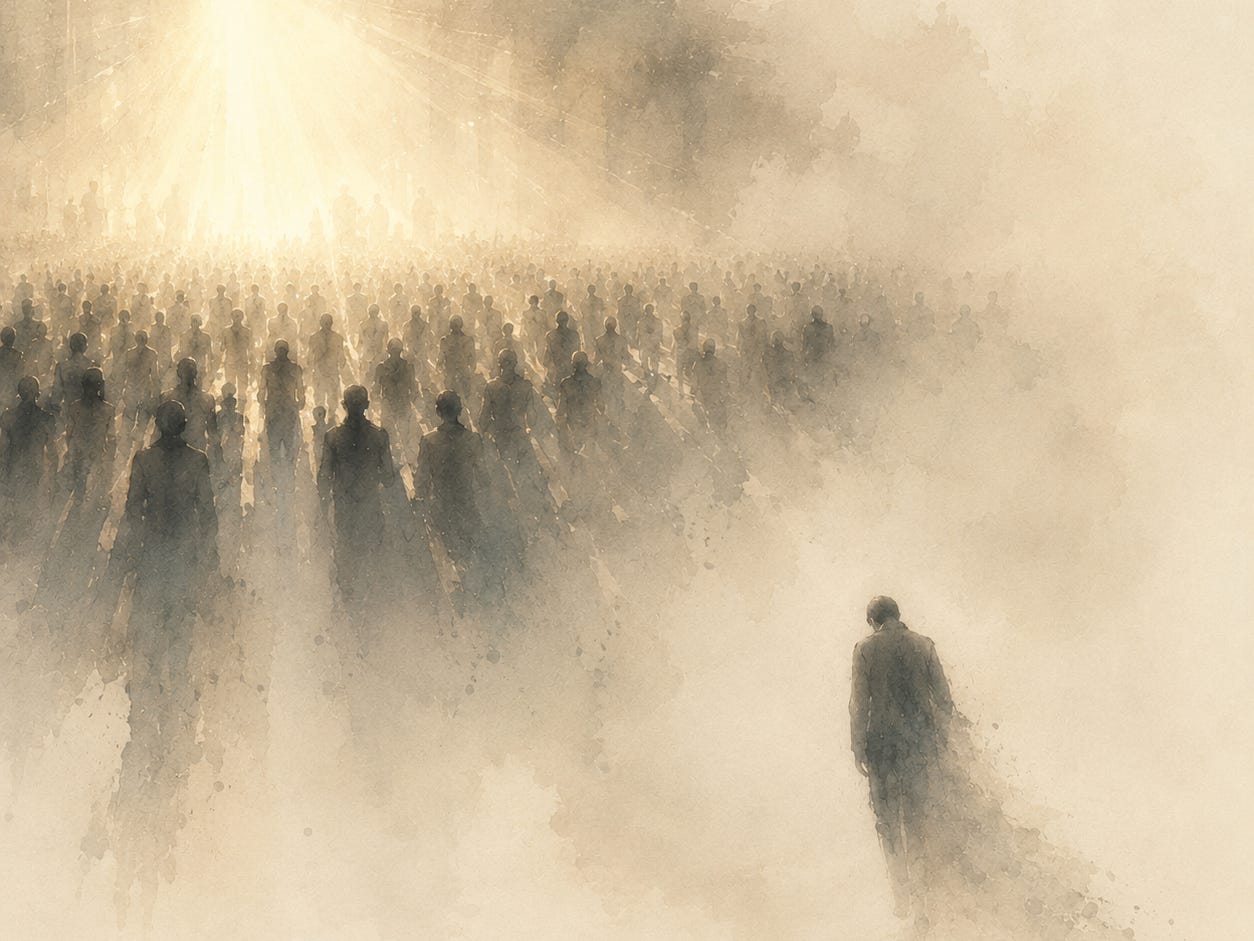
The concert ends, and tens of thousands of people flow out together, packed shoulder to shoulder — moments ago you were shouting the same lyric along with the entire crowd, the atmosphere blazing hot, a sea of light sticks swaying in unison. In that moment, it’s hard not to feel connected to everyone around you. You’re all inside the same song, the same emotion, all struck by the same instant at once. You might even feel that the stranger who was standing next to you a moment ago doesn’t seem so much like a stranger anymore.
Ten minutes after it ends, you call a car home. You don’t know a single person around you, and you probably never will again. That feeling of being wrapped inside one huge shared emotion starts fading the moment you walk out the venue doors. You look down at your phone, and your feed is full of that same show, the captions all sounding about the same — the excitement was real, but that excitement suddenly feels like it has nothing to do with you anymore. That drop feels strange — a moment ago you were sure you were with tens of thousands of people; how did you turn around and become just one person, alone?
Music festivals, pop-up stores, viral exhibitions — they’re all the same kind of thing. They’re a one-time stimulus, exciting, but they can be replaced at any moment by the next event just like it. This one ends, and next month there’s another; the theme changes, the venue changes, a whole new batch of people shows up, but the feeling is about the same, sometimes even more exciting. That photo-worthy wall you went to pose in front of will be torn down in a few months and replaced with an even trendier installation, and no one will feel any regret over its disappearance, because it was never built to last in the first place. There’s no real bond between the participants — they just happened to consume the same product at the same time. This isn’t anyone’s fault. It’s simply what this kind of event is — designed, from the start, to be replaced by the next one.
But this is exactly where the problem lies — it doesn’t always show up wearing this obvious a face. Some kinds of excitement look, on the surface, a lot like real connection. Take a concert built around the memories of people born in the ‘80s or ‘90s. Tens of thousands of people sing along together in a stadium, many of them crying, getting goosebumps, feeling suddenly pulled back into some particular era. That isn’t fake. There really is a generation’s youth in there, a stretch of time genuinely lived through together, a very real collective memory. You can’t just dismiss it as “consuming a one-off thrill,” because it genuinely touches something deep inside people. But this is exactly where things get most delicate. The feeling of being moved is real. The connection isn’t necessarily real at all.
There’s a difference here that’s easy to overlook. The connection at a concert is, more often than not, a refraction. The bond between you and the stranger crying next to you isn’t actually each other — it’s the cultural symbol on stage, the singer who grew up alongside you, those few songs that pull you back into the past the instant they start playing. You’re both resonating through one enormous cultural vessel. The thing you’re each moved by looks like it’s each other, but it’s really more like each of your own separate pasts being lit up, at the exact same moment, side by side.
So you’ll notice that the intimacy in a setting like this has a strangely weightless quality to it. Everyone sings together, shouts together, cries together — but the moment the lights come up and the show ends, that intimacy exits, fast. You leave the venue, and the people who were singing along with you a minute ago instantly become strangers again. What you shared was an emotion. Not a relationship. Real relationships don’t work this way.
Real relationships don’t need an external stage to mediate them. Old friends can sit together, and even if half an hour goes by without a word, that sense of steadiness is still there. Family gathers around a table to eat, the dishes about the same every year, the topics repeating themselves every year, even a little dull — but the connection doesn’t vanish the moment the meal is over. Because you yourselves, to each other, are the anchor.
This is exactly where the difference lies. The intense resonance at a concert is refracted through a cultural product; the connection between family and old friends is direct. You don’t recognize each other through some symbol — you’re simply, already, part of each other. Of course it also has its dull stretches, its hassles, its obligations, and it can even be exhausting sometimes, but it doesn’t depend on a performance to exist.
This also explains why something like a concert can be so addictive. What it offers is a togetherness that’s highly concentrated, but very light to carry. You can spend two hours surrounded by tens of thousands of people, struck by an old song, lifted back up by the memory of your youth — but once it’s over, you don’t have to answer to anyone, don’t have to maintain a relationship, don’t have to explain yourself, don’t have to shoulder tomorrow. It’s like a grand shared ritual, with the whole element of commitment deliberately removed.
This is exactly what makes it so modern. Modern people are growing more and more used to this kind of relationship: wanting intense resonance, without wanting to be tangled up in a real relationship. Wanting to well up with tears alongside a crowd of people, without wanting to take on long-term responsibility for any single one of them. So the culture industry has turned this need into a product — turned it into concerts, into brand collaboration exhibitions, into limited-time pop-ups, into every kind of “we all get it” emotional scene.
What it gives you is a prepackaged sense of community. But something prepackaged is, in the end, not the same as a real community. A real community isn’t just “we were moved in the same place, once.” It also means that tomorrow, the day after, many years from now, you still have some connection with these people that isn’t easily broken. That connection has commitment in it, has hassle in it, has responsibility, has long-term friction. It isn’t light. It’s even a little cumbersome. But it can pass through time.
What the culture industry offers strips all of this away. It keeps the excitement, keeps the resonance, keeps that feeling of “we really get each other,” but takes away the part that would actually require you to carry something. So, at the venue, you feel briefly like you belong to some vast group — but that feeling of belonging recedes fast, like a gust of wind, arriving hard and leaving just as quickly. What you get is emotional value. Not a bond.
This is the most hidden part of it. It doesn’t crudely deceive you — it satisfies you with extreme precision. It knows you’re lonely, knows you long to be understood, knows you want, at some moment, to sing loudly alongside a crowd of people, want to confirm, inside some atmosphere, that you’re not alone. So it gives you all of this, and gives it to you so precisely that it’s hard to spot the problem right away.
The problem is that this kind of connection is too light. Light enough that it can comfort you exactly when you need it most, while leaving almost no weight behind in your life at all. What can actually hold you up usually isn’t these highlight moments — it’s the specific relationships that look mundane, boring, even a little troublesome. It’s the meal you have together every year, the person who still reaches out every so often, the things that aren’t intense at all, but are simply there, year after year. They’re not as thrilling as a concert. But they’re still there, standing beside you, long after the excitement has faded away.
Out of every “many people together” occasion you’ve ever taken part in, is there even one where the connection was still there after it all ended? If you can’t think of one right away, it isn’t because you haven’t made enough friends. It’s because most of the places you’ve been were never designed to leave anything behind in the first place. And the reason you still get moved by them is that they resemble the real thing so closely.