

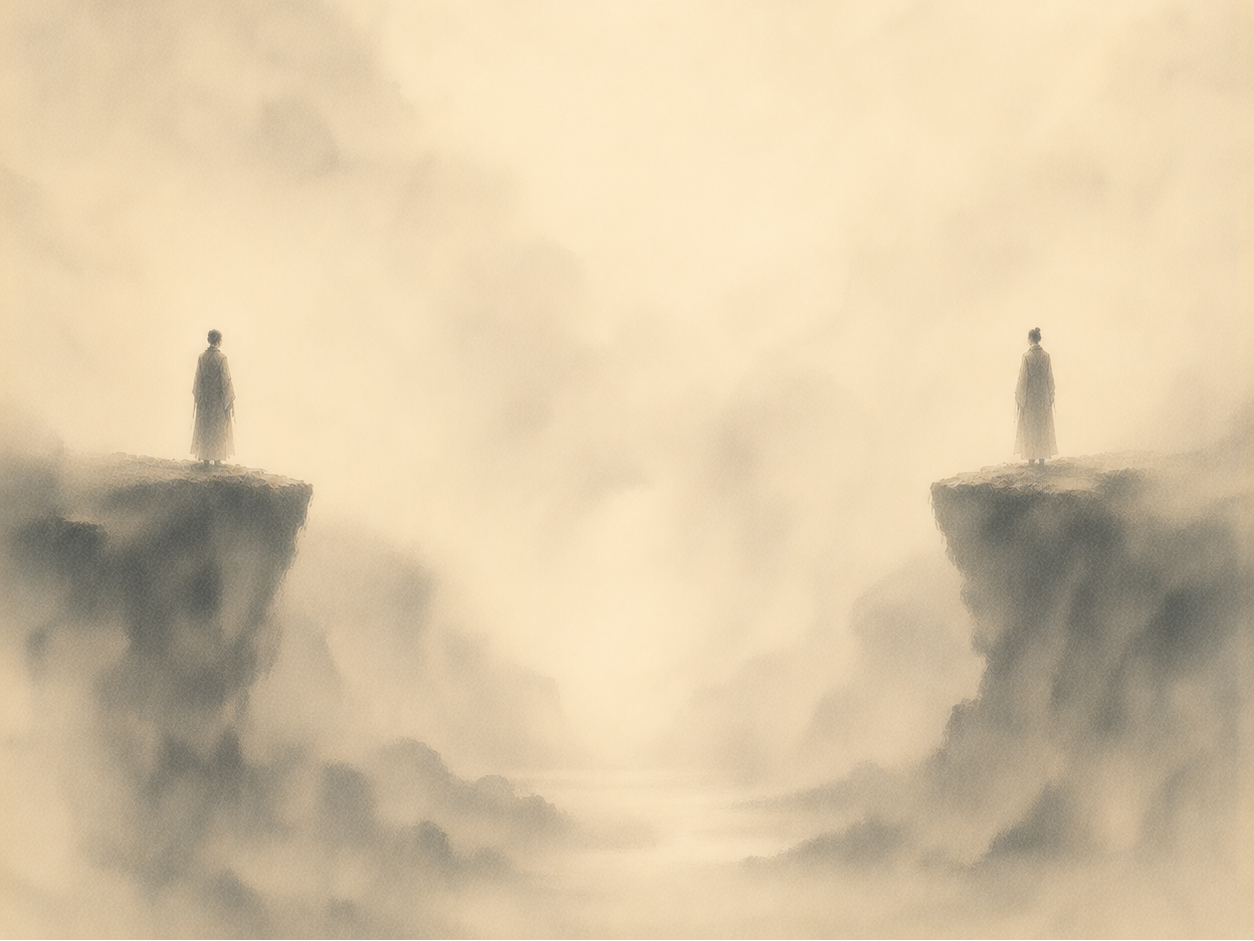
There’s something we rarely stop to think about. Trusting someone and knowing someone are, in fact, not the same thing. Sometimes the more you know about someone, the harder it actually is to feel at ease with them. Sometimes you barely know someone at all, and yet you’re inexplicably willing to hand certain things over to them.
Knowing can deepen trust, but knowing itself is not the same as trust. There’s always been a gap between the two. That gap is, in fact, exactly where trust actually happens.
Trust never really means “I fully know you, and so I believe you.” It’s closer to another state entirely: I can’t fully verify you, I don’t know what you’ll do in the places I can’t see, and I’m still choosing to keep this relationship open. It’s precisely the part that can’t be verified that gives believing any meaning at all.
If everything could be verified, trust wouldn’t be necessary at all — only checking would be. Trust exists because there’s always a region between two people that the other can’t enter, that data can never cover, a remainder left over no matter how transparent things become. In that space, you either choose to believe, or you choose not to. There’s no third option.
But the way we handle things today is to fill that space up entirely. Whatever can be tracked gets tracked, whatever can be logged gets logged, whatever can be made public gets made public, whatever can be quantified gets quantified. Behind this logic is a simple belief: if the information is complete enough, the relationship will become more reliable. It sounds reasonable enough. But quietly, it’s doing something else —It’s swapping trust out for verification.
Verification is not trust. “I believe you” and “I’ve checked your data and, for now, consider you credible” may feel similar, but they’re completely different in kind. The former is open — it’s staying connected inside uncertainty. The latter is conditional — a provisional agreement reached only after verification is complete. The former happens between people. The latter happens between a person and their data.
Once verification starts replacing trust, the relationship changes. Not into something safer, but into something more fragile — because it now depends entirely on the completeness of the data, and the moment any gap appears that can’t be verified, the relationship immediately falls into suspicion.
What’s more unsettling is that this is already happening everywhere, and we still think it’s progress. Two people who truly love each other don’t check each other’s phones every day. Not because they don’t care about anything, but because they’re willing to let the other keep a space they themselves can’t see into. That space isn’t a threat — it’s proof that trust genuinely exists. The moment two people start checking on each other, it isn’t a sign that trust has grown — it’s a sign that trust has already been shaken, and transparency is being used to fill the gap it left behind. Transparency tends to show up exactly when trust is already gone.
So today’s societal hunger for transparency is worth thinking about the other way around. We assume that demanding transparency is how we build trust. But it might be exactly the opposite: a society growing more and more frantic in its demand for transparency is precisely a society where trust has already collapsed on a massive scale. The stronger the hunger for transparency, the more it shows that people no longer know how to stay open in a state of “not seeing everything.”
Transparency isn’t the source of trust. It’s what we’ve learned to use to fill the space left behind once trust has died. And the more widespread it becomes, the harder it is for trust to grow back. Because once people get used to verifying with data, used to confirming through transparency, they gradually lose the ability to feel at ease in a place that can’t be verified at all. And that unverifiable place is precisely the one condition under which trust can ever happen.
This isn’t only about the relationship between two people. It’s also a kind of diagnosis of the entire structure of today’s society. When a society starts treating transparency as the default solution, when surveillance, disclosure, logging, and tracking become the first response to every problem, that society isn’t becoming more trusting. It’s using an ever more sophisticated mechanism to manage a world in which trust is growing thinner and thinner.
The problem isn’t transparency itself. The problem is that we’ve already started mistaking transparency for trust, without realizing that real trust has always grown in the place transparency can never reach.