

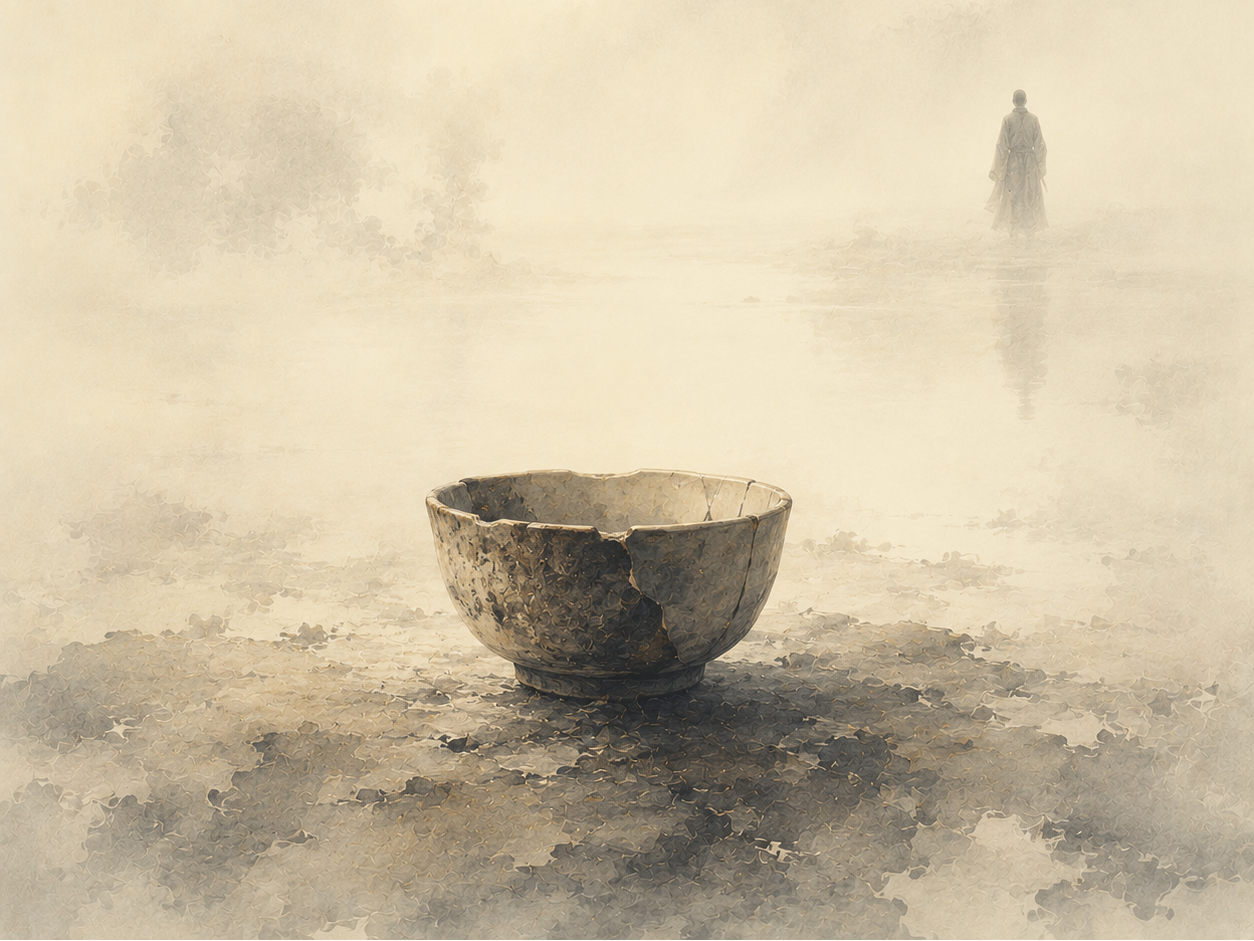
I have a wallet I bought ten years ago in the old city of Fez, Morocco.
Not from a tourist shop — from a stall run by an old craftsman in a narrow alley. Camel leather, hand-stitched, the seams not perfectly even, the edges not cleanly finished. I didn’t buy it because it was beautiful. I bought it for the feeling of holding it — soft leather, with weight, a texture that didn’t feel like it came from a factory, like someone’s hands had lived inside it.
Ten years later, it’s darkened. It’s softened. A faint sheen has worn into the edges.
Someone else might look at it and think: old, dirty, time to replace it. I like it more with every year. Not out of sentimentality — but because the texture keeps becoming more real. It carries the smell of that alley in the old city of Fez. It carries ten years of places I’ve been. It carries the slow impression of my hand’s shape on the leather.
A new wallet can’t give you this. Not because of price — because this isn’t something you buy. It’s something you use into existence.
This distinction is something the philosopher Hannah Arendt spent considerable space exploring.
She wrote that the human world is made of durable things. Not because people enjoy collecting, but because objects that outlast us connect past people and future people within the same shared world. An old table — your grandfather ate beside it, your children will eat beside it — it stands there, longer than any of us, bearing witness to time passing through. That fact itself is a form of stability.
Arendt had a precise image: people sitting around a shared table, the table both connecting them and keeping them apart, sustaining a kind of togetherness-with-distance. The table isn’t only furniture. It’s an objective foothold — it tells you that you and others stand together in the same stable reality, that there is something real between you, not only feeling, not only interest, but an actual table that exists.
The weight of things, their durability, the time that accumulates in them — these are the foundation of human existence.
But many of the things we use now are not things in this sense.
Byung-Chul Han calls them non-things.
A smartphone is not a more advanced object — it is something fundamentally different. An object has a surface, a back, scratches, a history. A smartphone has no surface, only an interface; no back, only a screen. You cannot build a relationship with it the way you build one with a camel-leather wallet, because its internal logic always points toward the next moment. Previous content is overwritten by current content. It doesn’t accumulate. It leaves no trace. It doesn’t deepen. The longer you use it, it won’t gain more stories — it will only get older, slower, more in need of replacement.
Objects gain weight the longer you use them. Non-things demand replacement the longer you use them.
This isn’t just an observation about product design.
It’s two fundamentally different logics of time.
More hidden is a reversal of power.
We think we’re using our phones. But the internal structure of the phone is designed for the phone to use us.
Algorithms decide what you see. Notifications decide when you stop. Recommendation systems decide your next move. You think you’re making choices — but the framework of those choices was set by someone else. Your attention, your time, your emotional states — these are not subjects in the face of non-things. They are resources. Things to be harvested.
It used to be that people governed objects. Now non-things lead people.
You sit there, phone in hand, feeling like everything is under your control. You are moving with a current engineered with extraordinary precision.
As the world of things is gradually replaced by the flow of non-things, something disappears — quietly enough that you might not notice it going:
That objective foothold.
The sense of standing together with others in the same stable reality. The sense of time accumulating beside you, rather than only passing through. The sense of having real connections to certain things, rather than only brief contact.
Life becomes a relentless flood of information. You’re pushed forward by the current — always in motion, always with content, always with response. But nothing truly belongs to you. Nothing truly persists. Nothing carries your mark.
This isn’t nostalgia. It’s losing ground.
It’s standing for a long time, and then suddenly finding there is nothing solid underfoot.
Is there still a real thing in your life?
Not the latest model. Not the best value. Something you’ve used for years, that has a story on it, that you can’t quite explain why you haven’t replaced.
If there is — take care of it.
It isn’t only an object. It’s proof that inside this endless forward current, you still have one piece of solid ground.