

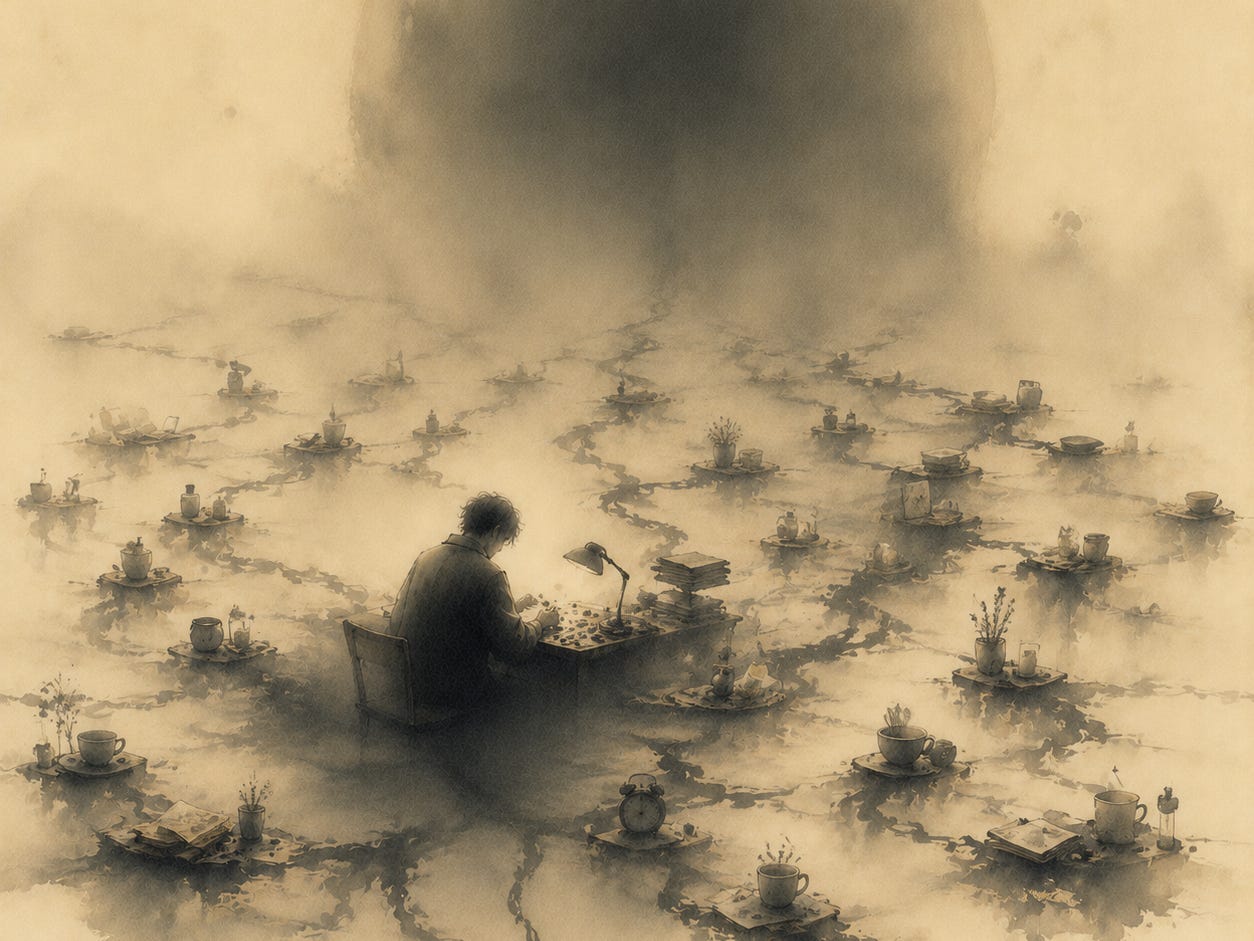
A lot of people have said this line, or at least heard someone else say it — “I’m just an anxious person, I overthink things.” When people say it, the tone usually carries a little helplessness, a little self-deprecation, as if describing an innate personality trait, something as inborn as your height or your taste in food.
But stop and look at this sentence a little longer, and you’ll find it doesn’t actually explain anything at all — it only describes a result, “I’m anxious easily,” without ever answering where that anxiety actually grew from.
When a person is genuinely overthinking, what they’re overthinking usually isn’t anything earth-shattering. It’s an email with a slightly harsh tone, read over three times, wondering whether there’s something meant between the lines. It’s one number on a checkup report, not really a big deal, slightly elevated, and you spend the whole night researching it online. It’s checking the door before you leave, again and again, even though it was already locked the very first time you checked.
Taken individually, each of these things is lighter than the last — light enough that it barely deserves to be called a “thing” at all. And yet it’s precisely these weightless little things that eat up an enormous, genuinely real amount of mental energy for so many people. That’s a bit strange, isn’t it — if the thing is really this small, why is the reaction this big?
The explanation that comes to mind most easily is that this person’s “mental fortitude isn’t very strong,” or that they’re “just sensitive.” This explanation is convenient — convenient enough that you barely need to think any further. That’s just how they are, nothing worth digging into. But if this explanation were correct, you’d expect to see a pattern — a sensitive person should be equally sensitive to every small thing.
But reality is often not like that. A lot of people stay unusually calm in the face of genuinely big things — they can take it, can hold up, can even keep steadier than most. And yet it’s precisely these petty, trivial matters that break them. This contradiction suggests the explanation of “sensitive personality” might be missing something more crucial.
If this overreaction to small things isn’t really a matter of personality, then it looks more like something else entirely, surfacing just a little, borrowing these small things as its vehicle. This sounds a little roundabout, but follow it through and it actually makes sense — an emotion that can be fully felt, called out by its proper name in the open — clearly knowing “I’m really scared right now” — at least has a concrete shape to it, something that can be faced, even spoken aloud, talked through with someone, or simply sat with for a while and then set down.
But a more fundamental fear, one that has never once been allowed to appear openly and legitimately, doesn’t disappear just because of that. It only finds a more fragmented, more scattered way to seep back out. That fear, very often, is the fear of death itself.
This might sound a little exaggerated at first — it’s just agonizing over an email, does it really need to be dragged all the way to something as big as death? But think carefully about death itself, and it has a particular quality — it’s too big, too final, and most people simply can’t stare at it directly, continuously; its weight exceeds what an everyday mind can bear for very long.
But here’s the problem: this fear doesn’t just disappear for no reason. It’s only pushed down, pressed into the cracks of daily life, and then it seeps back out, bit by bit, borrowing countless smaller, more concrete, more manageable things as its vehicle. A little pain, a little uncertainty, a little risk — the neural response these things trigger is, structurally, the same system triggered by actually facing death. It’s just that their “scale” is so much smaller — small enough that we hardly ever realize the tension we just went through and that fear buried deepest, almost never spoken of directly, come from the exact same source.
Heidegger said that a person is “Being-toward-death” — meaning that the awareness of death is embedded in every person’s structure of existence from the moment of birth. It isn’t something you only need to face at some specific moment — it’s a background that accompanies you the entire time.
If this background is always there, just pressed most of the time into a place beyond conscious awareness, that explains one thing — why that tension with no clear source almost never truly rests. It doesn’t need a big, specific reason to appear. Any small thing in daily life, a little bit of uncertainty, is enough to give it a gentle tug.
Looking back at “I’m just an anxious person, I overthink things” this way, you realize it actually has the direction backwards. The problem isn’t “this person overthinks.” The problem is: that truly heavy fear has never once been allowed to be felt in full. It can only surface, quietly, bit by bit, through one unremarkable little thing after another, then rapidly retreat again.
Anxiety, in a sense, isn’t a redundant emotional reaction — it’s the lowest-cost expression that a fear with no real outlet at all could ever find. Reducing this reaction to a simple “I’m just an overthinker” is the equivalent of shutting a deeper question down before it’s even asked. Once it’s shut down, that tension really does quiet down for a while — but it was never actually dealt with. It just found, once again, a more hidden place to hide.
If you genuinely want to understand why small things keep leaving you unsettled, you might try asking yourself a different question — not “why am I so anxious,” but: if this tension isn’t really about the thing right in front of you, what was it originally trying to say?
This question isn’t easy to answer, and it might even feel a little uncomfortable, because it means looking, one more time, at the place you usually never want to look at directly. But that one look might be the only thing that can actually let that tension loosen, even a little — not by pushing it back down, but by letting it, for the first time, actually be seen.