

The bluestone paving, the shopfront façades, the spacing between the lanterns, even the exact color temperature the lighting should be set to — all of it was marked out, clear as day, on the blueprints.
He and his team had stayed up through several nights drawing every line of it by hand. Coffee cups piled up in the corner of the conference room, the plan revised seven or eight times before it finally settled into what it is now.
The day the renovation was finished, he specifically brought his family to walk through it. Strolling down the old street he’d designed, a breeze picked up and set the lanterns swaying, casting small shadows.
He pointed at one particular corner and told his kid, they’d debated three different plans before settling on this one — a note of pride in his voice. That sense of accomplishment was real.
A street that used to be run-down, its tin signs rusted black, had become this — lanterns lit up, tourists holding up their phones, snapping away nonstop. Standing there in the crowd, the solid feeling of watching his own craft hold something up — that isn’t something you can fake.
A few years later, the neighborhood where his own hometown sat also launched a similar renovation project. When he went back, he made a point of turning first into the alley he used to frequent as a kid, still thinking about buying another bag of preserved plum candy from that little corner shop.
He turned that familiar corner — and the shop was gone. In its place stood a handicraft soap store in a uniform style, wooden sign, gold embossed lettering. He recognized the typeface instantly — it was the exact same font used on that old street he’d helped design years ago.
The same layout spacing, even the ratio of blank space on either side of the sign, all calculated from the exact same template. He stood there, frozen for a few seconds, still holding the things he’d brought for his parents.
That sense of familiarity was, at first, a little gratifying — it meant the plan was genuinely mature, genuinely effective, that even other teams taking it over were willing to follow the same logic. Proof it could hold up to scrutiny.
But standing at the mouth of his own hometown alley, that gratification didn’t hold for long — it soured fast. He could recognize the design logic, but he couldn’t recognize the alley anymore. The road was still the road, the wall was still the wall, even the old tree at the corner was still there. But the life that used to fill both sides of the road had been swapped out for something else entirely.
That familiarity wasn’t the familiarity of coming home — it was recognizing a template he himself had once had a hand in, one that had now been stamped onto a place that was supposed to belong to his own childhood. Like seeing, on someone else’s face, makeup he himself had once applied.
He suddenly realized that what he’d been doing, this whole time, was never really renovating any one specific street. It was taking an entire piece of logic — “how to make a space more convenient for displaying merchandise” — and copying and pasting it, over and over, onto different place-names.
What lay beneath the bluestone paving underfoot was no longer this particular street’s own memory at all. It was a template he and his colleagues had written together, one that could be dropped onto anywhere — just swap in a new place-name, and it would run, and once it ran, it would end up looking more or less the same everywhere.
What hurt most, maybe, was that he had no way to lock this logic away at other people’s hometowns and leave his own as an exception. Because once this system starts running, it doesn’t pick and choose places, doesn’t recognize people. It uniformly turns every corner suitable for renovation into the same shape, including the very alley he grew up in.
He’d never once thought to touch his own home, had never signed his name to any plan for this street. But this logic never needed his consent. It pushes forward at its own pace, and wherever it reaches, the signs get swapped for the same font, the corner shops turn into the same handicraft soap stores, and as it pushes forward, it never once stops to ask whether this happens to be someone’s hometown.
He raised a hand and touched the edge of the new sign. The wood had been distressed to look old, but it still carried the roughness of raw new timber under his fingertips — he could feel the trace of sandpaper. It was nothing like the texture he remembered, the wooden threshold of that old corner shop, worn smooth and glossy by countless hands over the years.
So what he’d built was maybe never a street at all. It was a method that could swallow any street whatsoever. And when that method came back to his own doorstep, it showed him no mercy at all. Standing at the mouth of the alley, he couldn’t pretend anymore to be the one steering this renovation.
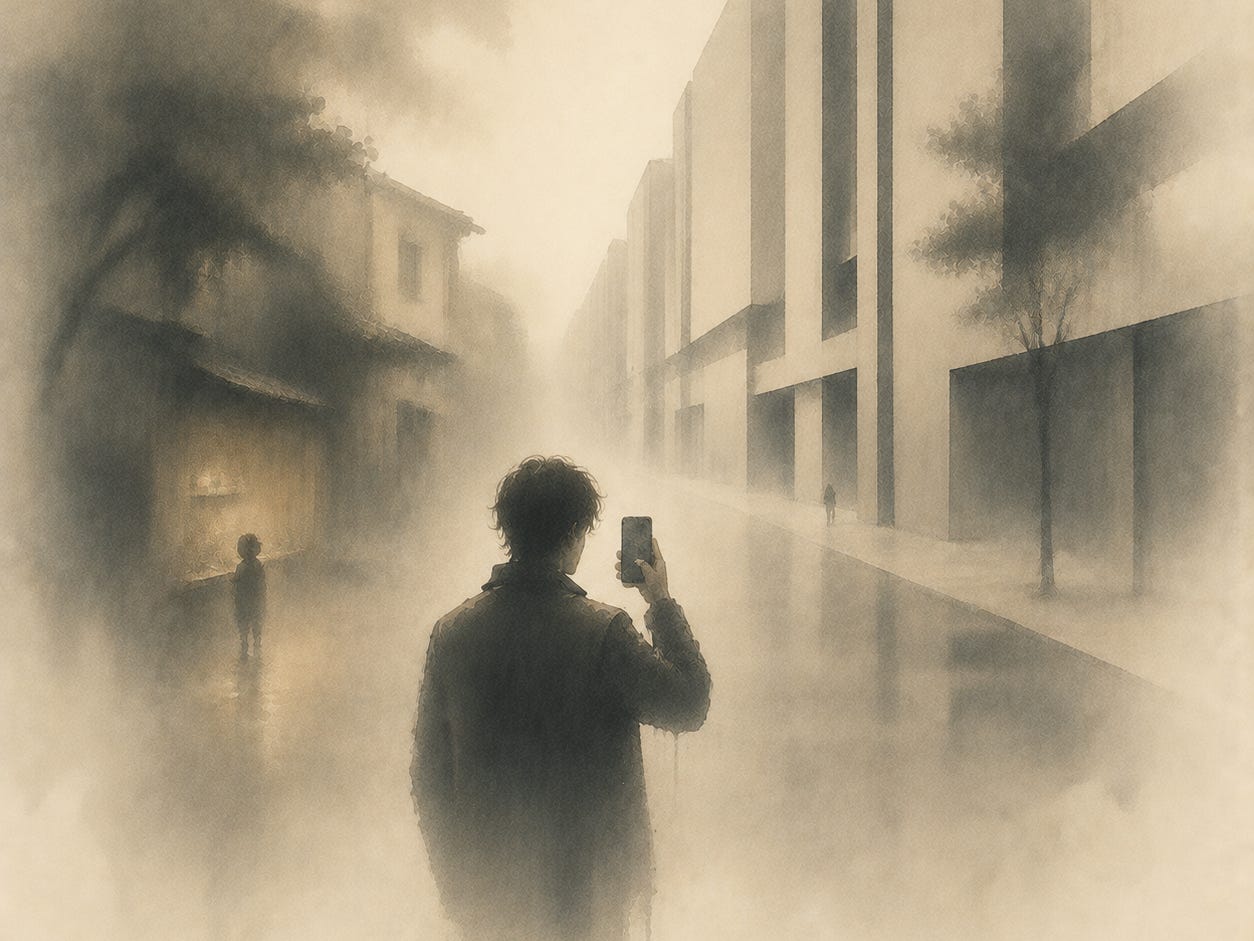
Right now, he was standing in the exact same position as any tourist visiting this alley for the first time to snap a photo — raising his phone to capture the gold-embossed new sign, from the exact same angle everyone else did, even the composition matching the sample images he himself used to walk his team through, back when he was explaining the plan.
He used to stand in front of the blueprints believing he was the author of this logic. But standing in this alley he could barely recognize anymore, he finally understood — this logic had stopped needing an author a long time ago. All it needed was one street after another for it to pass through. And once it passed through, it left behind the same signs, the same lanterns, and the same unrecognizable street corners.