

A bio field on some social app, or the self-introduction in a job interview — the question is always the same: tell us what makes you different.
You think about it, and mention a hobby, an experience, a personality trait. Here’s something you’ve probably never thought closely about — every “different” thing you name has to be something the other person can actually understand, can measure against something, can quietly score in their head as “this person’s kind of special.” If what you say is completely incomprehensible to them, they won’t think you’re special — they’ll just think you’re a little odd, and the conversation will end quickly.
“Different from everyone else” — from the very start, this phrase requires that you first be placeable on a chart, and only then stick out from it a little.
Everyone is trying desperately to seem authentic, to seem like “themselves,” and this desire has almost entirely been translated into a single thing: being different from other people. But the judgment “different” can never exist on its own. It has to attach itself to some shared coordinate system — for you to call yourself unique, there first has to be an axis everyone recognizes, and you occupy a point on that axis that’s different from most people’s. You can say you’re “opinionated,” because “wishy-washy” sits at the other end of that same axis; you can say your “taste is unusual,” because you already know what most people’s taste looks like.
This points to something deflating: pursuing uniqueness is, in fact, an act of acknowledging — and reinforcing — the very system that allows everyone to be ranked, scored, and compared. The more you want to seem special, the more you need that coordinate system to keep running, because otherwise your “specialness” has nowhere to land at all. This isn’t a victory for difference. It’s a victory for the logic of comparison, just dressed up in the costume of “I’m being authentic,” making you think you’re rebelling against something.
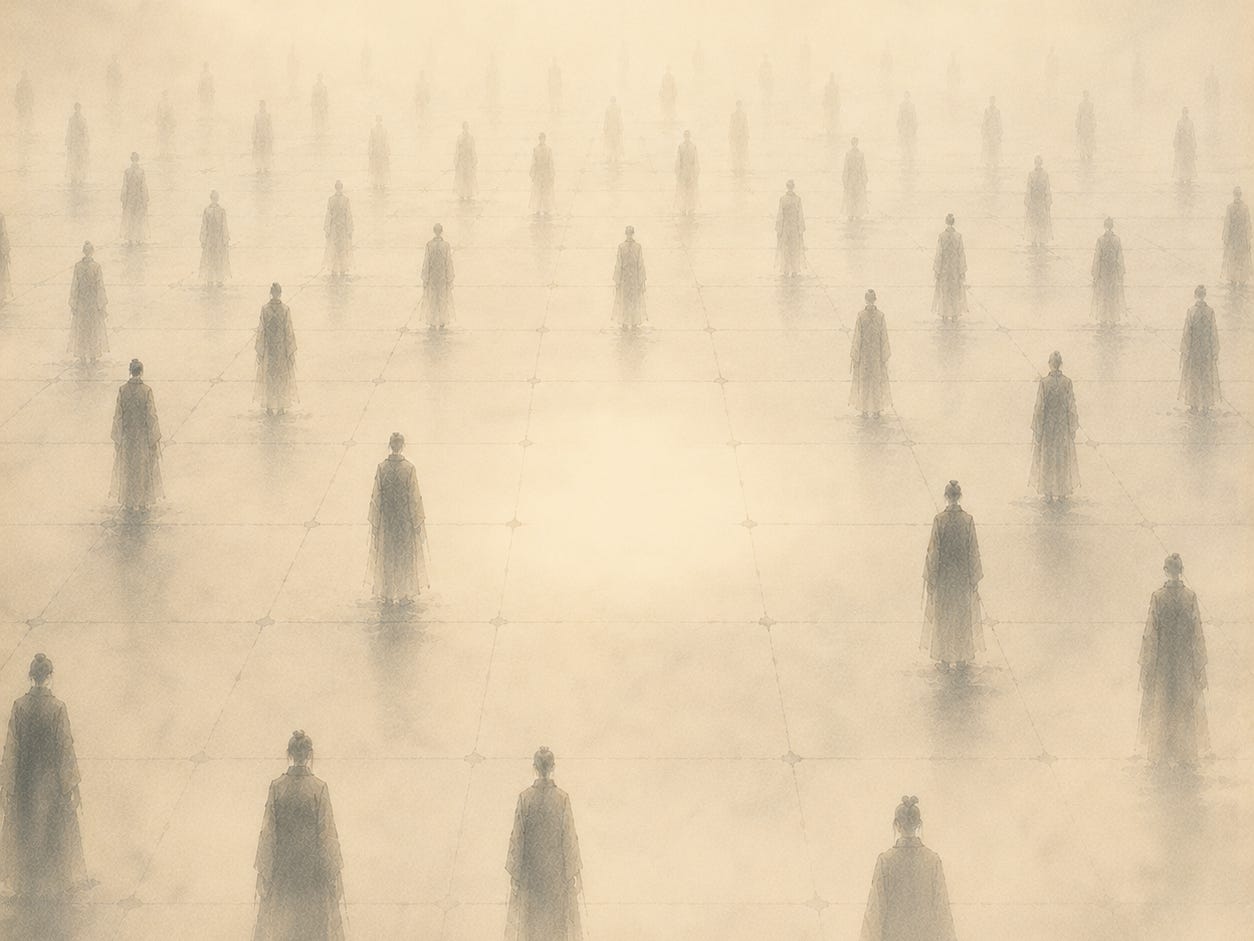
Socrates was once described with a single word — atopos. It means: having no place. Imagine a person you cannot describe using any existing standard whatsoever. Not “he’s special,” not “he’s different from others” — every axis in your head for describing people — clever, eccentric, interesting, profound — none of them apply, because he simply isn’t on that map at all.
This is the real meaning of “having no place.” It isn’t occupying some extreme position on the coordinate system — it’s that there’s no coordinate to place him on at all. Socrates wasn’t the most “unique” person in Athens at the time — if he had been, he could have been understood, categorized, remembered as some “type,” the way later ages remember some particular style of philosopher. What actually unsettled people about him was that he couldn’t be compared to anything. People couldn’t even find the right word to describe what kind of person he was — all they could say was that he was strange, using a word with no content to point at a being that exceeded all content.
And the thing this era is best at is eliminating “incomparability” right at the entrance, before it ever gets in. On the surface, we seem to live in an age that celebrates difference like never before — encouraging you to express yourself, to live authentically, to be different. But what this system can actually tolerate is only “difference that conforms to the norm.” You’re allowed a niche hobby, but it has to be sayable, understandable, something others can quietly file away as “oh, that type of person”; you’re allowed a distinctive style, but it has to be photographable, displayable, clickable, likeable — in essence, consumable.
And the kind of absolute difference that truly cannot be categorized, cannot be compared, cannot be reduced to a single sentence like “this person is such-and-such” — that atopos kind of existence — was never even on the shortlist to begin with. It hasn’t been suppressed. It was simply never seen by this logic in the first place, because the logic’s entire operating premise is that everything can be compared. Anything incomparable is, to this logic, equivalent to nonexistent.
Authenticity was supposed to point toward difference, but what it actually does is the exact opposite — it has everyone occupy a good-looking, understandable point on the very same coordinate system, and calls that “being yourself.” Beneath the appearance of a thousand different faces lies a thousand people sharing the exact same grammar, the grammar that makes “difference” visible, comparable, likeable.
If Socrates were alive today, he probably couldn’t get through a single job interview’s self-introduction — not because he wasn’t good enough, but because the interviewer would never find a coordinate to place him on the scoring sheet.
“Being yourself,” the thing most of us practice so hard at, is, when it comes down to it, just practicing how to strike a good-looking, understandable angle on that same chart. The truly uncategorizable never needs to be accepted by the chart. It doesn’t need that chart to exist at all.