

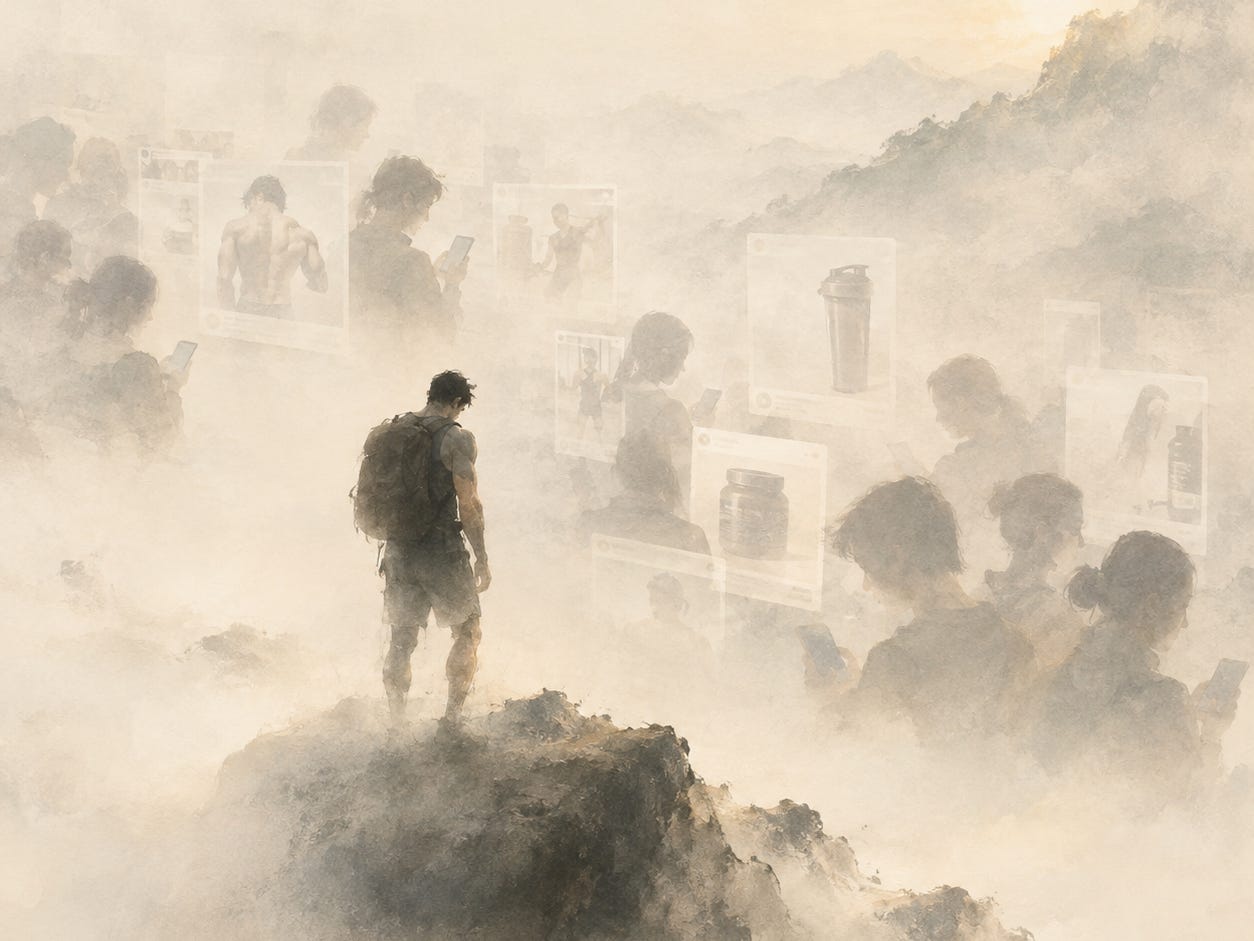
Someone posts a photo of their feet, blistered from running — toenails gone purple, heels rubbed raw and red — the caption written with real pride, saying this is what genuinely pushing yourself actually looks like. Plenty of people post themselves lifting weights until their hands shake, the caption usually something like “today’s version of me really gave it everything” — and the likes pile up underneath.
Think about this phenomenon a little, and it’s actually somewhat strange. Under normal circumstances, a person’s first instinct when they suffer is to deal with it quickly, to want to avoid it — no one wants to actively show off their own rough state. But here, the pain isn’t hidden at all. It gets earnestly photographed, edited, captioned, and deliberately put on display, for as many people as possible to see. Pain goes from a private discomfort belonging only to yourself, into a public exhibit.
What makes pain worth displaying is that it’s been reclassified. As long as it’s no longer treated as an ordeal that needs sympathy, comfort, but instead treated as proof of willpower — proof that this person can endure more than most, understands discipline better, deserves the words “getting better” more than others do. Once it’s reclassified this way, the act of posting it about-faces entirely — no longer complaining, it’s boasting, a measured, dignified kind of pride.
And once this boasting gets liked, gets validated, it doesn’t stay still. The more likes it gets, the more it inspires more people to go find a similar kind of pain to show off — training until they throw up, until their legs give out, until they need to hold the railing walking downstairs the next day. This exhaustion, which was originally supposed to be resolved through rest, slowly turns into material that needs to be actively manufactured and traded for validation.
And this is when some strange scenes start to appear — someone deliberately doing a few extra sets just to get a more convincing photo of soreness. Pain stops being a side effect of exercise and becomes the goal itself — deciding what to photograph first, then working backward to make the body endure the corresponding amount.
The fact that pain can be turned into a boast shows it has already been redefined as a virtue, rather than something worth questioning. A hardship that should, by rights, make someone frown, once packaged as admirable persistence, makes the very thought of asking whether it was necessary at all start to feel out of place.
And once a competition like this gets going, you’ll find the people standing on stage aren’t only the ones gritting their teeth for photos. Gyms and supplement brands make money off this enthusiasm for competitive suffering — whether a tub of protein powder sells or not largely depends on how many people are willing to believe that taking it long-term, combined with training, will earn them that liked, celebrated pride in their feed.
The platforms hosting all this content get their traffic off this intense engagement — a post showing off pain usually earns more attention than one showing an easy, ordinary day, so the platform naturally becomes more willing to push this kind of content to more people. The fiercer this competition over who can endure the most becomes, the more all these parties get to divide up between them.
But get down to any specific person gritting their teeth for a photo of their own sore expression, and what they actually get is usually just a few dozen likes and a handful of comments — “you’re really pushing yourself,” “inspired by you.” That payoff doesn’t seem quite proportional to a pair of genuinely blistered feet.
So once a competition over who can endure the most gets moving, the ones who actually come out ahead with nothing to lose were, it seems, never the participants gritting their teeth out on the track. It’s the spectators standing along the sidelines, steadily collecting money and traffic off this enthusiasm — they don’t even need to step onto the track and taste a single bit of the suffering themselves. All they need to do is stand off to the side and make the competition a little more exciting.
Those blistered feet are still real. That sense of accomplishment from seeing something through is still worth being happy about. But the next time your finger’s about to press the shutter, it might be worth asking yourself one more question first — is this photo really a keepsake meant for your own eyes, or has it, without your quite noticing, already become material prepared to be handed over, in exchange for something in return?