

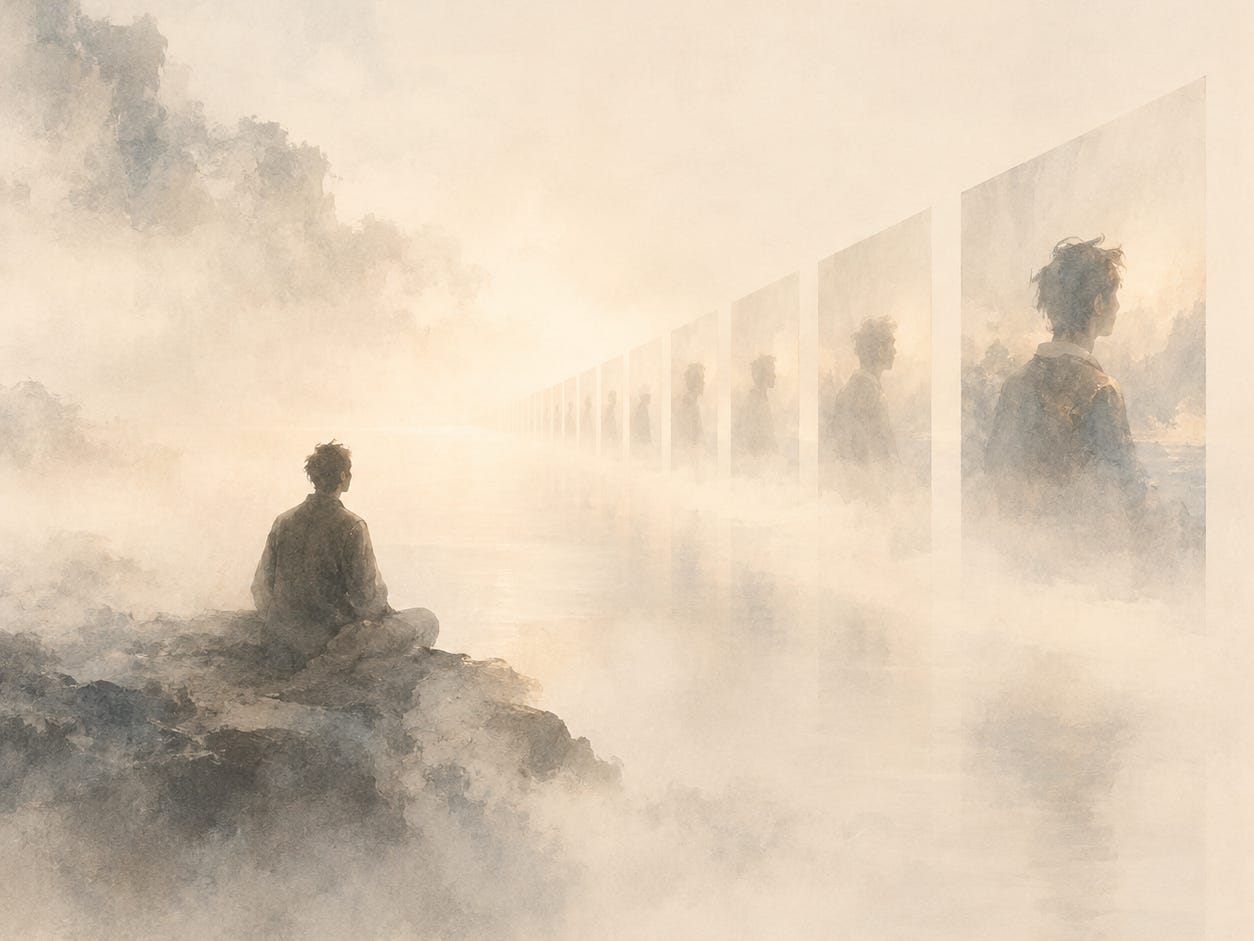
Scrolling your phone late at night, one video swipes past — what it was about, what numbers flashed across the screen, you basically can’t remember any of it a few seconds later. Your finger keeps swiping down, one video after another, none of them ever really taken in.
That day, on one particular video, the phone suddenly buzzed — a message popped up, a finger pressed down, and the screen just froze there. And it’s exactly in that frozen instant that a line from the video a moment ago — one that had flashed by in a blur — suddenly surfaces, clear as day: wait, that number seems way off. That line had already drifted past your ears seconds earlier, with no reaction at all at the time. Why is it that it only actually got heard, really heard, the instant the screen happened to freeze?
This time lag is worth turning over. The line itself never changed — it was the exact same line before and after. What changed was only whether the screen happened to be moving or frozen at the moment it appeared. The thing was there the whole time; the reaction only arrived late, and only after a pause showed up. This suggests the doubt was never actually called forth by the content itself — it was called forth by the gap that an accidental pause forced open, out of nowhere.
Think back to the experience of reading an article — hit a line that overstates something, and a knot ties itself in your head too. But when you’re reading, no one’s popping up a message for you, no one’s interrupting — and that knot still manages to tie itself.
Reading itself is a process made of pausing, sentence by sentence; the pause is built into the motion itself, no external reason needed to summon it.
Video isn’t like that. It never stops on its own — it needs some outside force, a pop-up notification, a lag, a misclick, to conjure a gap out of thin air that wasn’t there to begin with. Text comes with this gap built in. Video doesn’t. Video needs luck to stumble into one.
Seen this way, the problem was probably never whether the content told the truth or not — it’s whether it left you any gap you could actually question it in. A piece of text naturally carries this kind of gap — between one sentence and the next, between one paragraph and the next, these are all natural pause points. Even if the reader never deliberately uses them, these pauses are always sitting there, ready to be used at any time.
A video edited airtight, from beginning to end, has none of these gaps — it even deliberately cuts them out. Every editor knows: the moment a shot pauses for more than a fraction of a second, viewers swipe away. So these pauses that should have belonged to the viewer get treated as excess, cut before anyone even gets there, and the reason for cutting them sounds entirely legitimate — no one thinks of it as a problem, some might even call the clean, tight editing a mark of professionalism.
This discovery means that whether doubt gets to surface at all was never, from the very beginning, decided by whether the content deserved to be questioned. It was decided by whether the hands at the editing table were willing to leave a gap for it. And what those hands at the editing table are actually weighing was never whether to leave the viewer room to think — it’s how to keep someone watching, keep them from swiping away. These two goals run in opposite directions by their very nature.
And more and more content today is designed precisely along the lines of how to leave no gaps at all. The tighter the pace, the fewer the gaps in between, and the doubt that was supposed to surface gets systematically squeezed out of existence.
This isn’t some single video accidentally achieving this — the entire logic of content production is being optimized in this exact direction. Content full of pauses can’t hold an audience; content with few pauses is what keeps people swiping. Over time, what survives is the airtight kind, and the content that would have naturally left gaps gets eliminated in this competition instead, slowly vanishing from the recommendation feed, judged by the algorithm as having a pace that isn’t good enough.
By the time you actually catch on, the content has already landed and taken effect. This “catching on” is usually just some moment, long after you’ve already swiped away, when it suddenly strikes you that something felt off about it. Maybe you’re lying down about to fall asleep, and you suddenly recall that some video you watched during the day doesn’t actually hold up under scrutiny. But by then, the emotion has already passed, you may have already shared it — and that belated doubt, aside from leaving you with a slightly bad taste in your mouth, changes nothing at all.
So what’s truly worth paying attention to isn’t only what a piece of content says. It’s whether it quietly took away a pause that was supposed to be yours. Taking it away once doesn’t mean much — everyone gets caught up in the moment and forgets to think it through sometimes; scrolling through dozens of posts a day, you were never expecting to stay sharp on every single one anyway.
But take it away enough times, and a person forgets they ever had this pause to begin with — forgets they could have left a bit of space between every sentence, for that doubt to slowly surface in. It’s only on some day when you genuinely need it to show up right on time that you discover this pause, once such a familiar habit, hasn’t been used in so long that it’s hard to find again.