

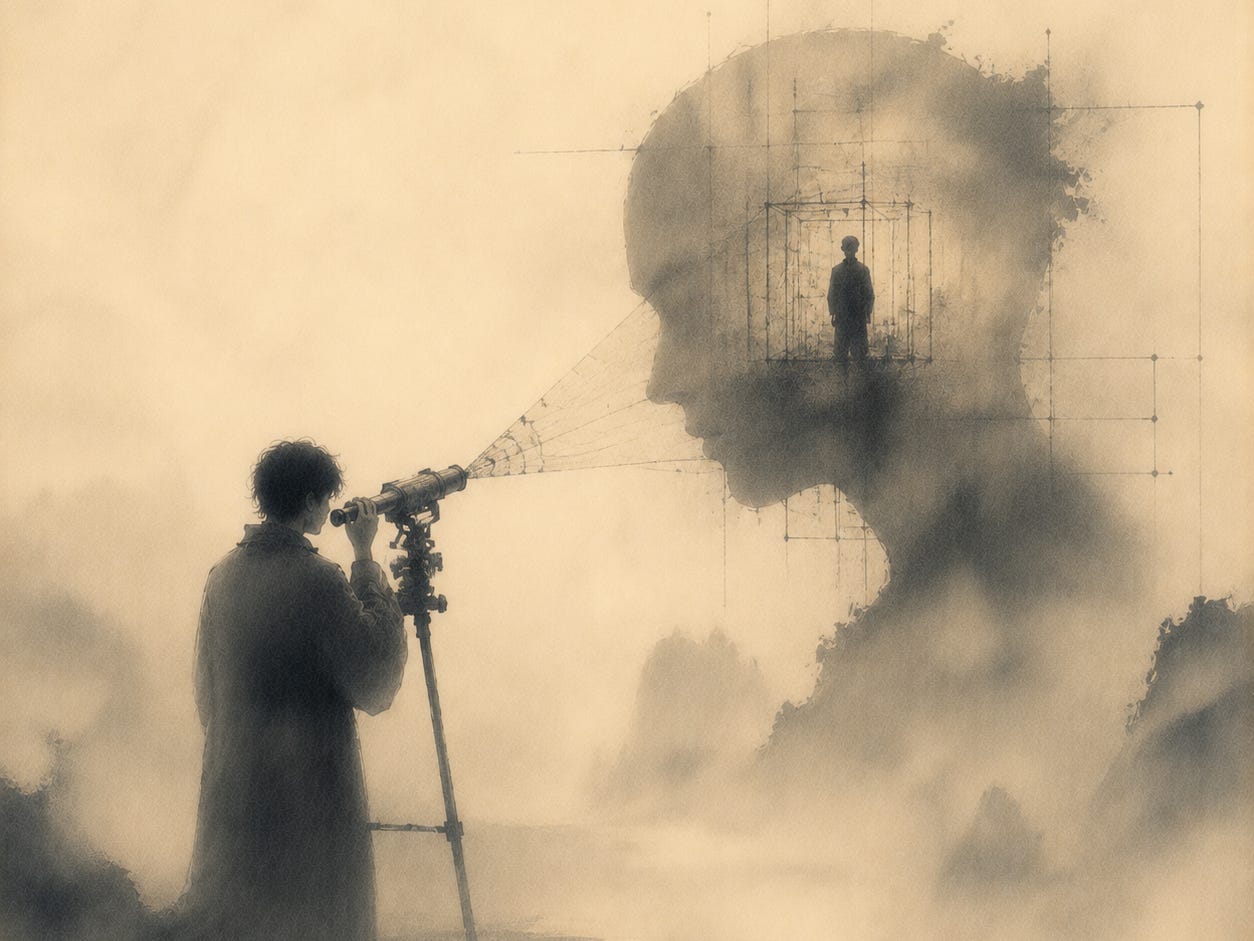
Almost everyone who has seriously studied psychology or sociology has had a strange feeling. What these fields say feels real, important, personally relevant. But somehow they don’t quite feel like physics, don’t quite feel like mathematics, don’t quite feel like biology. The boundaries are blurry, the methods keep getting borrowed from elsewhere, the conclusions keep getting overturned, and everything stays tangled up with words like “critique,” “expose,” “liberate.”
You can’t quite say whether they count as science. But you also wouldn’t call them nonsense. This feeling isn’t a misperception on your part. There’s a very precise reason behind it.
Modern knowledge is divided into several distinct territories. Mathematics and physics have their own deductive logic, where the relations between propositions are clear and can be formalized. Biology, economics, linguistics have their own empirical research methods; they study laws that objectively exist — whether or not people are aware of them, those laws keep operating. Philosophy has its own fundamental mode of inquiry, its questioning of being and meaning.
Psychology and sociology don’t sit on any of these territories. They live in the gaps enclosed between these territories. They borrow statistical methods from mathematics, the concept of “function” from biology, “system” analysis from linguistics, the questioning of “meaning” from philosophy. They have no original epistemological foundation of their own — every tool they use is borrowed.
This isn’t because psychologists and sociologists aren’t smart enough. It’s structural — they’ve always lived in the gaps, and they’ve never had an independent territory of their own to begin with. That feeling of “blurry boundaries” comes exactly from this.
But the deeper reason lies in what they actually study. There’s a distinction that needs to be made here. What biology studies is the mechanism of life itself — how cells divide, how organs function. That process is objective; whether or not people know about it, it’s simply there. What linguistics studies is how phonetics evolves, how grammar is structured. Those laws are objective too, not dependent on whether the speaker is even aware of them.
What psychology and sociology study is not these objective processes themselves. What they study is this: when a person lives, labors, speaks, how does he understand and represent these activities within his own consciousness. This is exactly what “representation” means — not the thing itself, but the shape the thing takes in a person’s mind, the way a person understands it, the image a person uses to describe it. Psychology doesn’t study neural mechanisms — it studies how people experience and understand their own psychological states. Sociology doesn’t study relations of production themselves — it studies how people understand the power, interests, and conflicts between them.
To put it in a single sentence: what they actually study isn’t what the world is like, but what people believe the world is like. This difference changes everything. Because the world people believe in is itself unstable, historical, full of misunderstanding. People frequently have mistaken understandings of their own activities, engage in self-deception, unconsciously conceal things from themselves. So the task of psychology and sociology is almost inevitably to expose — what’s being concealed behind the way you think things are. This is why they’re always entangled with words like “critique,” “expose,” “liberate.” It isn’t incidental — it’s determined by the very nature of what they study.
But what tools do they use to do this? Foucault said the human sciences have only three sets of tools, and all three are borrowed.
The first, borrowed from biology: function and norm. It treats the person as an organism, with functional needs that must be met, and anything that deviates from normal function is a “disorder.” This is, roughly, the basic logic of psychology. That sounds objective enough. But where’s the problem — where does the standard of “normal” come from? Who decides what counts as normal function? That “norm,” which looks like a fact of biology, is quietly packaging some particular historical period’s expectations of “the normal person” as if it were a natural standard. When you’re diagnosed with “anxiety disorder,” it’s done in a seemingly neutral medical language — but hidden inside that language is a historical judgment about what a normal person is supposed to look like.
The second, borrowed from economics: conflict and rule. It understands society as an arena of competing interests, with law and morality as the rule systems that manage that conflict. This is, roughly, the basic logic of sociology. But who has the authority to make the rules? Is the rule itself the result of power operating, rather than some neutral solution? Marx was asking this same question too, but he never actually stepped outside this toolkit — he simply swapped the source of the rules from “the social contract” to “class interest,” while still using the exact same framework of conflict and rule.
The third, borrowed from linguistics: signification and system. It treats every human behavior as a sign, as a text that can be decoded, with a discoverable system of meaning lying behind it. Freud is the key figure here. The moment he began analyzing the unconscious in a linguistic way — treating dreams, slips of the tongue, symptoms as chains of signs that needed to be decoded — he did something unexpected. He erased the boundary between “normal” and “abnormal.” Within the function-norm framework, there’s a clear divide between health and pathology. But within the signification-system framework, “pathological” behavior is simply a system of meaning following a different set of rules — dreaming and waking thought aren’t a relationship of healthy versus pathological, but two systems of signs with different grammars, with no essential ranking between them. Your compulsive behavior isn’t “broken” — it’s expressing some meaning through a logic that other people simply can’t read.
This shift was a quiet but profoundly consequential displacement in twentieth-century intellectual history. So, back to that feeling. That vague, hard-to-name strange feeling you’ve always had about psychology and sociology — it’s correct. They really are different, not because they’re worse than other disciplines, but because they’re doing something structurally harder — studying not the objective laws of the external world, but people’s understanding of themselves, an understanding that is itself full of misunderstanding, concealment, and historical drift. They always work in the gaps, always borrow other people’s tools, always work at exposing what lies behind representation. This doesn’t signal weakness. It’s simply the nature of the task they’re bound to carry.
So — the last time you described yourself using the language of psychology — “I have anxiety,” “I need security,” “I have boundaries” — which toolkit was that description actually using? What did that toolkit help you see — and what did it, at the same time, conceal?