

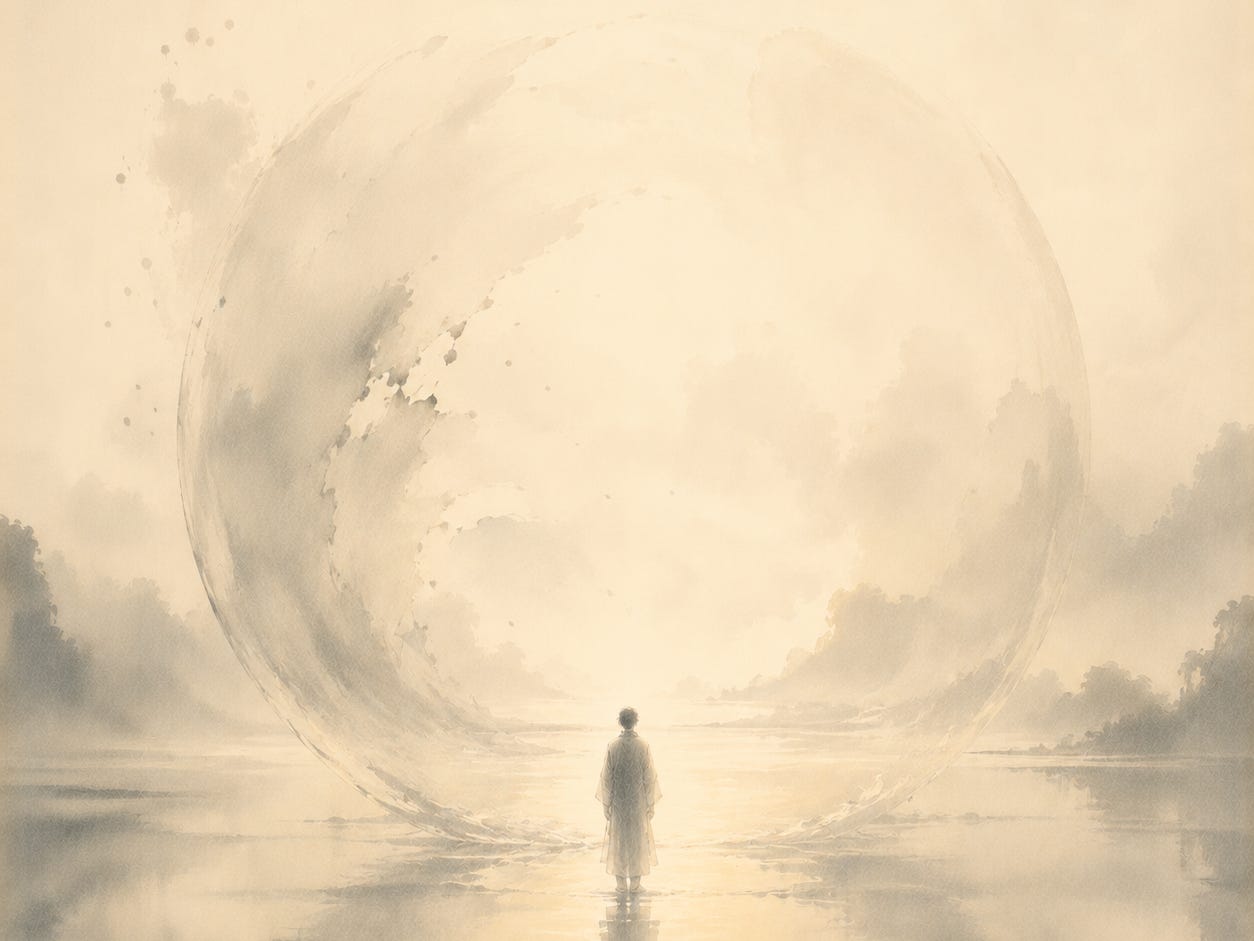
There are moments you only realize happened after the fact. Not the big kind of moment. Not a turning point in your life, not tears streaming down your face. It’s the quieter kind — a piece of music halfway through, and suddenly you don’t know where you are.
Not zoning out — that self who’s always running, who knows who they are and what they need to do next, suddenly goes quiet for a second. You’re not thinking about anything. You’re just there, with that sound, and something between the two of you that you can’t quite put into words.
Then your phone buzzes, or the song changes, or someone next to you says something. The moment passes. You go back to whatever you were doing. But something had, gently, landed on you, and then left.
I started paying attention to these moments later on. Not because they’re especially special, but because they’re getting rarer and rarer. Rare enough that I started thinking this was worth taking seriously — not where that moment went, but: is there something in me that no longer lets it happen at all?
Usually, when we explain the spiritual crisis of modern people, we talk about the loss of faith. Science advanced, the place once held by the divine got replaced, and religion became something old and optional in modern society. This explanation has its merits, but it explains what people no longer believe — it doesn’t explain what people have lost.
There was a theologian at the end of the eighteenth century named Schleiermacher, who did something quite radical for his time — he pried religion loose from “what you believe” and “what you do,” and said: the essence of religion isn’t doctrine, isn’t commandments, it’s an inner capacity. It’s the sensibility that touches the infinite within the finite. It’s a passive, childlike capacity to wait, in silence, for something to arrive.
He swapped religion’s verbs — from “doing” and “thinking” — for “listening” and “feeling.” The first time I read that shift, I sat with it for a long while. Because if he’s right, then the real crisis of modern people isn’t “being unable to believe in anything” — it’s something deeper than that. Even that capacity to listen and to feel has already atrophied in us.
When was the last time you did absolutely nothing, and just were there? Not waiting for someone. Not thinking about something. Not “resting to recharge.” Just being there, doing nothing, asking for nothing, with no goal waiting for you to complete it.
When you ask that question, most people’s first reaction is that they can’t remember one. Not because such a moment never happened, but because we’ve grown so used to “doing something” that those moments when we did nothing don’t seem to count — they never got recorded.
But the more honest answer may point the other way: you can’t remember it because such moments really have become rarer and rarer. Every gap where one might have happened — the three minutes waiting for the subway, the stretch of time before falling asleep, eating alone, walking somewhere — has already been filled in. No one forced you to fill it. You filled it yourself, having already, without noticing, come to treat that blank space as something that needs to be dealt with, rather than an opening that could let something arrive.
The problem isn’t that we don’t want to be moved. The problem is that we’re too full. Someone who’s always outputting — always expressing, producing, responding, refreshing, confirming their own existence — their soul stays in a state of continuous activation. They can’t receive anything, not because there’s nothing outside worth receiving, but because they’ve never stopped to make room for it. Being moved requires you to have an opening first. And we’ve already sealed off every place that might have become one.
I tried to recall what that kind of moment is actually like. Nothing grand — just some ordinary thing in daily life. A song. An evening. A sentence someone said. A moment of locking eyes with someone, neither of you saying anything, but something passing between you.
That moment has an odd structure to it: the thing that’s always drawing the boundary between “I am me, you are you” temporarily stops working. It’s not that you disappear — it’s that your boundary becomes permeable, and you dissolve into something larger. That “something larger” has no name, but inside it, you don’t feel lonely, you don’t feel like you need to do anything — you’re just there, feeling some kind of wholeness you can’t quite explain.
A moment like this doesn’t need a god, doesn’t need a ritual, doesn’t need any religious framework at all. But at its core, it’s the same thing as what Schleiermacher called touching the infinite within the finite. And then it asks you to let go of your sense of control. It asks you to be able to tolerate not knowing what happens next. It asks you to stop worrying about whether that moment is “meaningful,” whether it’s “worth it,” whether it “produced” anything. And that turns out to be the hardest thing for us to do today.
It isn’t the loss of faith that has taken these moments from us. It’s that we’ve lost that inner passivity, that capacity to receive, that space that allows something to genuinely come in — and so those experiences no longer have anywhere to land. They’re still there — the music is still there, the evening light is still there, the moment of locking eyes with someone is still there. It’s just that we’re already too full, so full that the moment they touch us, they bounce right off. What we’ve lost isn’t the object of faith. It’s the capacity to receive.
When was the last time you let something truly come in?