

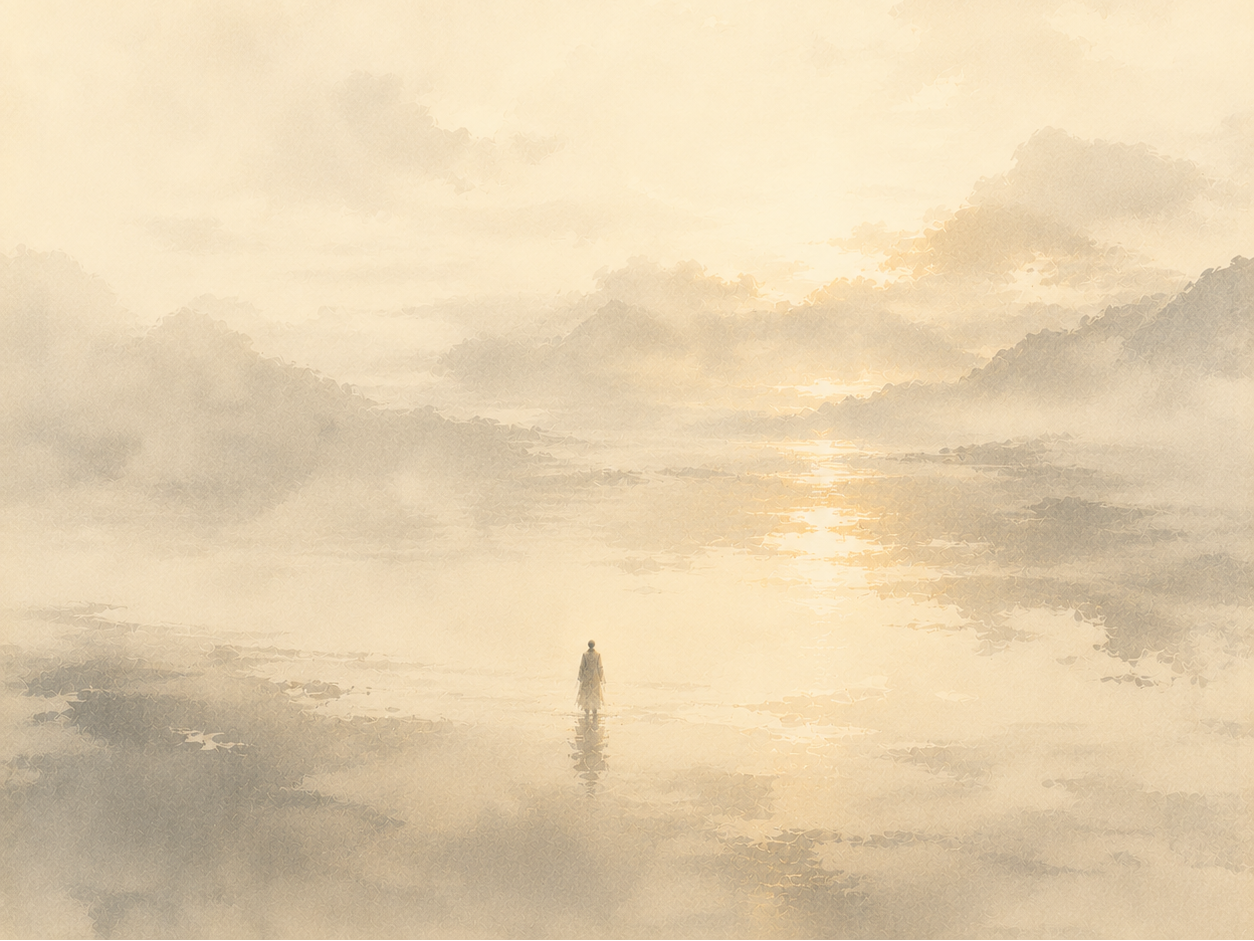
Sometimes, walking into a certain place, you suddenly don’t want to speak. Not because you have nothing to say, but because something already seems to be there. The trees are there, the light is there, some sound you can’t name is there. Speaking would only be excess. You stand there, and for some reason, you feel yourself grow a little smaller — not insignificant, just ordinary.
You’re no longer the most important thing in the scene. You’re just one of the things in it, there together with the trees, the stone, the evening. That feeling is brief; it usually passes quickly. But in the moment it happens, there’s a very particular kind of quiet. I’ve kept wondering, since then, what actually happens in that moment.
A Tang dynasty poet once wrote this into eight lines.
Empty mountains, after fresh rain,
the air turns autumn as evening falls.
Bright moon shining among the pines,
clear spring flowing over stones.
Bamboo rustles — washerwomen heading home,
lotus leaves stir — a fishing boat comes down.
Let the fragrance of spring fade as it will,
a prince may still choose to stay.
Wang Wei calls it an “empty mountain.” But there are clearly people in it — washerwomen coming home, a fishing boat moving, sound, motion, life going on. So what exactly is “empty” here? It isn’t the people that are empty. It’s a certain posture of standing above everything else that’s emptied out. It’s the will behind “I have arrived, and here is what I intend to do.” It’s the stance that places itself over everything and turns every other being into background.
Once that is emptied out, the whole poem gains its particular breath. The washerwoman isn’t appreciating nature, isn’t managing nature, isn’t conquering nature. She’s simply washing clothes, by that stream, in that evening, as one ordinary participant in that evening. She and the moonlight, the pines, the water flowing over the stones — they’re all equal.
We Chinese call this “the unity of heaven and man” (tian ren he yi). The phrase has become so smooth on the tongue that we barely feel what it’s actually saying anymore. What it’s saying is a position — not humans above nature, and not humans dissolved into nature, but humans as one being among others, sharing the same moment alongside everything else that exists.
More than two hundred years ago, a German poet, in a completely different language, said almost the same thing. Novalis imagined a state he called the “coming society.” He described it in a strange way: “Everything is the same as before, and yet everything is completely different.” Not a revolution of institutions, not an external change. A fundamental shift in the relationship between people and the world — from a subject’s control over an object, to an equal being-together.
He called it the “republic of all beings.” Humans are no longer the sovereign and lawgiver of the universe, but ordinary citizens in the republic of all beings — living alongside plants, animals, stones, clouds, and stars, as equals.
The first time I read this, the thing that came to mind was Wang Wei. A Tang dynasty poet and a Romantic philosopher, a thousand years apart, half a world apart, describing the same perception, each in his own language. That fact alone says something — this perception isn’t a cultural preference, isn’t the fashion of some era. It’s something more fundamental, something humans have arrived at, independently, again and again, in different places and different times.
Novalis described one more thing, which he called “the chaos of reason.” The phrase sounds like a contradiction, but it’s describing a state we’ve actually all seen — a forest. No tree is managing the forest. No rule is coordinating the relations between species. There’s no sovereign, no lawgiver, no being standing at the top issuing commands. And yet the whole displays an order more intricate than anything humans have designed — soil, mycorrhizae, light, rain, animals, decaying leaves, every being following its own inner possibilities while also responding to the inner possibilities of every other being.
That order isn’t produced by management. It’s produced by being-together. Our understanding of order today is almost entirely the logic of management — order exists because someone is in control, some rule is running, some subject is driving it forward. But the forest isn’t like that. The evening in Wang Wei’s poem isn’t like that. The society Novalis imagined isn’t like that either. The deepest order might be exactly the kind that has no sovereign at all.
Then I started wondering: what posture do we usually carry with us when we enter a place? Walking into some mountains, or a park, or any place with trees and water, with things humans didn’t build — are you there to appreciate it, to conquer it, to take a photo to prove you were there, or are you simply there, as one ordinary being among others, occupying the same evening as equals with those trees, that stone, that bird you can’t name?
That last kind of posture is hard to put into words. But when you’ve been in that state, you know it. For that, you don’t need to travel to some far-off mountains. You don’t need to believe in any religion. You don’t need to have read any book. All it takes is you, at some moment, setting down the posture of standing over everything. Forgetting that you’re the master.
The moonlight still shines on the pines. The clear stream still flows over the stones. You’re there, an ordinary participant in that evening. That’s it. That’s already enough.