

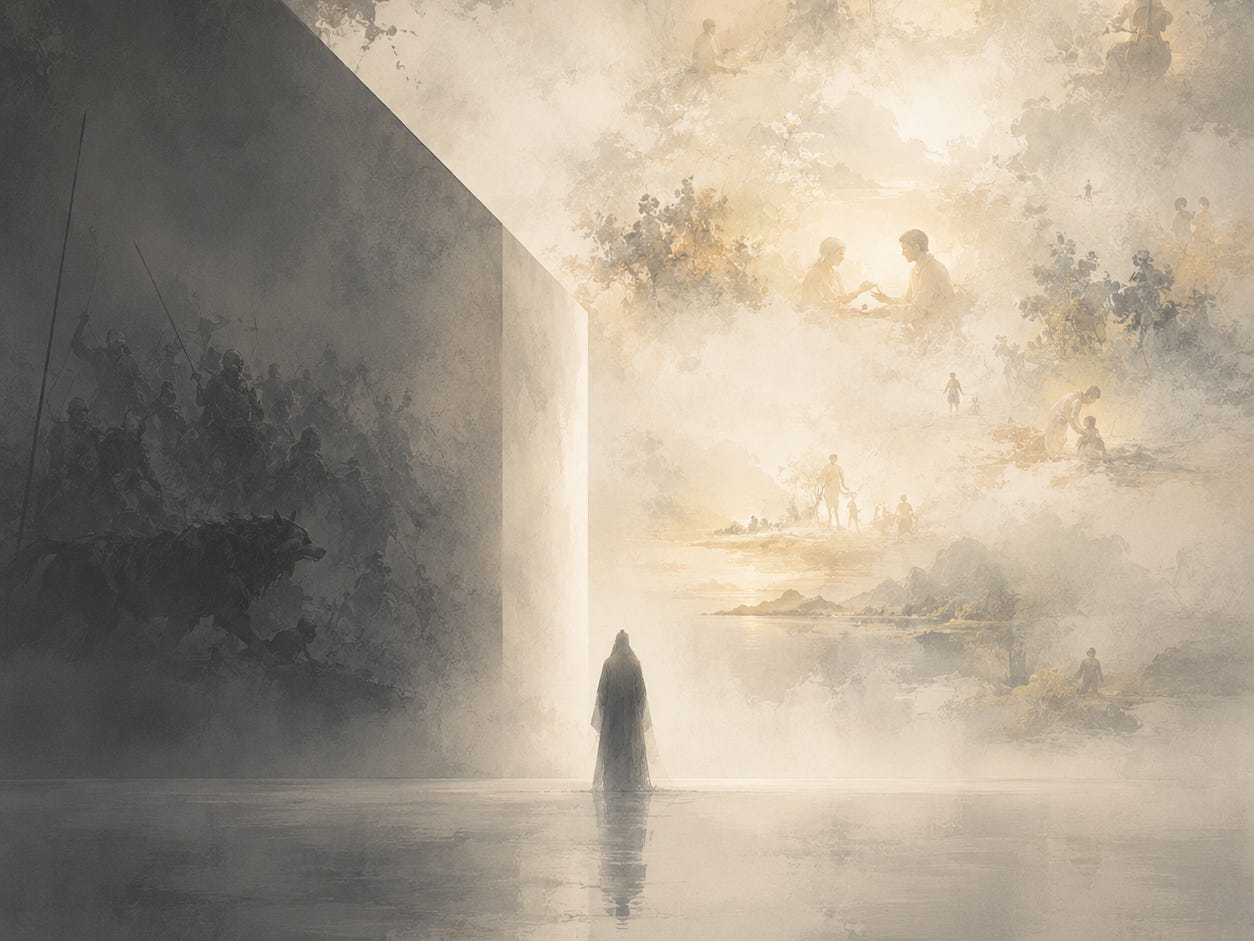
Have you ever seen posts like these?
“All social interaction is essentially exchange and manipulation. You need to learn to use the lowest cost of honesty to get the maximum value from the other person.”
“Don’t talk about pure love—that’s just to fool the poor. Men want looks, women want money. In this marriage market, exchange is the only eternal truth.”
“Remember, if you’re not ruthless to others, they’ll be ruthless to you. Put away your pitiful compassion. In this jungle, only hunters survive.”
After reading them, you feel an unspeakable unease.
Then you want to argue.
But you find you can’t.
There really is exchange in social life. There really are interests in relationships. Some people really do climb over others. The law of the jungle really does hold in some places.
Every single sentence has a real example to back it up.
So all you can say is: This doesn’t feel quite right, but I can’t articulate why.
That elusive why is what I want to make clear today.
These statements have a very clever structure.
They pick up a real side of human behavior—exchange, competition, interests, calculation—magnify it to the extreme, and then proclaim: Look, this is the truth. Everything else is an illusion.
The power of this move lies in the fact that the side they’re talking about *is* real.
You can’t say “there’s no exchange in social life,” because there is.
You can’t say “there’s no consideration of interests in relationships,” because there is.
You can’t say “the law of the jungle never applies,” because it does.
But there’s something that’s not being said here—
Humans cry for complete strangers.
Humans share food with strangers even when they themselves are struggling.
Humans created art, music, literature—things that have no meaning in pure jungle logic; they consume resources and offer no direct return, yet humans are willing to pay a huge price for them and devote their lives to pursuing them.
Humans do things they believe are right, even when no one is watching and there’s no reward.
These, too, are real human behaviors.
And likely more universal, deeper, and closer to what the human species truly is, than those jungle behaviors.
But in those statements, this part disappears.
Not because it’s unreal, but because acknowledging its existence would make the whole theory crumble.
These statements aren’t lies; they’re a mutilated version of the truth. They use one real side of human behavior to completely obscure the other side. You can’t refute them because you’re searching for counterarguments within the boundaries they have drawn. But the real problem is that boundary itself—it excludes half of reality from the very beginning.
So why does that obscured half never show up?
Not because the people saying these things have never seen kindness, genuine connection, or relationships not based on interest.
They have.
So why does that part never appear in their words?
Listen closely to what these statements are really doing.
“All social interaction is manipulation”—so it’s okay if I manipulate.
“True love is a scam”—so it’s okay if I don’t give my true heart.
“Harvesting is a calling”—so it’s okay if I hurt others.
“Only hunters survive”—so it’s okay if I am cold and indifferent.
Every single sentence is doing the same thing—
Giving the listener a permission slip to free themselves from a certain predicament.
What predicament is that?
It’s the predicament of genuinely getting close to another person. It requires you to give your true heart, to risk being rejected, hurt, let down, and to make yourself vulnerable before another.
This is hard.
Not because people don’t want to, but because it requires you to expose your real self with no idea how the other person will respond.
This uncertainty is a real fear.
What these statements are ultimately selling is a way out of this fear—
You don’t need to be real, because being real is useless.
You don’t need to be vulnerable, because vulnerability is a sign of weakness.
You don’t need to take risks, because smart people only calculate, they don’t bet.
They make loneliness and coldness sound like a wisdom that sees through the world.
But it’s not wisdom.
It’s fear wearing a coat of wisdom.
These statements are viral not because they speak the truth, but because they speak what many people want to hear—you don’t have to be vulnerable anymore, you don’t have to take risks anymore, you can redefine the thing that scares you as stupidity. After hearing it, loneliness makes sense, coldness becomes correct.
But there’s a deeper question that never gets asked—
What do the people who choose to believe this system get?
Do they really live better lives because they’ve stopped being vulnerable, stopped giving their true hearts, and treat all relationships as exchanges?
Or do they gain a sense of security, but lose something else—something they might not even realize they’ve lost?
When someone truly believes all social interaction is manipulation and starts using the lowest cost of honesty to get maximum value—
What happens next?
They get good at scheming. They *win* in many exchanges. They feel like they see through others and have mastered the rules.
But one thing starts to disappear.
They begin to feel that no relationship is real.
Not because others aren’t real with them—but because *they* aren’t real with anyone. So they’ll never know how the other person would respond if they showed up authentically. They never will.
Because they’ve never tried.
This eternal *not knowing* is a special kind of loneliness.
Not the loneliness of being alone in a room, but the loneliness of being in a room full of people engaged in exchanges, where no one has truly *seen* them, even for a second.
And they haven’t seen anyone either.
And at the deepest level—
They can no longer believe that anyone truly *likes* them.
Because within their framework, “liking” doesn’t exist. Only “using” exists.
So when someone is kind to them, their first reaction is: What does he want from me?
When someone says “I love you,” their first reaction is: What’s the strategy?
They’ve locked themselves in a room where no one can truly get close to them.
Not even themselves.
*Those who choose the law of the jungle gain one kind of safety—they won’t be let down because they never place a bet. But they lose something else—the possibility of being truly seen. That possibility only exists when you show up authentically. If you don’t show up, it doesn’t exist.*
So, back to those statements.
“All social interaction is exchange.” “True love is to fool the poor.” “Only hunters survive.”
Now you know why you couldn’t argue but felt something was off.
Because they are true, but only partially true.
They use one real side of human behavior to obscure the other side—the side where humans also cry for strangers, give without expecting anything in return, and risk vulnerability for the sake of a connection.
They aren’t selling wisdom. They’re selling a permission slip—you don’t have to be vulnerable anymore; from today, loneliness and coldness shall be called “seeing through the world.”
And those who choose to live inside this logic gain safety but lose the chance of being seen.
That being seen only exists when you show up authentically.
If you don’t show up, no one can see you.
Including those who say, “In the jungle, only hunters survive.”
They survive.
But no one has truly *seen* them.
And they haven’t truly seen anyone.
In that sense, they are the loneliest animals in the jungle.
Not because they are alone.
But because they live in a room they built themselves, the door locked from the inside, and even they’ve lost the key.