

“Form is emptiness, emptiness is form” — for a lot of people, the first time they heard this line, it probably wasn’t from a sutra, but from some film or TV drama, spoken by a monk right before the camera cuts away, and the audience walks away half-remembering these few characters, not quite sure what they mean.
It’s so familiar that almost no one ever actually stops to look at its structure. Most people’s understanding of it stays at the level of a vague feeling — something like, the world is empty, everything is an illusion, once you see through it you’re fine. That understanding clearly never gets anywhere near the bone of what the line is actually saying.
The line doesn’t say “form leads to emptiness.” It doesn’t say “emptiness hides behind form.” What it uses is “is” — form *is* emptiness, and, said the other way around, the same holds. That word “is” is very different from “leads to” or “hides behind.” Because it cancels out any sequence of before and after, and it cancels out any relationship of surface and depth. It isn’t that form comes first, and then, going deeper, you eventually discover emptiness; nor is emptiness hiding behind form, waiting to be peeled open before it can be seen. What it’s saying is that these two words actually point to the same single thing — just spoken once from each of two angles.
A lot of people’s understanding of “emptiness” makes a directional mistake. They assume emptiness is a layer more real, more fundamental, than form — that form is merely an appearance of emptiness, a layer of illusion that needs to be seen through. This understanding secretly promotes emptiness to a higher rank — emptiness becomes the truth hiding backstage, form becomes the prop out front, and only by smashing the prop do you finally get your hands on the truth. But this line leaves no room at all for that move of “seeing through.”
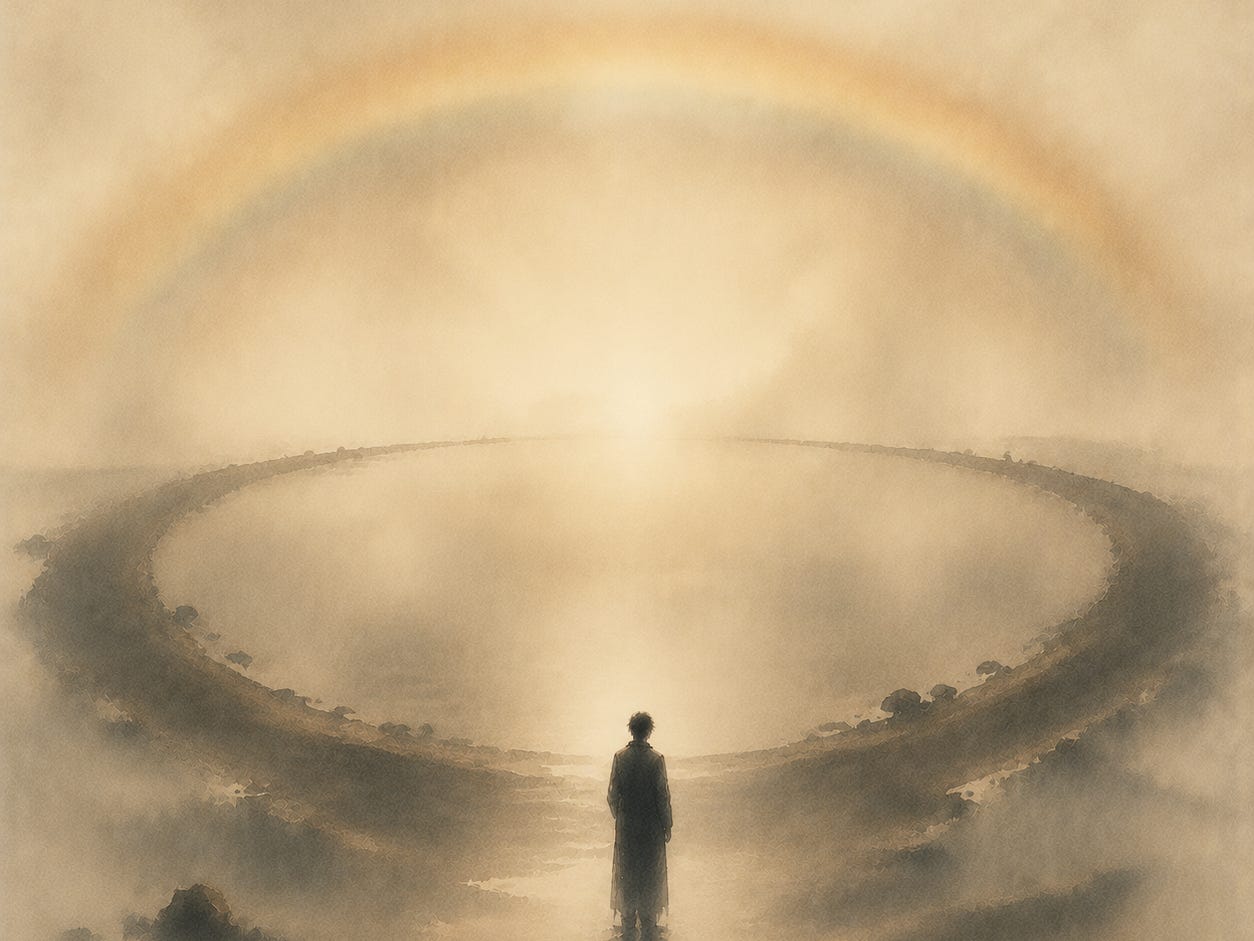
Because there’s no skin between form and emptiness that needs to be peeled off. A rainbow hangs in the sky. You can’t first see a “fake rainbow” and then, further behind it, find the “real light and water vapor.” What you see in that single instant already is the whole of it — that curved, vivid arc, and the fact that behind it there’s no fixed, unchanging self of its own — these were never two layers. They’re the same layer, just spoken twice.
So what is this line actually describing? It’s probably not describing the relationship between two things. It’s describing one single thing, seen in two different ways — form is what this thing looks like when seen as a concrete phenomenon; emptiness is the same thing, seen in the way that it has no fixed, unchanging core. The angle of looking has changed. The thing itself hasn’t.
This line isn’t teaching you a piece of knowledge about the world. It is itself a demonstration of the very “is” relationship it’s trying to describe. You don’t need to first understand form, then understand emptiness, and then figure out how to fit the two together.
And right now, the act of reading this line, of working out what it means — that act, too, isn’t actually split into two steps. It isn’t that you first understand the half that says “form is emptiness,” pause for a moment, then understand the half that says “emptiness is form,” and only then, by stitching the two together in your mind, do you finally get it. The instant you read the word “is,” form and emptiness have already arrived together, in the very same thought. What this line is trying to say, and the way you are, right now, understanding it — from start to finish, these are the same single thing.
This feeling of “arriving together in the same thought” sounds a little convoluted, but it’s actually hiding inside the most ordinary muscle memory we have. Take someone learning to ride a bicycle for the first time — the person teaching them shouts from the side, “Don’t think about balance, just ride.” Whoever’s just starting out finds this strange — how can you possibly balance without thinking about balance?
But the moment they actually learn to ride, looking back, it really is like that: it isn’t that they first work out what “balance” means and then adjust their body according to that principle — the body and the bike, in that instant, find that state together, at the same time, with no step in between of “understand first, then do it.” Understanding something as it’s happening, and the thing itself — sometimes, these simply aren’t two separate things at all.
It’s a bit like the idea that awakening isn’t some special experience you can go out and acquire — it’s simply the way you already are right now. At first that sounds like it’s saying you don’t need to do anything, you’re already there. But what it’s actually trying to dismantle is the very same trap — the assumption that the truth is hiding somewhere else, that you need to travel there first before you can touch it.
“Form is emptiness, emptiness is form” — this line has been chanted over and over for a thousand years, and used by countless TV dramas as a decoration that sounds wise, recited and then the page turns.
But if it’s ever actually been heard, truly heard, in that moment the listener won’t feel like they’ve “come to understand one more principle.” They’ll feel like the rainbow they’re looking at right now, the river they’re crossing right now, the very sentence they’re speaking right now, was never missing anything to begin with, and doesn’t need anything closed back up either.