

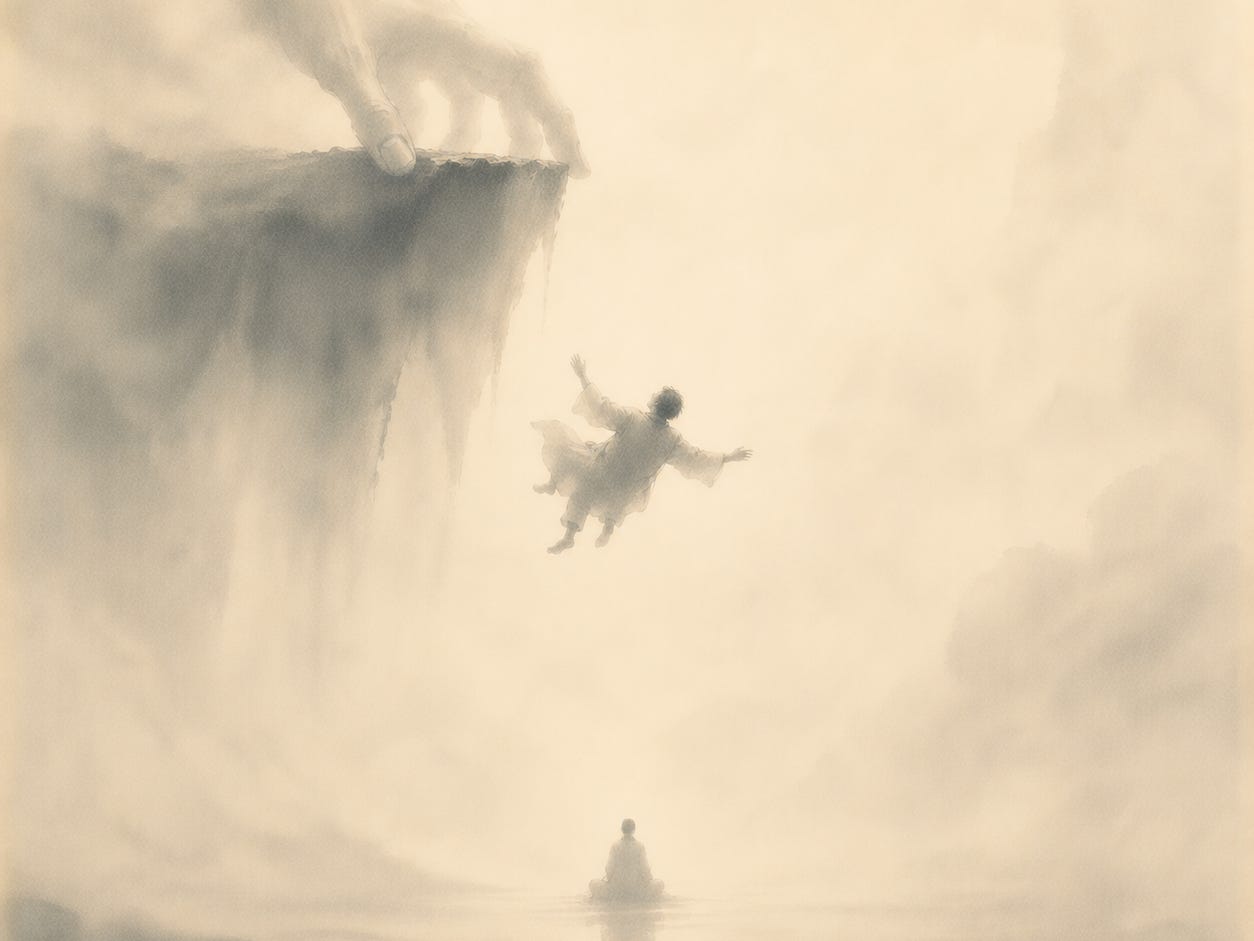
There’s a state of mind I find harder to endure than a lot of actual pain. It’s not that something bad has happened. It’s that something bad hasn’t happened yet, but you can already faintly sense it on its way — something in that relationship has started to feel off, that job has started to carry a certain atmosphere, some part of your body has started to produce a feeling you don’t dare think about too seriously.
You don’t know whether something is really going to go wrong, but you also can’t pretend there’s nothing there.You just hang there, suspended. The core of that suspended feeling is this: “maybe it will, maybe it won’t.”
In theory this leaves you room. In practice it’s a lock — you can neither truly let go nor truly face it, and you’re left grinding away in that in-between zone, pouring enormous amounts of energy into that “still not knowing.” I later realized the root of this torment isn’t the situation itself. It’s the framework.
The way we almost always deal with uncertainty is probability — how likely is this to happen, and can that likelihood be brought down. This framework works fine when you’re dealing with numbers. But applied to a human situation, it does something rather cruel: it lets “maybe it won’t” stay legitimately in place forever, and as long as that exit is still there, a person will instinctively lean toward it, unwilling to truly move. And then, by the time “maybe it will” finally crushes you, that probability was never actually dealt with at all.
Something got struck when I came across Dupuy. He argued that thinking about catastrophe shouldn’t use the framework of “it might happen,” but rather the framework of “it is already fated to happen” — looking back from the far end of the future, fixing the worst outcome in place first, and then, standing there, searching backward for points of intervention.
At first this sounds even more hopeless. But I sat with it for a while, and noticed something had quietly happened — That feeling of hanging suspended disappeared. Not because the outcome had gotten any better, but because I’d stopped grinding away on “will it or won’t it.” Once you let the worst outcome settle into place by default, it can no longer threaten you with “maybe.” The deepest part of that torment was the thing that hadn’t landed yet — the moment you let it land yourself, the most tormenting part has nowhere left to hang. And the position you’re standing in becomes something completely different.
An image came to me later. Imagine yourself as the iceberg — the Titanic is steaming toward you. From the iceberg’s point of view, the ship is going to hit it; that’s fixed. But you’re not asking “will it hit or won’t it.” What you’re looking at is: before it hits, how many moments were there when it could have turned away? Ten minutes earlier, someone could have spotted it. Five minutes earlier, someone could have turned the wheel. A month earlier, someone could have made that decision — Those moments genuinely existed. Some of them haven’t even passed yet.
This isn’t something you can shrink down to something one person alone can fix — I know that. But the posture itself — working backward from a fixed outcome to find points of intervention, instead of waiting inside “maybe” — that posture is portable, downward-compatible to smaller scales. That relationship where you’ve already sensed the crack, that thing you’ve been putting off for a long time, that situation where you actually already know the answer but don’t dare look at it straight — all of these can be entered through this same framework. Not “will it turn into that or won’t it,” but “before it turns into that, what moments do I still have.”
“Maybe” is a trap, not room to breathe. What it gives you is the feeling that there’s still space. What it actually does is lock you in place — unable to let go, unable to set out, left only to hang there, waiting for that outcome to hand down its verdict on you.
Take that “maybe” away. Let it default to happening — not as a surrender, but as a way of switching to a position you can actually stand on. Only once you’re standing steady can you look back and find the moment there’s still time for. You aren’t waiting for fate to hand down its verdict. You’ve already found out the verdict — and only then do you actually start looking for the way out.