

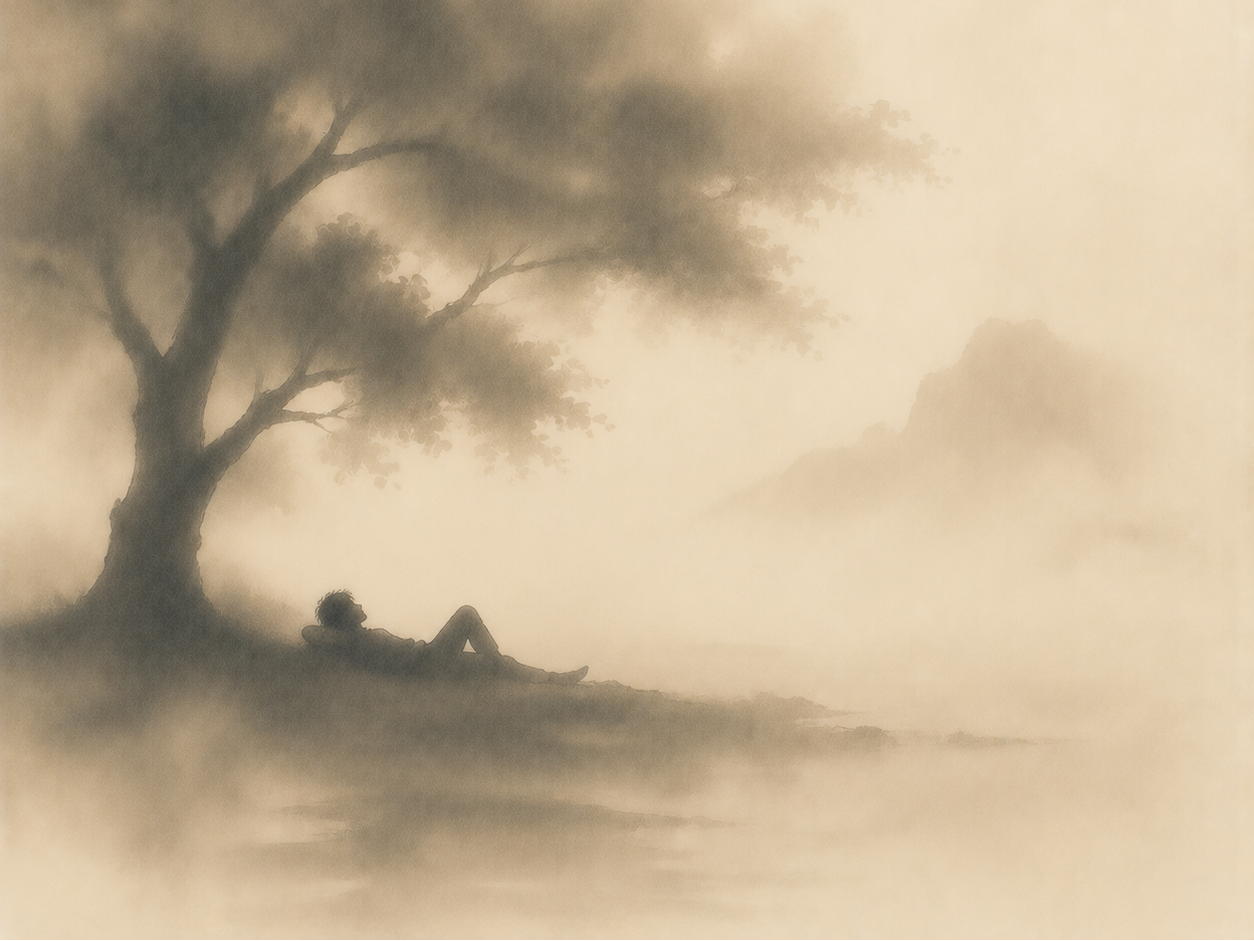
Summer, high noon, tired from walking, you find a big tree, sit down in its shade, lean against the trunk, and drift off almost right away. When you wake, the sun has tilted a little, the wind has gone a little cooler, the sweat on your neck has mostly dried.
Between you and this tree, not a single word was ever exchanged, not even a proper glance more than a couple of times. And yet, once that stretch of time has passed, something like a relationship seems to have formed — one with no clear name, but one that undeniably existed.
Think about this relationship closely, and it feels quite unusual. The person lying in the shade took nothing away from the tree — didn’t pluck a leaf to carry off, didn’t snap off a branch to keep as a memento. The tree didn’t actively do anything either — it didn’t reach out to block the sunlight, didn’t deliberately spread its branches a little further toward the person.
It simply stood there, having grown into exactly the shape it was always going to grow into, and that shape happened to block the sun. The shade wasn’t an action the tree performed — it was a byproduct, incidentally falling out of a state the tree had been in all along.
This is quite different from how most ordinary relationships work. Most relationships nowadays carry, to some degree, a whiff of exchange — I do something for you, you do something for me, back and forth, both sides giving, both sides receiving. Even the closest relationships tend to hide a faint ledger somewhere inside them — who did a little more, who responded a little less, all quietly logged.
But between this tree and this napping person, there’s no such ledger. The tree gave nothing that needed to be remembered; the person took nothing that needed to be repaid. The two simply happened to be, at the same time, in the same place, each staying in their own state. The tree stood, the person lay down, and the only thing between them was the width of a stretch of shade — no one waiting for a response from the other, no one calculating what this stretch of time was worth.
Think further, and you’ll find it’s precisely because there’s no exchange here that this relationship feels so unusually easy. If this shade were a favor the tree actively bestowed, the person lying under it would probably feel some obligation to say thanks, to remember this kindness, to find some way to repay it eventually.
But this shade was never something the tree deliberately gave — it was simply the tree’s own shape, which happened to fall in that spot. No thanks needed, no response needed, because no one was ever giving anyone anything in the first place. The two acts of giving and taking never actually happened at all.
This is also why this nap can be slept so soundly. In any other setting, no matter how tired you were, some part of the mind would still stay taut — running into an acquaintance means a bit of small talk, owing someone a favor means remembering to pay it back, even just sitting on a friend’s couch tends to come with some sense that you should probably say something.
Under the tree, none of that is needed. No one is waiting to be answered. Sleeping is just sleeping, the wind is just wind, and the moment your eyelids grow heavy, there’s nothing left to worry about.
So the most relaxing kind of company might be exactly this state — no exchange, no demand. A lot of the exhaustion between people was never caused by the being-together itself. It comes from that faint pressure of always feeling you should give something, should respond to something, to deserve the relationship at all. Even if the other person never asked for anything, this pressure surfaces on its own, because we’ve grown so used to treating relationships as a transaction that needs to be kept in balance.
And that stretch of time under the tree’s shade can only let someone truly, soundly fall asleep because there’s no pressure to respond here at all — only two beings, each complete in itself. A tree that grew into its own shape. A person who lies down when they’re tired. The two simply happened to be in the same place, staying there, quietly, like that. Neither one became something different because of the other. Neither one owed the other, needing to find some occasion to make up for anything.
Between the person napping in the shade and the tree, nothing was exchanged, and yet nothing was missing either. The kind of relationship that can actually let a person fully relax might not be the back-and-forth kind, tallied down to the last detail. It might be the kind of companionship where each side is already complete, happens to coexist in the same place, and owes the other nothing at all.
This kind of togetherness, ironically, can outlast many carefully tended relationships — because from beginning to end, it never once carried a debt that had to be repaid.