

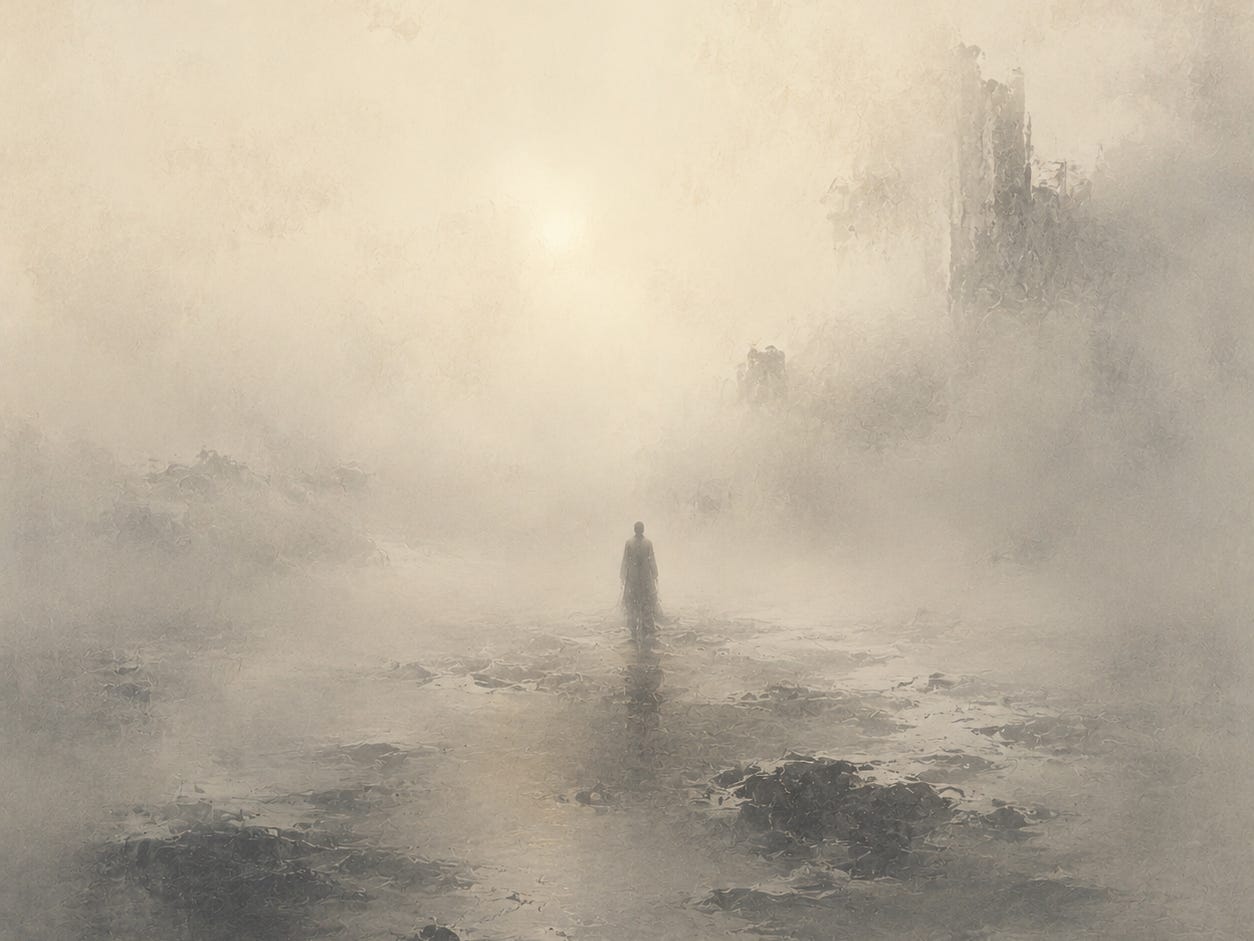
You’ve met someone like this — you tell them something, and their eyes never lit up.
Not that they were listening and holding the reaction back. The reaction simply didn’t happen.
You tell them you pulled something off. Nothing. You tell them you failed. Nothing. You tell them there’s something you’ve wanted to do for a long time and you’re finally starting — still nothing. It isn’t that they don’t care about you. It’s that they seem to maintain the same distance from everything — not far, not close, not cold, not warm, just there. Like a door that’s always open but no one ever passes through.
You drop a stone into that well, wait a long time, and never hear it hit water.
I used to have no precise word for this feeling. Then I read Nietzsche, and he gave me one.
He called it the Last Man.
Not the failure. This distinction matters, because a failure still wants to win, still feels pain — after failing, something very specific presses down on them, and that weight itself proves there’s still something inside that’s making demands. The Last Man isn’t like that. He doesn’t want to win, doesn’t want to lose, doesn’t expect, doesn’t rage, doesn’t push back. He’s alive, but that thing that always wanted to press forward — at some point, it stopped moving. Like a machine still running but producing nothing, needing to produce nothing, turning is enough.
Failure is a condition. The Last Man is a direction — downward, continuous, and not necessarily visible to the person going there.
The deeper part is that no one becomes the Last Man suddenly.
A logic runs through them slowly, quietly, patiently, and finally brings them there.
The weak have a particular way of saving themselves. They can’t win, can’t surpass — so they do something more clever: they swap out the coordinate system entirely. They redefine strength itself as a vice — someone else’s ambition becomes greed, someone else’s desire becomes shallowness, someone else’s passion becomes impulsiveness, the things someone else dares to want become ingratitude. Then they rename their own side: compliance becomes maturity, retreat becomes wisdom, stopping becomes having figured things out, no longer demanding anything of yourself becomes letting go.
This logic is highly effective, because it requires no winning — and yet it makes you feel good.
It isn’t peace. It’s resentment wearing peace like a coat, until even the wearer believes it.
The Last Man is where this logic arrives at its end. He hasn’t only stopped — he’s completed one final step: convinced himself that stopping was the right thing. This step is the most fatal, because it severs the path back. A person who still knows, even slightly, that their fire has gone out — they can still be reignited by something, somewhere. But a person who has come to believe that being extinguished is happiness — that fire is genuinely gone. He isn’t resting. He’s using this is fine to seal the exit shut.
So the person who still has ambition but took a wrong turn — the angry one, the unconvinced one, the one still pushing back — the person with too much desire and nowhere to put it — they still have something alive in them.
Nietzsche’s judgment on this kind of person: the life force is still there, only the direction is wrong. A wrong direction can be corrected, can be redirected. Even if that force is currently destructive, careening, crooked — it’s moving. Still turning. Hasn’t gone cold. You can still do something with it.
With the Last Man there’s nothing to do, because there’s no material. No anger, no pushing back, no desire, no expectation, no pain. Just there — like a pile of ash that was once fire, but now without even warmth. You reach out and touch it, and it’s cool. You can’t rekindle anything from ash.
I would rather someone still be in pain, still pushing back, still taking wrong turns, still making a mess of things — than have that well go silent.
This isn’t about trying harder. It isn’t about succeeding.
Those words are too light. They don’t land on what this is actually about.
This is about something more fundamental — that thing in your body that has always wanted to move forward, the thing that makes you react to certain things, desire certain things, feel angry at certain injustices, feel your pulse quicken at certain possibilities. Whether that thing is still there. Not where it’s pointing right now. Not whether it’s going the right way. Only whether it’s still turning.
Because still turning means there’s still possibility.
Extinguished means there’s truly nothing left.
The ones that fill me with a kind of wordless sorrow — it isn’t the people who failed, or the ones who took wrong turns, or even the ones who are angry and resentful and find fault with everything they see —
It’s the ones who no longer have even that anger.
Not peace. Extinguished.
The difference is subtle. But that subtlety only exists before you’ve been in the room with both.