

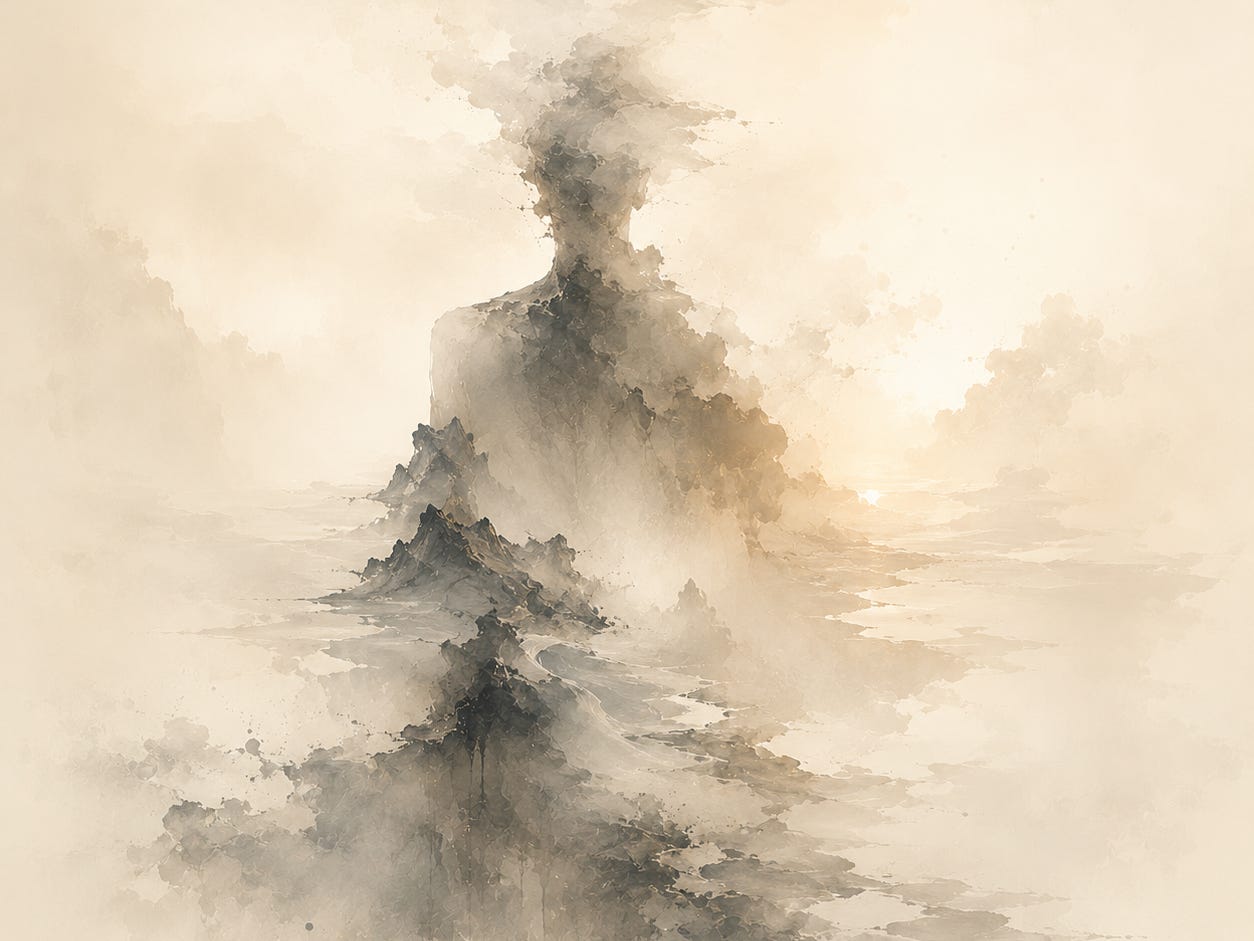
Someone once asked me: what do you do?
I gave an answer. As I said it, there was a slight heaviness.
Not because I was dissatisfied with the answer. It was because I could feel that the answer was smaller than me. It could hold what I used to be. It couldn’t hold what I was becoming.
I didn’t say more at the time. But that heaviness stayed.
From childhood, we are trained to define ourselves with is.
A résumé says I am. A self-introduction says I am. The bio field on social media asks what are you. Fill it in, send it out, let people understand you at a glance.
This language is useful. It makes communication efficient, tells others how to treat you, helps you locate yourself in any given context.
But it carries a hidden cost: it assumes identity is a fixed thing. Something that can be accurately described, compressed into a word, held stable across a long stretch of future time.
And within this language, there is simply no room for I am becoming.
Nietzsche wrote that man is a rope fastened between beast and Übermensch — a rope suspended over an abyss.
The first time you read this, it seems a little dramatic. But it describes something very plain:
The value of a person lies not in what they are, but in what they have crossed.
The meaning of the rope is not its material, not its current position, but the act itself — connecting the two ends, suspended over the void. A rope that has stopped crossing is simply hanging there. It’s still a rope, but it has lost the reason for being one.
Nietzsche called this self-overcoming.
But there’s an easy misreading here — this is not the self-help version of “push past your limits,” not “be better today than you were yesterday.” It’s colder than that, and more honest. It asks you to hold a fundamental dissatisfaction toward the self you are now. Not because you aren’t good enough — but because you know that the self you are now is only a temporary form, not a destination.
“Man is something that shall be overcome.”
Overcome — not erased. To move beyond the limitations of your current shape. To refuse to treat any one stage of yourself as the final answer.
The most common mistake modern people make is freezing the process of becoming into a state of being.
Find a label. Move in. I am a creator. I am a minimalist. I am someone who doesn’t follow the crowd. The moment it’s said, there’s a comfort — finally knowing who you are.
But labels have weight.
At first it’s a garment — put it on, and you know which direction you’re walking. But worn long enough, it becomes a silhouette. Others understand you through that silhouette. You start understanding yourself through it too. Gradually, everything you do gets measured against one question: does this fit who I am?
The silhouette goes from garment to armor, and from armor to cage.
You’re still inside it. But you’ve stopped crossing.
What’s interesting is that the society of display loves what you are — and has very little use for what you’re becoming.
Platforms need you to have a stable, recognizable identity that can be described in a single line — because only stable identities can be precisely recommended, can accumulate an audience, can be understood and amplified by the algorithm.
You are a “workplace creator,” the platform knows who to push you toward. You are a “minimalist lifestyle” account, the algorithm knows your audience profile. You are an “independent thinker,” so stay consistent, don’t suddenly change.
But someone genuinely in the middle of becoming is unstable. They will confuse longtime readers, will drift from their original direction, will suddenly become interested in something entirely inconsistent with their persona, will one day write something that looks nothing like anything they’ve written before.
The platform doesn’t know what to do with them. Neither does the algorithm.
Platforms prefer nouns. Nietzsche said man is a verb.
I think of something small.
For a period, I described myself as a particular kind of writer. The description was accurate, and I meant it. But after a while, I noticed I had started avoiding certain topics — not because I wasn’t interested in them, but because they “weren’t quite the kind of thing I should be writing.”
When that thought appeared, I didn’t immediately register that something was off.
It became clear later: I was protecting a label, not protecting myself. That label was a version of me frozen at some earlier stage, and I had already moved on. I was using an old silhouette to constrain a newer self.
Becoming has a very specific feeling.
It isn’t grand. It isn’t dramatic. It’s more like a persistent, mild discomfort — you did something the previous version of you wouldn’t have done, said something the previous version of you couldn’t have said, hold a view on something that’s completely different from what you thought three years ago.
That discomfort isn’t being lost. It’s growing.
What’s genuinely dangerous isn’t the discomfort. It’s its disappearance — when you no longer feel any confusion about your own state, when you feel that you know very clearly who you are, when you are entirely at peace with the self you currently inhabit and feel no pressure from any direction —
That is when the rope has stopped crossing.
The description you give of yourself right now — is it your actual state, or is it the shell left behind by a previous version of you?
No need to answer immediately.
But if you can feel that heaviness — the heaviness of a label that’s smaller than you, that can’t contain what you’re becoming —
That heaviness is a good thing. It means you’re still crossing.