

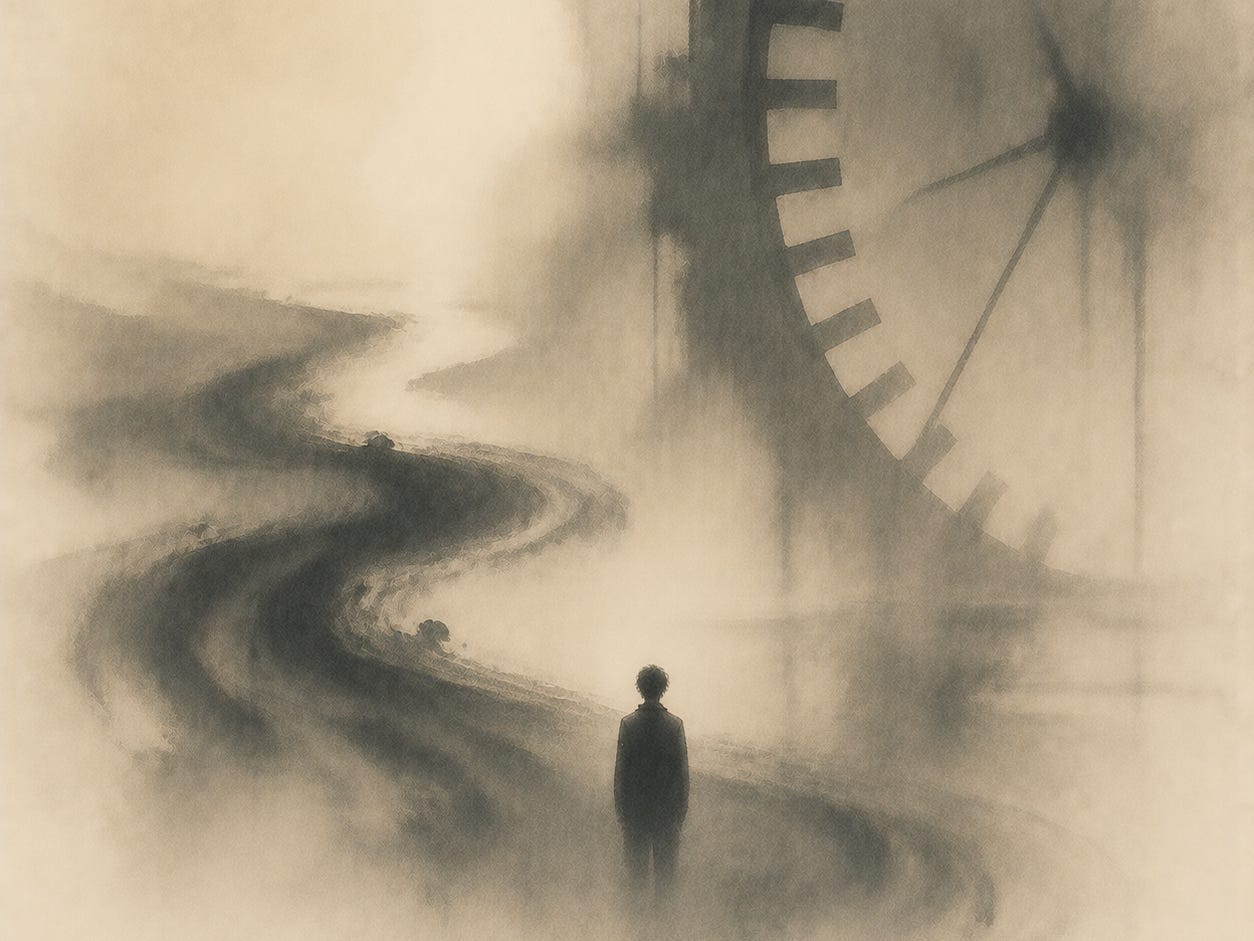
A quartz clock hangs on the office wall, its hands giving off a cheap silvery gleam, the second hand ticking forward notch by notch, steady and precise. Measure the distance between each notch with a ruler and you’ll find it dead accurate — one notch is one second, sixty notches is one minute, forever precise, forever even.
From the day it went up on the wall to now, it’s never run a notch fast, never run a notch slow. Even the cleaning lady, wiping down its glass cover as she passes, barely dares to knock it crooked.
But think about this evenness for a moment, and you’ll find it’s actually a rather unnatural thing. Those five minutes waiting in line for coffee — shifting your feet in place, watching the person ahead of you inch forward cup by cup, swiping your phone three or four times without finding anything new — those five minutes feel like they’ve been stretched hard by someone, refusing to end no matter how long you wait. Those five minutes having dinner with family in the evening — a bit of small talk, a second helping of rice, a bite of something your mother cooked — you look up, and the meal’s already over, gone in a blink.
Two stretches of time exactly the same length, and yet they feel like completely different things — one as long as the sting of a slap, the other gone like the wind before you know it. But the clock doesn’t care about any of this.
It measures both five-minute stretches as exactly the same length, the second hand ticking through exactly the same number of notches, not one more, not one less — never once letting a notch linger a little longer just because that stretch of time was more worth keeping.
Look back at earlier days, and you’ll find humans never really lived by this kind of even measurement. They lived by the sun rising and setting, by whether the wheat was ready to harvest, by the solar terms cycling year after year, or by the old tree at the edge of the village — when its leaves turned yellow, when they turned green.
This way of keeping time, following nature’s own rhythm, had its fast stretches and its slow ones. During the busy farming season, people went out to the fields before dawn and didn’t stop until well after dark, the days wound tight as a rope. During the slack season, the sun hung in the sky warming the whole courtyard, men leaned against the doorsill smoking, children chased chickens around the yard, the days loose enough that you could hear the wind passing over the eaves.
The shape of time followed the shape of life itself. No one took a ruler and insisted on measuring two completely different stretches of time as the exact same length.
And this even measurement the clock represents was pushed into everyone’s life alongside the factory. Factories needed workers clocking in at the same time, clocking out at the same time, needed the time each stage of the process consumed to be precisely calculated, compared, optimized — because only that way could output be scheduled, costs be accounted for, every link in the chain continuously improved.
So this measurement was never, from the very start, designed to match the rhythm of human life. It was designed to match the production process, and people were simply stuffed into it, made to match it instead. Time stopped asking “how long does this thing need” and started asking “how many pieces should this be cut into, how long should each piece be, what’s the standard labor-hour.”
Which means what this clock measures was never “days” at all — it’s “labor hours.” No matter how precisely the second hand ticks, every notch it measures out is, at bottom, a unit of production that can be calculated, exchanged, compressed. Take this measurement and lay it over the five minutes spent eating dinner with family, and lay it over the five minutes spent tightening bolts on an assembly line — it’s the exact same ruler either way.
But these two stretches of time were never the same kind of thing to begin with. One is lived, alive, actually lived through. The other is calculated. One is filled with the smell of a home-cooked meal. The other is filled with an output report.
This clock was never meant to measure a person’s life. What it measures is how much calculable output can be squeezed out of a person. The second hand moves at exactly the same speed because what it’s actually serving was never that meal, that time spent together, those rhythms that were supposed to run fast or slow according to life’s own decision — it’s the production cycle waiting to be calculated cleanly, somewhere down the assembly line.
Once days get stuffed into this measurement, the difference between fast and slow gets smoothed flat, just like that. The second hand on the wall keeps ticking, notch by notch, the glass cover giving off its cold gleam — it doesn’t know, and doesn’t care, whose life this notch it just measured out actually belonged to, or what it was spent on. Either way, when quitting time comes, it finishes its lap the same as always — not one second held back, not one second given extra.