

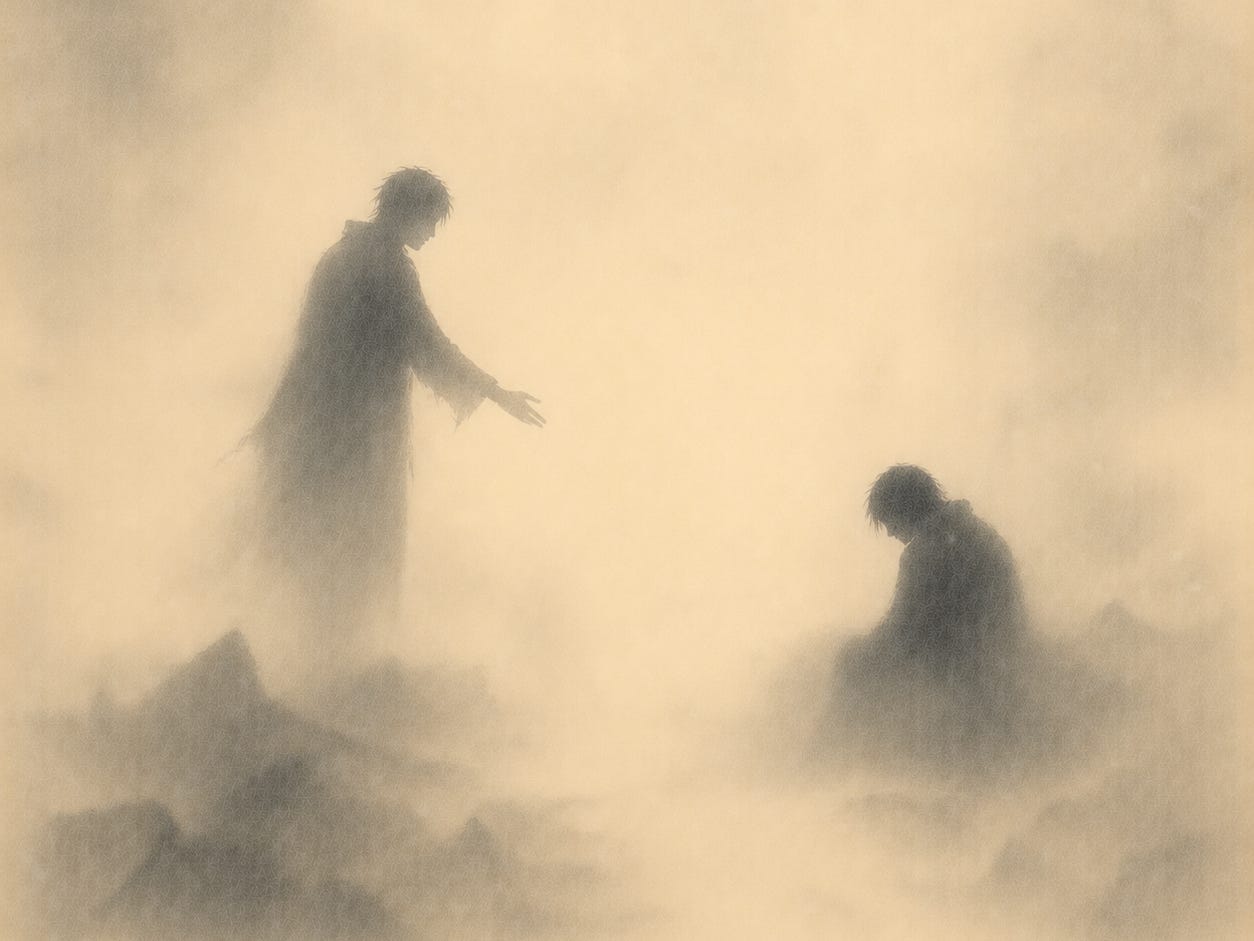
The hardest part of being with someone going through deep pain is usually not comforting them. It’s that they themselves can’t say what’s wrong. Ask them “what happened,” and they open their mouth, eyes perfectly lucid, but they just can’t piece together a complete sentence. They get halfway through, stop, and what’s left is a blank.
At times like this, a lot of people feel this silence needs to be “broken” — ask a few more questions, guide them a little more, pull the words out of them, bit by bit. Hidden behind this impulse is an assumption — that the words are already there, just held down by something, and that with a little more patience, a little more effort, they can be dug out. This assumption sounds reasonable enough, even carries a kind of goodwill — I’m willing to stay with you, willing to wait for you, willing to spend the time it takes to wait out the sentence sitting inside you.
But what if this silence isn’t “words being held down” at all? A complete sentence usually needs a subject, needs a verb, needs to say clearly who, went through what, under what circumstances, leading to what outcome. Being able to organize an experience into a sentence is, in itself, already doing something — weaving that experience into a web of meaning that someone else can understand, can catch. Saying a sentence was never just “expression” — it’s already, in itself, a form of organizing.
If a person can’t even manage this step, the problem might not be “unwillingness to speak.” It’s that the experience is too pure — pure enough that all that’s left is a torment with no boundary, no content — no identifiable cause, no account that can be given, nothing but the pain itself, occupying everything, laid bare. Language, which can only run on “content,” has nothing here to get any traction on at all.
So what happens when you force a person to put it into words? It’s essentially demanding they complete a task they genuinely cannot complete right now — not because they’re unwilling to cooperate, but because the tellable “content” language needs in order to run simply doesn’t exist yet. The harder you push, the more they can only crash, once again, into that blank they can’t say anything about, and feel, more clearly than before, trapped in a place even they themselves cannot enter.
Valéry once wrote a character named Monsieur Teste, tormented by such acute pain that he couldn’t get out a single complete sentence — only an ellipsis was left. This isn’t a rhetorical gesture of holding something back before saying it. It’s evidence of language’s complete failure in the face of pain — a scream is still, at least, a form of expression, pre-linguistic and raw, but still something being released outward. The ellipsis marks something else: the very possibility of expression has already been canceled.
If the possibility of expression has already been canceled, shouldn’t the way we accompany someone change along with it? Not forcing out a complete sentence, but maybe staying beside them, together, slowly reorganizing that experience into a shape that can be told — no need to get there all at once, no need to make it clear all in one go. Maybe, at first, it’s just the single word “hurts.” Then, a long while later, “here” gets added. Some time after that, “since that day” slowly gets pieced in. This process can be slow — slow enough that the person standing beside them needs enormous patience just to stay with it to the end.
This is what accompaniment actually does — not forcing the words out, but staying beside someone whose language has failed, bit by bit, making the act of speaking possible again. Not speaking for them, not rushing them to speak. Just staying steadily by their side, letting them know that whenever they finally manage to piece together even half a word, someone will still be there, listening.
Thinking about it this way, a complete sentence was never a light or trivial thing. It’s a person finally shaping some formless torment into an outline — and once that outline appears, the experience has, for the first time, the possibility of being caught by someone else. Whether an ellipsis can turn into a sentence was never a matter of how strong the person themselves is. It usually depends on whether there’s someone beside them willing to spend a long time staying with them, bringing that untellable experience back into language, bit by bit.
Hemingway once wrote: “The world breaks everyone, and afterward many are strong at the broken places.” A lot of people use this line to motivate themselves. But look at it from another angle, and those places that become “stronger” were probably never something a person endured alone. Someone was there, when they couldn’t get out a single sentence, who didn’t walk away — who stayed with them, and, bit by bit, refilled that blank into a sentence that could finally be spoken.