

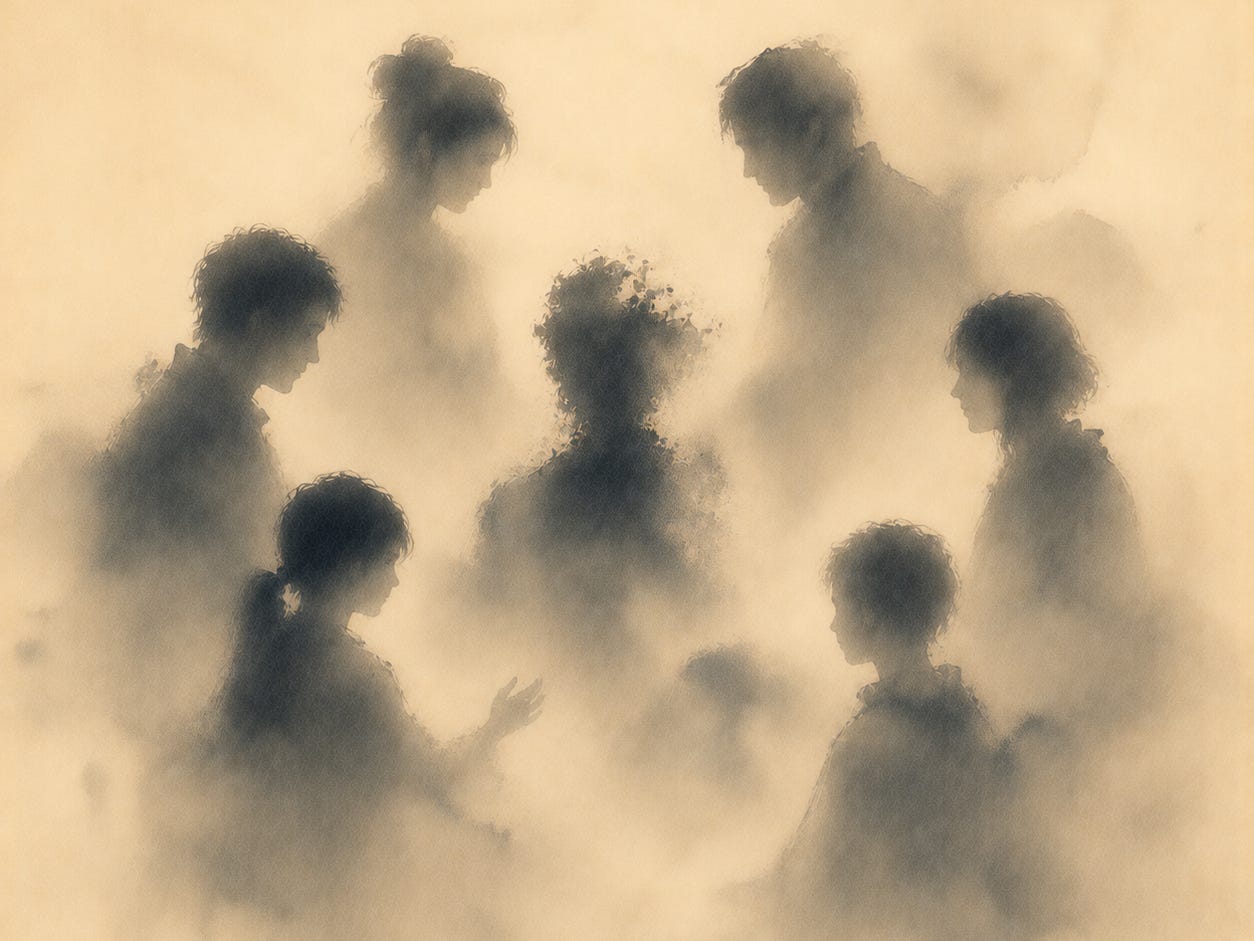
Someone asks you to describe your mother. As you talk, you notice that a lot of your sentences can’t seem to avoid yourself — she always brings in a cup of hot water when I’m up late; when she’s worried about me, she suddenly goes quiet. Even if you try to talk about her alone, you keep finding yourself mixed back into it.
This is completely different from describing a stranger. Describing someone passing on the street, you can just list height, weight, appearance, mannerisms. But the moment you start describing your mother, you almost always need “me” as a reference point before you can say clearly what kind of person she actually is.
Thinking about it this way, you realize it’s probably not that you’re bad at objective description. It’s that this relationship, from very early on, already wired the two of you together — a lot of her responses grew shaped around the variable of “me,” and some of my own deep habits grew shaped around her. Trying to lift either side out on its own, to describe it clearly, always seems to leave something missing.
So what happens if you really do remove “me” entirely from this description, and just talk about your mother as a person on her own? You find what’s left is just a handful of hollow adjectives — very caring, very traditional — still separated by a thick layer from truly knowing her. The part of her you truly know is precisely the version of her that only ever shows up in interaction with “me.” She might be caring, might go quiet, in front of other people too. But the exact shape that caring and that quiet take, when they land on “me,” is different — and that difference is the thing that truly belongs to her, even though it can only ever be held up by the two of you together.
This difference, in the end, was never meant to exist independently — it isn’t a part of my mother that was already there, that I just happened to notice. It’s something she and I made together, on the spot, in real time. By habit, people assume there’s already a complete “her,” contained inside a body, waiting to enter into a relationship with “me,” with other people. The relationship is something that comes later, something added onto a person who is already whole. But if the part of her that’s truly known has never been able to exist apart from “me” — then the sequence “the independent her comes first, the relationship comes after” might need to be reversed.
The philosopher Martin Buber said that a person doesn’t first exist as an isolated “I” and then go looking for a “Thou” — it’s at the moment of meeting the “Thou” that the “I” first truly takes shape. That line fits perfectly here — it isn’t that there’s first a mother, and then an “I” who relates to her. It’s that “mother,” from the very moment “I” came to exist, was already being defined together, alongside the variable of “me.”
So if relationship comes before “the independent self,” then the whole question of “knowing a person’s true self” might not be an answerable question to begin with. People often say they want to know what their parents were like when they were young, before having children; want to know what a friend is like alone, apart from the friendship. This curiosity sounds natural enough, but think about it closely, and what these questions are actually asking about is something that never truly existed — the gap between “the mother before she had children” and the person she is as a mother isn’t just “one more layer of identity added on.” It’s two fundamentally different states, each co-defined by a different relationship. Trying to step outside “me” to find some purer, more real version of her won’t necessarily get you a truer answer — it might just get you another version, defined by another relationship.
It isn’t that two independent people are each whole first, and only afterward draw close to each other. It’s the relationship that comes before “the independent self,” and defines the two people together. This means there’s no version of a person that’s truly “hers alone,” waiting somewhere deeper to be discovered. But looked at another way, this unease can actually be flipped around — trying to find, within a person, a “true self” that has nothing to do with any relationship at all, you’ll usually only find a hollow outline with the soul drained out of it, not the person herself.
The real person was never a core hidden behind the relationship, waiting to be peeled out. She lives in every specific moment spent with “me” — that cup of hot water brought in while staying up late, that sudden silence when she was worried. Take “me” away, and these moments stop existing. But that isn’t something to mourn — it’s exactly what proves that this relationship once truly held the two of you up together.