

There’s a relationship you’ve been in for a long time.
One day, a thought surfaces for the first time: Should I leave.
Before that thought appeared, his silence was just “that’s how he is” — something you’d long grown used to, something that didn’t even register. He forgets to reply because he’s busy. He goes quiet when he’s down because he’s naturally introverted. All of it was background noise, the weather of your relationship, not a problem.
But once that thought appears, within a few days, something strange happens — the same silence suddenly becomes “evidence.” Forgetting to reply becomes “he just doesn’t care.” Going quiet when he’s down becomes “he’s never truly opened up to me.” One by one, you start remembering details from the past few months that you never once cared about, and now they line up, all pointing to the same conclusion: this relationship has been wrong for a long time.
He hasn’t changed at all.
What’s changed is the unspoken goal you’re now carrying — should I leave — which has already started gathering evidence from him.
You think you’re finally “seeing clearly.” What you’re actually doing is relabeling everything that already happened, using a goal you just installed.
Behind this is a structure colder and more universal than “feelings.”
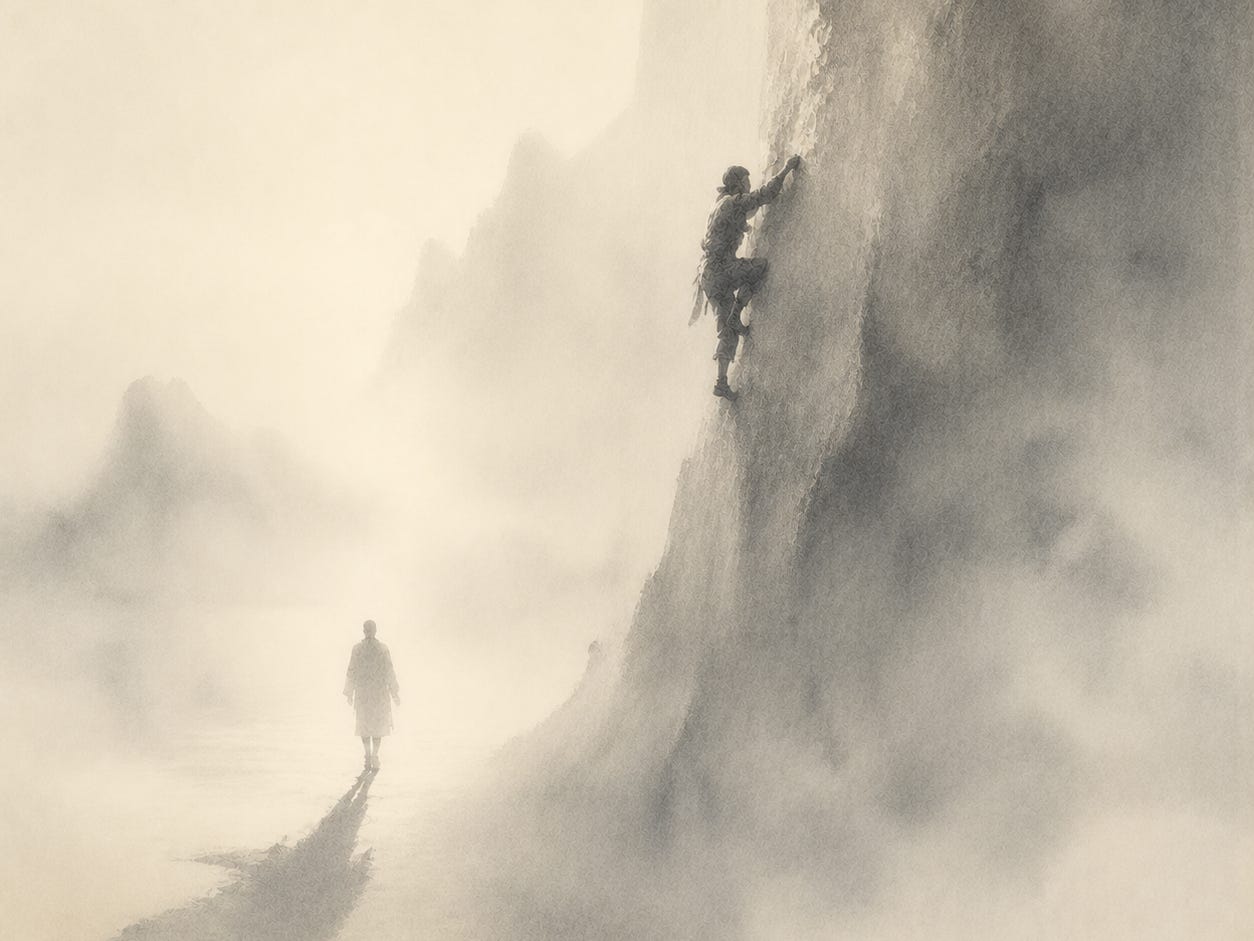
Picture a cliff face. The same rock surface, the same cracks, the same outcroppings, the same smooth patches — not an inch of it has changed.
If your goal is to climb to the top, those jutting rocks instantly become obstacles you need to work around; those cracks instantly become lifesaving handholds you need to grip for dear life; and that smooth patch of rock face becomes the most dangerous part of the entire cliff, because your fingers can’t find a single hold there.
But swap the goal for “quickly paint a watercolor of this cliff,” and the entire structure of meaning flips instantly. That smooth patch of rock is now the easiest part — one brushstroke and you’re done. And those cracks and pockmarks, the very things that could have saved your life, are now the most troublesome details — you have to stop and painstakingly trace their uneven shadows, and they’re slowing you down.
Not one inch of the physical world has changed.
What’s changed is only the goal you’re looking through.
This points to something rather deflating: the word “obstacle” has been lying to you all along. It sounds like it’s describing some objective property of the world — “this rock is just hard to climb,” “this thing is just a hassle.” But it isn’t describing the world at all. It’s quietly reporting your goal. When you say “this is too hard,” you think you’ve stated a fact, but you’ve only said something about yourself — “measured against the direction I’ve currently set, this looks hard.” Change the goal, and the difficulty gets reshuffled, sometimes reversed completely. The rock never changed. The ruler in your hand did.
But maybe the more unsettling question is this: did you actually choose that goal?
Most of the time, probably not.
You want a job that’s “stable and respectable” — who gave you that standard? Quite possibly it’s survival wisdom your parents’ generation distilled in hard, lean years, passed down to you without a second thought, and you absorbed it into your body as a teenager, long before you had the capacity to question it. You want a relationship that’s “harmonious, no fighting” — that standard might come from a terrifying marriage you witnessed as a child, and from that moment on you swore, silently, never to have that. You want to be “recognized by a lot of people” — that standard might not even be yours; it might be the only definition of success the environment you grew up in ever allowed to exist.
These goals entered you like air. You never formally “decided” to have them — they were simply installed at an age when you had no defenses.
Then you start using them to carve up everything in front of you — turning certain people into obstacles, turning certain choices into crack-like lifelines, reading some smooth, easy paths as “too easy, something must be wrong,” and some rough, difficult paths as “this must be what’s truly worthwhile.” You think you’re honestly facing reality. What you’re actually doing is slicing reality into “things to climb,” “things to avoid,” and “things to grab onto,” using a set of goals you’ve never once examined.
Heidegger gave a simple example of this: a hammer is only a hammer within the project of “I need to drive in a nail” — otherwise it’s just a lump of metal with a handle, not really a “tool” at all, neither “useful” nor “useless.” Being a tool was never a property the object carries in itself; it’s a relationship that only emerges once a project is projected onto the object. An obstacle works the same way. It isn’t a label the object carries — it’s something generated the moment your goal collides with that object.
And most people spend their whole lives inside a landscape of meaning they never designed, experiencing it as simply “reality,” then spending all their energy fighting obstacles that were actually carved out by themselves — or by someone else, on their behalf. They never stop to ask: does this rock look this hard to climb because it truly is, or because of the direction I happen to be climbing in?
But flip this over, and it reveals another side — a more powerful one.
If a goal really can turn a smooth rock face into paradise and a crack into hell, then the reverse holds too: changing your goal is the one way to truly change the world you inhabit — and this path is far faster, and far more radical, than “changing your environment.”
Most people deal with “this is too hard” by trying to flatten the rock — changing jobs, changing partners, changing cities, changing the entire environment. That path can certainly work, and is sometimes genuinely necessary. But very often, what actually needs changing isn’t the rock — it’s the summit you’re heading toward. You think you lack the capacity to cope with reality. What you actually lack the capacity to fight is the specific friction generated when the goal you set collides with reality — change the goal, and that same reality will instantly hand you a completely different landscape.
The thing that makes you feel, at two in the morning, that you can’t go on — that weight probably isn’t coming from the world itself at all. It’s the direction you never noticed, never chose, that has been weighing the world for you and handing you this number.
So the silence in that relationship, the cracks on that cliff, the thing that feels “too hard” — in themselves, they were always silent, always neutral.
They never turn themselves into “evidence,” into an “obstacle,” into a “sign you should run.”
It’s only once you’ve taken up a direction that they start speaking to you at all.
You think you’ve been struggling against the world.
What you’ve actually been struggling against is a goal you never examined — the world was only the first wall that goal ran into.