

Something that would only take a few days to finish, if given a month-long deadline, will most likely get put off until the final few days before anyone actually starts. Plenty of people have experienced this. It’s usually chalked up to “laziness” or “procrastination,” as if it were some flaw of character that needs to be overcome through willpower.
But look at it from another angle, and this procrastination is actually perfectly rational — as long as the deadline hasn’t arrived yet, pushing something back is always the lowest-cost choice. Don’t do it today, you can still do it tomorrow; don’t do it this month, there’s still next month. What actually forces a person to start isn’t “this needs doing” — it’s “if I don’t do it now, it’ll be too late.”
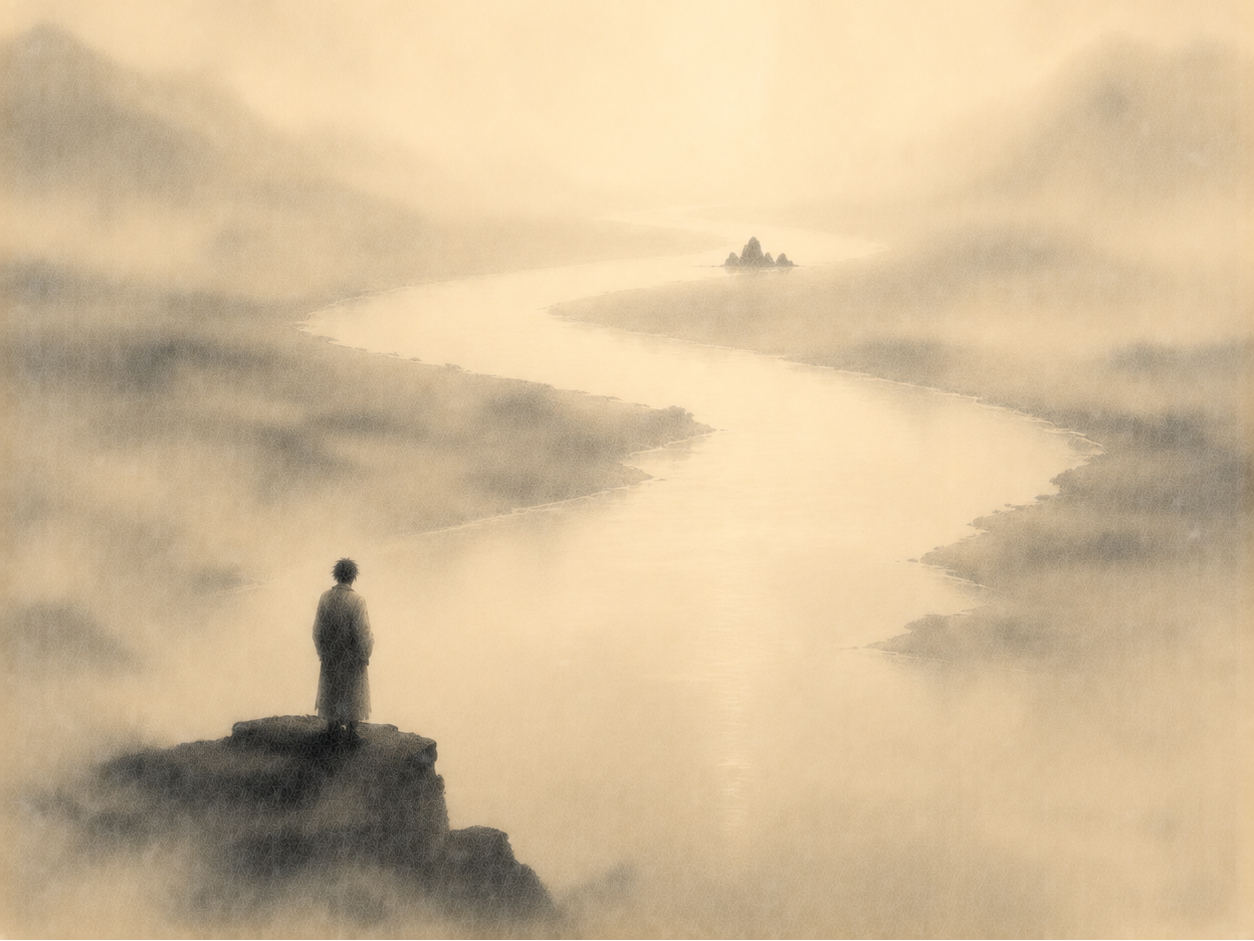
Thinking about it this way, a “deadline” is a bit like a rock sitting in a riverbed. It blocks the middle of the channel, looks like an obstruction, a constraint. But it’s precisely this rock that carves out, for a river that would otherwise just keep flowing forever, a destination it must reach — and that destination gives the water its direction and its speed. Remove the rock, and the water doesn’t disappear. It just spreads out with no sense of direction at all, willing to flow any which way, flowing slowly, and so never actually arriving anywhere.
What a deadline forces out of you isn’t just efficiency — it’s something more fundamental: a sense of urgency, a feeling that it has to be now. The moment that urgency is removed, the time left over looks like it’s become more spacious, but in reality, it becomes so slack that no single moment is worth being taken especially seriously.
So what happens if you apply this logic to an entire life? The deadline of a life is death. That sounds a little heavy, but follow the river metaphor one step further, and it isn’t hard to understand — if death didn’t exist, life would go on without end, which sounds like a kind of liberation, a freedom finally free of any urgency. But if there really were no endpoint, anything you were supposed to do right now could always be pushed to “later,” because later would always still be there.
Someone might argue that infinite time is exactly what lets you truly do everything well, without rushing. But this argument overlooks something fundamental — “rushing” and “never starting at all” are two completely different problems. What the absence of a deadline brings isn’t ease. It’s a state where even the act of “starting” loses its reason to exist at all — since you could start whenever, this particular moment becomes no different from any other.
Spiritual practice can’t escape this structure either. Truly understanding what it means to be alive, truly settling into the present moment — these were never easy to begin with, and if you add the default assumption that “there’s plenty of time left,” they’re almost guaranteed to be put off indefinitely. Not because you don’t want to do them, but because no endpoint is forcing you to start right now.
Buddhism has a common practice called maranasati, or “mindfulness of death,” meant to remind practitioners that death could arrive at any moment, and to use that to spark diligence and keep them from growing complacent. This practice might sound a little extreme, but it points exactly to the role that rock was always supposed to play — only if a person truly believes the next moment could be the end will the thing in their hands right now actually be taken seriously.
Thinking about it this way, that relaxed feeling of “there’s always still time” was never a sign of maturity. It’s simply what a river looks like once you take the rock away — spread out wide, flowing slowly, seeming to fill the entire riverbed, while actually never truly reaching anywhere at all.
A river with no end appears to have gained infinite space, but in reality, it might never truly reach any real river mouth at all — because the very absence of an endpoint strips the act of “arriving” of the meaning it was always supposed to have. Since the river just keeps flowing regardless, whether it ever arrives stops mattering all that much.
That rock, the one that makes you feel cramped, feel pushed forward against your will — looking back, it turns out to be the one thing that lets the water actually have direction and force. A deadline was never the enemy of efficiency — it’s the very precondition efficiency depends on.
A person becomes willing to take something seriously right now not usually because they’ve finally worked out some grand truth, but because they’ve finally felt that this might be their only chance at it. And the finitude of life is the largest rock of all — it forces this river, which would otherwise just flow on forever, to seriously push forward, in every single present moment, a stretch of water that truly belongs to that moment alone.