

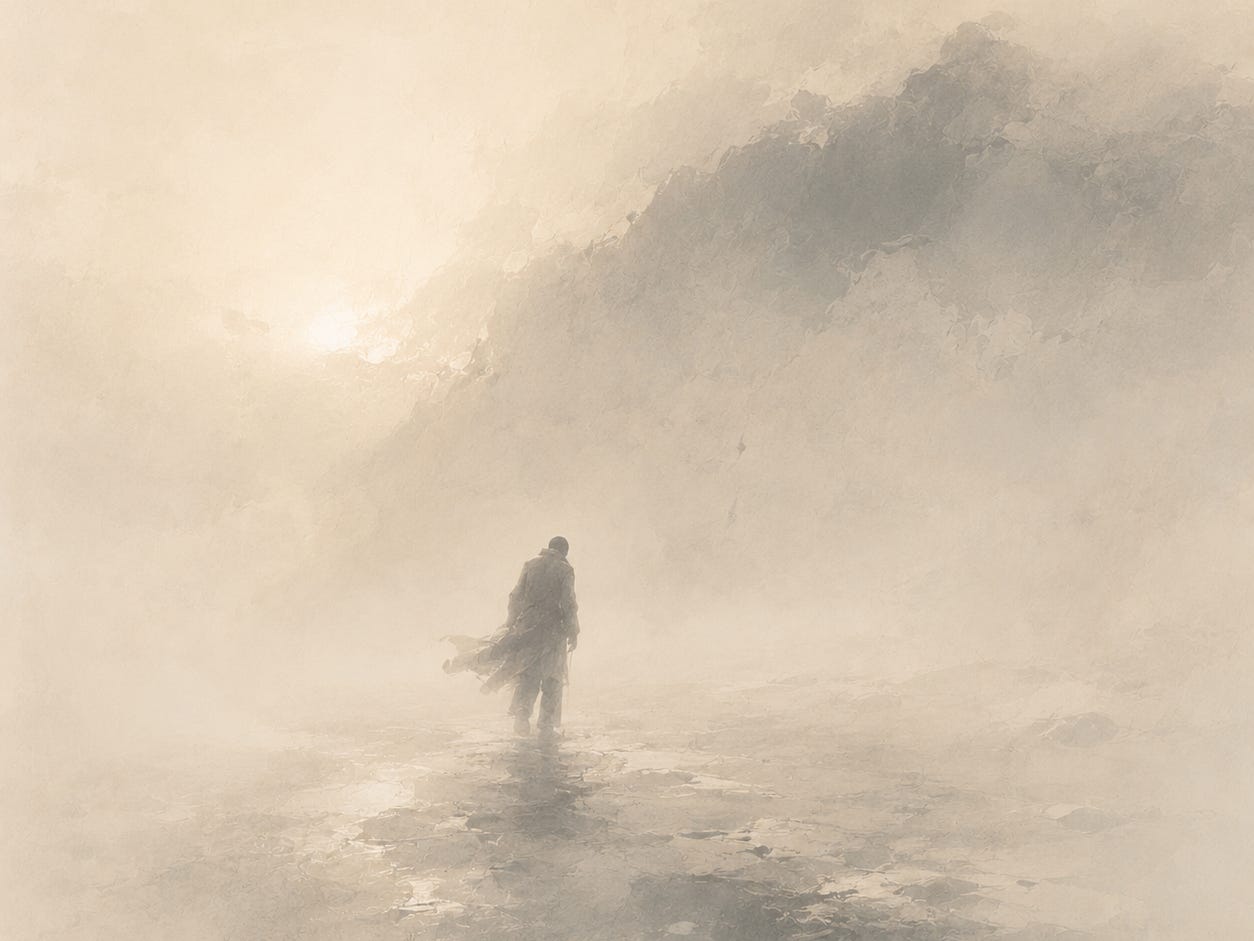
My family’s grave is on a mountain.
Not a maintained trail — a genuinely difficult one. No steps, no handrails, overgrown with grass. We have to go once a year, and if we don’t, the path disappears. Literally disappears — swallowed by vegetation, until even knowing where it was becomes uncertain.
So we go every year. Not only to tend the grave, but to walk the path again — to keep it from ceasing to exist.
Then the town developed. The older members of my family moved into apartment buildings, one by one. Elevators. Smooth tile floors. Roads right outside the door.
A few years later, at a Lunar New Year gathering, I noticed that several of them could no longer make it up the mountain.
Not because of illness. Not because of any accident.
Because the roads had been too flat, for too long.
City roads keep getting better.
Smooth, even, accessible. Elevators where there are slopes, escalators where there are stairs, and where stairs remain, they’re perfectly uniform. We call this development. Progress. Making life easier for people.
None of that is wrong.
But something goes unsaid:
The resistance that was removed — it had been a form of connection all along.
My relatives’ legs didn’t fail because of age. They failed because the relationship between those legs and that mountain path had been interrupted long enough that both sides quietly atrophied. The path, unwalked, disappeared. The legs, unused in that particular way, did the same.
These are the same thing.
Once, planning a trip abroad, I deliberately excluded every English-speaking country from consideration. I ended up choosing Russia.
The reason was simple: going somewhere I could speak the language felt too easy.
Shared language, familiar cultural logic, an exit route available whenever things got hard — that kind of place would let me feel like I’d never really left. And leaving wasn’t the point if I was just going to continue my existing life in a different location.
Russia was difficult. The language was impenetrable. The culture was completely foreign. Every day required effort.
But the effort meant I was genuinely *in* that place, not gliding through it.
Every day drew on things in me that normally go unused. That feeling wasn’t suffering — it was a very real sense of being present.
I’ve come to think these two things share the same structure.
My relatives climbing the mountain each year weren’t only tending graves. They were maintaining a relationship with their own bodies, with the ground beneath their feet. That path was a thread connecting them to themselves.
When the thread was cut, no one felt it. The elevator was convenient. The tile was smooth. Nothing seemed wrong.
Until that New Year, when the legs didn’t cooperate.
Modern life is exceptionally good at one particular thing:
Removing friction, layer by layer, under the name of *doing good.*
Smoothing the road — for your benefit. Installing the elevator — for your benefit. Navigation replacing the ability to find your way, delivery replacing cooking, algorithms replacing choosing — each substitution, taken alone, is reasonable. Convenient. An improvement.
But what gets substituted away isn’t only inconvenience.
Some of it is the way you stay connected to your own body. Some of it is the friction between you and real life — and that friction, precisely, is what lets you know you’re still in it.
The friction disappears, and you don’t feel it go.
Just as no one felt anything wrong the moment my relatives stepped into the elevator.
I’m not saying live with difficulty for its own sake. Convenience isn’t the problem.
What I’m saying is that one question is worth pausing for:
When the friction in your life was removed — did you notice, as it disappeared, that something in you disappeared along with it?
Maybe not. Maybe nothing was lost.
But if something was —
that thing might matter more than the smooth road that replaced it.