

A friend came back from Yunnan and posted a nine-photo grid on social media.
I opened an AI image generator, waited thirty seconds, and sent him a set of my own.
I joked, “See? All that exhausting work you did to take these, and mine look better without even lifting a finger.”
He replied with a “haha.”
I could tell he was caught off guard. Honestly, so was I—because after I said it, I wasn’t even sure if I was joking anymore.
***
Those AI-generated images really were better. More saturated colors, cleaner compositions, perfectly balanced lighting.
My friend’s photos had tourists, utility poles, and a stranger who wandered into the frame.
But I had a strong gut feeling they were fundamentally different. If you pressed me to explain why—I couldn’t quite put it into words.
“Different experience,” “the process matters,” “the result isn’t everything.”
Those are all things I could say, but they’d feel like reciting a tagline. Even I wouldn’t buy it.
***
I thought back to a trip.
Xinjiang, over 5,000 meters above sea level. I was flying my drone to capture the landscape when it crashed, landing on a patch of terrible terrain on the mountain.
I was already struggling with altitude sickness. But the drone was expensive, and I still needed it for the rest of the trip. So I gritted my teeth and started climbing.
There was no trail. Every step meant choosing where to plant my foot. I was oxygen-deprived, my body heavy, my mind foggy. After over an hour, I found it.
Once I packed up, my first instinct was: get down fast. Stick to the schedule, keep shooting, follow the plan.
Then I looked up.
Just that one motion.
And suddenly I realized how beautiful the view actually was.
***
That realization wasn’t because the scenery had changed. It was because I hadn’t been looking before.
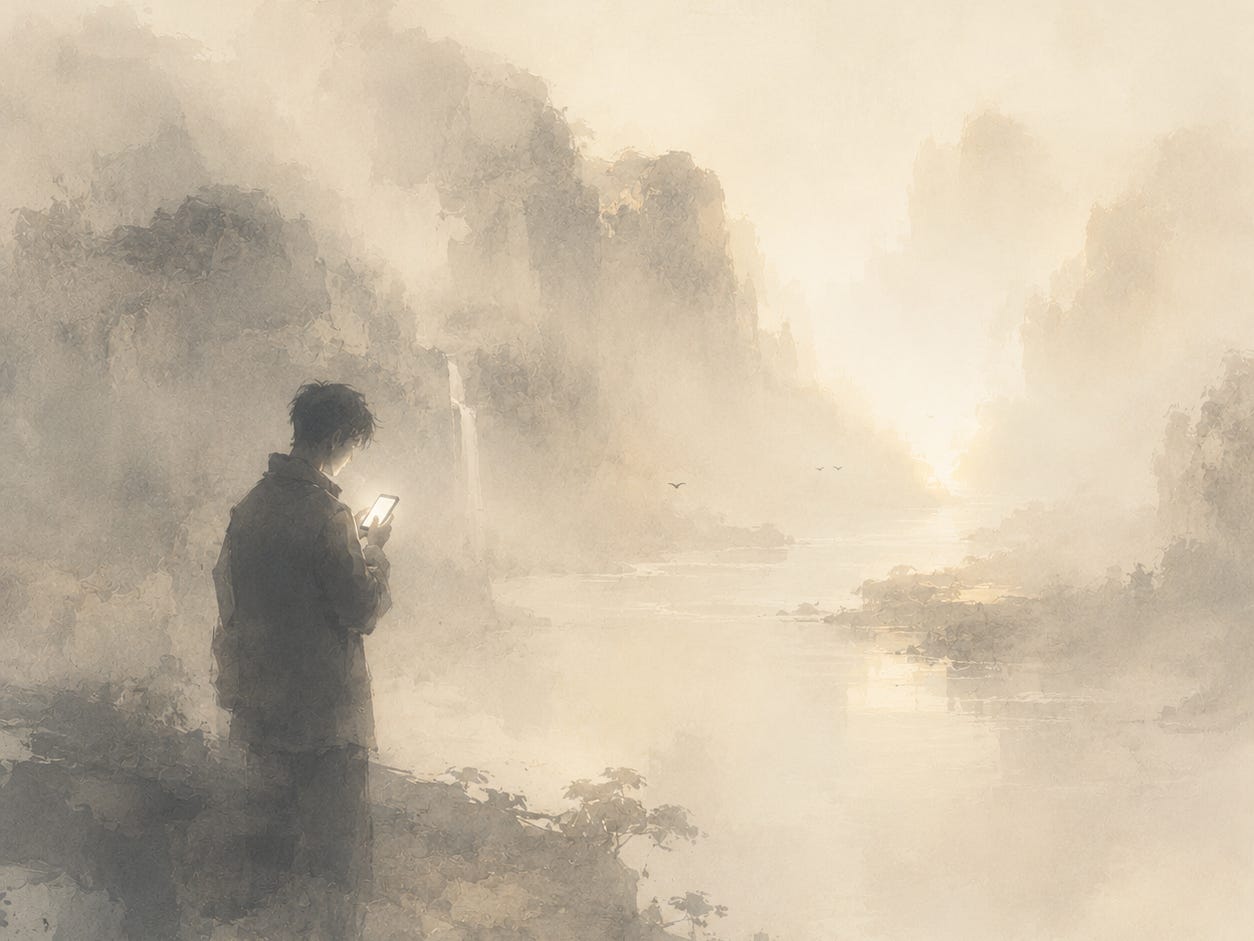
What had I been looking at the whole time? The drone’s screen. Composition, battery, obstacle avoidance, signal.
My eyes had become tools—scanning the landscape, judging whether it was worth shooting, then moving on to the next scan.
Before the crash, I wasn’t traveling. I was executing a task called “shoot the scenery.”
That accident forced me to climb for over an hour, drained my body, and ended the task. The next task hadn’t started yet.
In that gap, I looked up.
My senses came back online. Not because the view was more beautiful, but because I had no task at that moment. My eyes became my own again.
I sat there for half an hour. Told my friend, “I need to rest a bit.”
That was the first moment of the entire trip when I was truly present.
***
So what does AI really lose at?
I thought about it for a long time, and finally realized I’d been asking the wrong question.
AI doesn’t lose on photo quality. It doesn’t lose on “authenticity.” It doesn’t even lose on “the process.”
It loses on something more specific: it doesn’t crash.
It won’t throw you an accident. It won’t give you a climb with no output. It won’t give you that blank space after a task ends.
It’s too efficient—so efficient that you’re always producing, always receiving the next image, never landing in that gap.
And that gap is the doorway for your senses to come back online.
***
Lots of people travel without ever being there.
They fly to a place, but their eyes are on their phone screens. They stand at a mountaintop, but their focus is on editing photos. Their bodies are in Yunnan, but their sensory system is switched off.
AI pushes this trend to the extreme—you don’t even need to go to the mountain anymore.
But for some people, AI could be something else. It can take over those mechanical, repetitive tasks done purely for “output,” freeing up time to actually look at what’s in front of you.
Not by leaving your phone or drone behind.
But by carrying them without being glued to them the whole time.
***
My friend came back from Yunnan and posted nine photos.
The ones I generated with AI were definitely better than his.
But on some turn of the mountain road, did he ever stop and just zone out? At some meal, did he forget to take a picture and just sit there?
Those moments aren’t on social media.
They’re not in those nine photos.
Even if they were, they wouldn’t be in the ones I generated.
I mean I get being present in the moment etc but it's also not horrible to take photos travelling either.
Sometimes photos can explain the experience better than words to ones that weren't there. Doesn't have to be all or nothing.